Tag Archives: infertility

Inside ESHRE: Where Women’s Bodies are Big Business – Guest Blog from Mel Daley

The EXcel Conference center in East London was recently host to the European Society of Human Reproduction and Embryology’s huge international expo, focussing on AI use in IVF, surrogacy, the genetics of ovarian response and the success rates of Embryo Transfer.

ESHRE’s vast expo was laid out over 90,000 square feet, featured over 220 exhibitors, with sponsors from 140 countries – all because quite simply, for the global surrogacy and fertility market, the ongoing ruthless commodification of women’s bodies continues to be big business. I attended not as a doctor, embryologist or delegate, but as part of the events team helping to organise the four-day congress. During our briefing, we were told that the Belgium-based organisation was focused on fertility treatments both within and beyond Europe. We were expecting around 12,000 delegates – although event managers later said attendance had reached over 14,000.

Delegates arrived from across the globe, including representatives from former Soviet republics such as Georgia, Kazakhstan, Armenia and Belarus, as well as Islamic countries including the United Arab Emirates, Kyrgyzstan and Turkey. (Women earn considerably less in these countries than women do in Western Europe). Our role was to highlight the ‘missions and visions’ featuring research on human reproduction and embryology to the general public, scientists, clinicians and patient associations and were told that ESHRE “collaborates with politicians and policymakers throughout Europe.”

Dr. Bart Fauser, a renowned Dutch reproductive endocrinologist and Professor Emeritus at Utrecht University, declared in his speech on the first session that there is a critical global decline in fertility, most notably across Europe. He noted that women are increasingly delaying motherhood and shifting away from prioritising traditional maternal roles. While countries such as France, Hungary, Sweden, and the United Kingdom provide at least one free IVF treatment, these measures remain insufficient to alter demographic decline, even as global IVF births exceed 20 million.

In Denmark, IVF conceived children comprise roughly 10% of total births, with 30% of assisted reproduction therapy is for LGBTQ+ individuals. Within this framework, access to reproductive ‘therapies’ encompassing post-mortem conception, surrogacy, and care for HIV-positive or transgender couples, is treated as a universal right, broadening the definition of infertility treatment to all individuals regardless of reproductive capacity. He also added that Australia is the only country that has data on lesbian couples, single men, and gay men who cannot have children without the involvement of the opposite sex.

In the Sunday session Dr Fauser said to a packed audience “It was once the hetrosexual couple, usually married, that wanted to be together forever and have children and if it didn’t work out they would come to us. Now they are in a minority so the term has changed from INFERTILITY care to FERTILITY care – because we are treating people that are not infertile. Until very recently the World Health Organisation did not want to have anything to do with infertility. Again, why? Because there are too many people in this world – and I’ve been discussing this with them for quite some time and they say we know there are maybe in some parts of the world too many children – but it doesn’t make their pain any less. It’s about means and individuals.”

These ‘means and individuals’ include womb transplants from young or deceased donors (Womb Transplant UK reported more than 65 healthy babies worldwide in 2025, with more live births to be recorded in 2026), as well as finding countries where it is easy to obtain donor eggs, i.e. those with looser regulations.

Across the four days, there were more than 80 sessions, alongside pre-congress courses, keynote lectures, and numerous oral and poster presentations held in huge suites. And they all came with a little bit of controversy. The coordinator of ESHRE is Professor Antonio Capalbo, who is also a member of the Italian Society of Human Genetics. Antonio’s presentation entitled ‘Debate: Back to Basics or Back to the Future’, featured slides of various political leaders (Trump, Meloni and Nawrocki) who stand against embryo testing and surrogacy.

Irene Cervelló, who specialises in Cell Biology, Somatic Stem Cells and Reproductive Medicine, discussed research in which pig and rabbit wombs are stripped of their cells, leaving the natural biological scaffold of the uterus to be processed into biomaterials for potential use in regenerative medicine (accompanied by lots of cute animal pictures). And the Ukrainian-UK obstetrician and gynaecologist Evangelia Katsika greeted her audience with her national flag and took an impromptu photoshoot with pictures of a bombed Kyiv before her presentation. But the pièce de résistance was a speaker from Chile presenting to a packed auditorium on the “International Glossary on Infertility.”

In essence, he was explaining that the 348 terms now considered internationally acceptable in the fertility industry for 2025, has an updated version of the original 2017 glossary, which contained 283 terms.
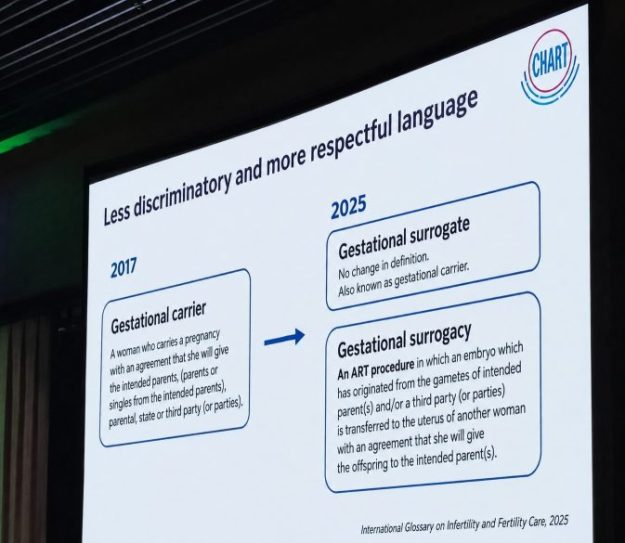
Photo of screen showing updated Glossary language.

The glossary is intended “for all stakeholders, including policymakers” and the latest update is designed to “reflect contemporary scientific knowledge, changing social needs and more inclusive definitions, while standardising language across clinical practice, research, policy and the public domain.”

The speaker was Dr Fernando Zegers-Hochschild, Professor Emeritus at the Faculty of Medicine at Diego Portales University in Santiago, Chile, and a prominent figure in reproductive medicine and assisted reproductive technologies. Reading straight from the trans-ideology playbook, he rattled off terms such as ‘assigned at birth’, ‘gender identity’, ‘cisgender’, ‘Not aligned with the sex at birth’, ‘gender dysphoria’ and ‘gender reassignment’.

What struck me was hearing a man in his late 70s delivering a presentation using the language of Gen Z identity politics – particularly terms such as “inclusive definitions” and “social needs” – to an auditorium packed with highly educated medical professionals. The contrast was striking, and, frankly, rather surreal.

Dr Fernando Zegers-Hochschild, a speaker at the ESHRE expo.
Dr Fernando Zegers-Hochschild

His closing remarks called for ‘open dialogue’ and ‘mutual respect’  and the importance of avoiding language that might offend, yet in the same breath, he referred to surrogate mothers as “gestational carriers”. When it comes to the commodification of women’s bodies in the fertility and surrogacy industry, it seems the person whose dignity and feelings are given the least consideration is the woman herself.

Walking around the exhibition hall, I was struck not only by the sheer number of delegates from every corner of the world, but by the spectacular scale of the stands themselves. The largest belongs to Ferring Pharmaceuticals. Owner by billionaire Swedish owner, Frederick Paulsen,  Ferring Pharmaceuticals Ltd. has donated £1.43 million to the Liberal Democrat party over the past six years through the UK subsidiary of his Switzerland-based company. (Ferring is also one of the world’s leading makers of the puberty-blocking drug, triptolen, which halts puberty by suppressing sex hormone production in boys.)

The BSV Bioscience stand was also huge and boasted its positioning as a market leader in theIndian women’s health and fertility drug market . There was a corporate display of the operational footprint map including developing countries such as Afghanistan, Guatemala, Ethiopia and Mauritius. Very few poor nations have not been mined for their resources and potential benefit to the global fertility industry.

Walking across to the London Egg Bank stand, there were smiling faces of women featured on it’s posters. The young hostesses were eager to greet you for a chat. I wondered whether they were fully aware of who their employers are exploiting. Despite being the first and only ‘UK egg bank’, it was criticised for targeting students as potential egg donors at a welcome event at King’s College London in 2020 and at Kent and Canterbury Christ Church University in 2018. (photo)

Everywhere I turned I was bombarded by pictures of babies and glossy adverts for same sex parents to obtain babies via surrogacy. Cyromate who ‘proudly serve lgbtq families around the world’ (photo) showed 3 men on the back of their leaflet along with their clearly marked position that they ‘believe everyone has the right to parenthood’.

Human beings are apparently something you are entitled to create no matter your circumstances or sex, and you can play human pick-and-mix with women who donate their eggs by choosing the eye colour, hair colour for a potential child and even weight and occupation of your chosen DNA provider (under the assumption that you would want an educated and high-IQ take-away human).

The London Sperm Bank, which obviously focuses on lesbian couples and single women, eagerly touts a free demonstration of its online sperm-choosing software portal. I was given a flyer for a ‘Queer and ethically-driven surrogacy journey’ for a french podcast called ‘Surrogacy Daddy’ which can be heard on Spotify and Youtube. Based on a gay French couple, each episode explores their journey to the USA to obtain a baby. (picture). Episode – 12 – A Tale, Some Doubts details their surrogate’s serious hemorrhaging a few days after giving birth and describes this horrendous medical emergency as “a difficult trial”. (This event resulted in a hysterectomy for the woman involved.)

The BMJ (2024) states that ‘surrogates seem to have a higher risk of developing complications such as postpartum haemorrhage and severe pre-eclampsia and are more likely to give birth prematurely. This was not something that was ever mentioned in the podcast.

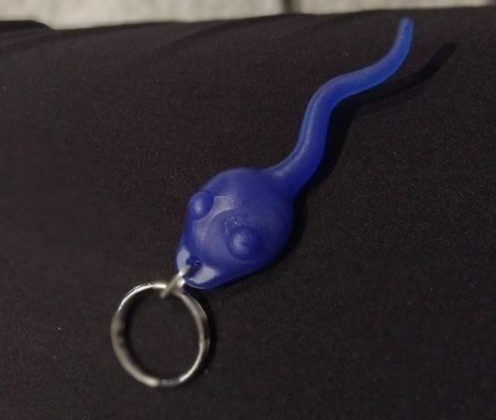
Despite the endless freebies (cartoon sperm bags, keyrings, pens and notepads galore) and the relentless promises of increasing populations, there was remarkably little acknowledgement of the effects of modern feminism, social media and poor education on women’s relationship with their bodies. Women’s bodies are still ruled by biology.

I was left with a rather sad reflection. With all the science, technology and supposed progressiveness of modern society, particularly here in Europe, women in 2026 are still being commodified and advertised. Their bodies are treated as resources to be used to fulfil other people’s needs and desires, like privatised medical machinery sold to the highest bidder.

Europe’s largest fertility expo is doing nothing to help challenge these regressive and misogynistic ideals, and instead is doing everything they can to perpetuate them.

What does ‘Mother’ mean?

On Mother’s Day we celebrate our own mothers and our children celebrate us. It is a day to acknowledge the sheer hard work of raising children, how we come to have them and how family units are created in different sizes and forms, but the focus is on mothers.

Only women can be mothers. Only women can become pregnant, give birth and breastfeed and ‘mother’ is both a social term and a legal one. The legal definition was in response to scientific developments in IVF, where egg donor conceived pregnancies created the question “of what a “What is a Mother?” Prior to this, there was no confusion about the meaning of the word ‘mother’.

The 1990 Human Fertilisation and Embryology Act (Section 27) defines ‘mother’ as

“the woman who is carrying or has carried a child as a result of the placing in her of an embryo or of sperm and eggs, and no other woman, is to be treated as the mother of the child.”

In other words, the woman who gives birth has legal parental rights and responsibilities and the woman who provides the egg for that embryo does not.

Before this law, the word mother had one meaning which everyone understood. The only deviation and subsequent sub-subcategory was when legal rights and responsibilities were transferred from a birth mother to an adopting mother.

in surrogacy, the definition of the noun ‘surrogate’ is:

a substitute, especially a person deputising for another in a specific role or office.

For me, the person deputising or standing in for the mother is the commissioning parent; an adult – male or female – who not only commissioned the child into being but is the social parent caring for and raising the child, as a result of an arranged pregnancy, with or without a contract.

This person – single people can obtain a child through surrogacy in the UK – or couple, later become the legal parent/s when a parental order is granted by the courts. A parental order cannot be applied for, under the current law, before the newborn reaches 6 weeks old. So these people are not the legal parents from birth and there is always (as with adoption) a birth mother, regardless of how invisible they might want her to be.

Proposed law reform would see a seismic shift with the introduction of a ‘new pathway’. This would allow for parental rights for the commissioning couple to be transferred during the pregnancy, with a pre-birth order (like that seen in commercial surrogacy arrangements, a model we are told is rejected by the Law Commission and pro-surrogacy lobbyists).

That’s right, whilst the woman is still pregnant, the baby inside her doesn’t belong to her and in fact someone else has legal parental rights to the child she has not yet given birth to.

The idea that a child you have within your body belonging to someone else has lead to what I consider to be dangerous and deceptive discourse around surrogacy. Euphemistic language begins with ‘surrogate’, where the word mother doesn’t feature at all, (or worse ‘gestational carrier’) and ends with the claim that the mother is ‘giving the baby back’. Back to where, where the original order was made? The baby is not returning to the place they began. With IVF that would mean taking the child to a lab where they were conceived.

No, this claim refers to handing the baby over to the strangers they may or may not be related to. Under current UK law and reform proposals, the requirement for one commissioning parent to be genetically related to the child remains but the UK’s largest agency, Surrogacy UK, campaigns for ‘double donation’ so no genetic link would be required.

The dominating theory here is that the genetics are equal to ownership and that pregnancy and birth are minor details. This denies the reality of how babies are made, with or without a Petri dish. It dismisses the mother baby bond, something agencies and proponents of surrogacy, denies exist. Academics downplay the sharing of cells in the womb as “a mere fantasy of romanticism”.

Some supporters of surrogacy prefer to dehumanise the woman further, reducing her to an electrical appliance, calling women ‘ovens’ and the baby a ‘bun’. This goes beyond a lighthearted joke when they consider having a baby for others to be ‘extreme babysitting’ – like Ultra Marathons or Free Solo climbing. Something that is impressive in the danger and fraught with risk. I’m not convinced that the medical risks are fully explained prior to conception or implantation but that’s a different blog…

Saying that a pregnant woman is simply ‘babysitting’ is an insult to the magic of motherhood and it seeks to separate the mother and baby by reducing pregnancy to a bodily function or a paid role. There may be more truth shared in this than was intended.

In surrogate motherhood, a genetic link is unimportant, whilst the genetic link between the baby and the commissioning parent/s is paramount. In surrogacy, the natural maternal bond is dismissed as emotional and romantic and known science of maternal-foetal microchimerism is waved away.

But surrogacy doesn’t remove the reality of how babies are made, however inconvenient it may be. Everyone has a mother, whether she wants to be thought as one or not.


Motherless doesn’t exist

I was pleased to see coverage of a recent surrogacy dispute in the mainstream media last week. Pro-surrogacy lobbyists say these cases are rare but we cannot be sure of this. The family court is closed to the public and it is only with the judges’ permission that details of a case be released to the press. It was Julie Bindel who sought permission to write on the case of Z (the child) and her article was published in The Critic in June, with the mainstream press picking it up in The Times, The Telegraph and the Daily last week, so it it feels like a good time to revisit this particular case.

I am limited in what I can share for obvious reasons, but I can say that I am honoured to know and support the surrogate mother from when we met 3 years ago to today. She is the picture of dignity and strength in incredibly challenging circumstances.

When such disputes happen there are lifelong consequences for all involved. Perhaps what pro-surrogacy lobbyists mean is that it rare for judges in the family court to rule in favour of the surrogate mother. Such as this case where the commissioning parents were not entirely honest about a condition one of them suffered from and the surrogate mother wanted to withdraw her consent as she considered them to be unsuitable parents. The child was placed in foster care.

Or the case of a surrogate mother who, as she already had a large family and with no genetic connection to the child, the judge decided that the commissioning couple should retain custody. The surrogate mother is allowed to visit the child 6 times a year. (Significantly, in this case, the court notes state that a parental order “tells one nothing about what the best welfare arrangements for the child will be after birth.”)

We know of UK cases where there is significant pressure on a surrogate mother to agree to the parental order and situations when her consent is not forthcoming it can be ‘dispensed with’. Marie Anne wrote of her experience and told us that counsel for commissioning parents argued that because a UK surrogate mother had tragically died and was therefore unable to give her consent, so should she, a very much alive surrogate mother, have her consent dispensed with. (It’s likely that the wider public wouldn’t believe this unless they read about it in the papers or heard it on the news, but coverage of Marie Anne’s case was wholly positive at the time.)

These cases are complex and I am not a lawyer, but my reading of the case of Z it is that the commissioning parents had the early intention to remove the mother from their lives once they got what they wanted; the child. It was never their intention to have her as an extended family member, despite what they promised. The court proceedings made it clear that commissioning couple didn’t want a mother in Z’s life, there was “no vacancy to fill” and G, the surrogate mother was referred to as “just an egg donor”.

By applying this reductive, dehumanising language and failing to acknowledge reality and her role as mother, their aim to sever the connection with her child was made starkly clear.

Some say that G could have changed her mind and kept her son but once ‘signed up’ to surrogacy, it is very difficult to back out. It’s not a matter of simply changing your mind. You are pregnant with child you are told is not yours.

Whilst within the legal limits, a surrogate mother can access an abortion in the UK, but an article from New Zealand, where the laws are similar to ours, a woman terminated her surrogacy pregnancy and a politician (with now two surrogate born babies) put forward a private members Bill. The wording of which alludes to access for abortion in a surrogacy pregnancy possibly coming under threat.

“Labour MP Tāmati Coffey, who, with his partner Tim Smith, welcomed their son Tūtānekai by surrogate in 2019, currently has a members’ bill in ballot calling for modern laws for modern families. It includes reform of birth certificates, providing a way to enforce surrogacy arrangements and creating a register of potential surrogates.”

Outrageously, accusations of homophobia were made of G. In my view this (along with a legal argument of human rights) this was done to garner sympathy, claim victimhood and tarnish G as bigoted. If a woman was homophobic would she seek to engage in having a baby for a same-sex couple? No.

Whilst social services were in support of the two men the clinical psychologist in the case said “The fathers…claimed that they are a ‘motherless’ family” and it is from here we get the title of this blog: “Motherless’ doesn’t exist.”

Ultimately the judge ruled in the best interests of the child and that was for the child to know his mother and have an ongoing relationship. It is an unprecedented decision where “free and unconditional consent that is required by section 54(6) of the Human Fertilisation and Embryology Act 2008” was central to the ruling.

Had all parties stuck to the original agreement then the situation would undoubtedly be entirely different for the adults and more importantly, very different for the child. But the State cannot legislate to force a friendships in any form and this case demonstrates how the ‘friendship’ was temporary, one sided and transactional. It was not based on the natural-founded and enduring friendships we are led to believe is common in surrogacy.

Readers should be reminded that reform proposals seek to introduce a model of commercial surrogacy where a pre-birth order transfers the parental rights at birth. The mother gives her consent to transfer her parental rights before the birth but she is not required to confirm her consent afterwards. The Law Commissions of England and Wales and Scotland found this to ‘disrespect’ her autonomy:

“A requirement for further consent after birth also suggests that the surrogate’s consent before conception is not adequate, which does not respect her autonomy.” ~ Law Commission’s Core Report, Page 37.

But as we know from this case, a lot can change between conception and birth.

With the ‘cooling-off period‘ (which I use deliberately as a contractual term) much reduced from 6 months to just 6 weeks after the birth, a surrogate mother has much less time to raise the alarm, decide to try to reclaim her parental rights or instruct lawyers. Under the Law Commission’s preferred model her name has already been removed from the birth certificate. Her name, rights and role in the child’s identity documents, knowledge of their relatives and experience of their family has been erased from the outset.

Thankfully, this is not the case for Z who will know his mother but it would have been very different had reform been in place at the time.

We would like to thank the legal team who supported G and we invite anyone who is or knows a surrogate mother with regret to contact us