Tag Archives: egg donation

Inside ESHRE: Where Women’s Bodies are Big Business – Guest Blog from Mel Daley

The EXcel Conference center in East London was recently host to the European Society of Human Reproduction and Embryology’s huge international expo, focussing on AI use in IVF, surrogacy, the genetics of ovarian response and the success rates of Embryo Transfer.

ESHRE’s vast expo was laid out over 90,000 square feet, featured over 220 exhibitors, with sponsors from 140 countries – all because quite simply, for the global surrogacy and fertility market, the ongoing ruthless commodification of women’s bodies continues to be big business. I attended not as a doctor, embryologist or delegate, but as part of the events team helping to organise the four-day congress. During our briefing, we were told that the Belgium-based organisation was focused on fertility treatments both within and beyond Europe. We were expecting around 12,000 delegates – although event managers later said attendance had reached over 14,000.

Delegates arrived from across the globe, including representatives from former Soviet republics such as Georgia, Kazakhstan, Armenia and Belarus, as well as Islamic countries including the United Arab Emirates, Kyrgyzstan and Turkey. (Women earn considerably less in these countries than women do in Western Europe). Our role was to highlight the ‘missions and visions’ featuring research on human reproduction and embryology to the general public, scientists, clinicians and patient associations and were told that ESHRE “collaborates with politicians and policymakers throughout Europe.”

Dr. Bart Fauser, a renowned Dutch reproductive endocrinologist and Professor Emeritus at Utrecht University, declared in his speech on the first session that there is a critical global decline in fertility, most notably across Europe. He noted that women are increasingly delaying motherhood and shifting away from prioritising traditional maternal roles. While countries such as France, Hungary, Sweden, and the United Kingdom provide at least one free IVF treatment, these measures remain insufficient to alter demographic decline, even as global IVF births exceed 20 million.

In Denmark, IVF conceived children comprise roughly 10% of total births, with 30% of assisted reproduction therapy is for LGBTQ+ individuals. Within this framework, access to reproductive ‘therapies’ encompassing post-mortem conception, surrogacy, and care for HIV-positive or transgender couples, is treated as a universal right, broadening the definition of infertility treatment to all individuals regardless of reproductive capacity. He also added that Australia is the only country that has data on lesbian couples, single men, and gay men who cannot have children without the involvement of the opposite sex.

In the Sunday session Dr Fauser said to a packed audience “It was once the hetrosexual couple, usually married, that wanted to be together forever and have children and if it didn’t work out they would come to us. Now they are in a minority so the term has changed from INFERTILITY care to FERTILITY care – because we are treating people that are not infertile. Until very recently the World Health Organisation did not want to have anything to do with infertility. Again, why? Because there are too many people in this world – and I’ve been discussing this with them for quite some time and they say we know there are maybe in some parts of the world too many children – but it doesn’t make their pain any less. It’s about means and individuals.”

These ‘means and individuals’ include womb transplants from young or deceased donors (Womb Transplant UK reported more than 65 healthy babies worldwide in 2025, with more live births to be recorded in 2026), as well as finding countries where it is easy to obtain donor eggs, i.e. those with looser regulations.

Across the four days, there were more than 80 sessions, alongside pre-congress courses, keynote lectures, and numerous oral and poster presentations held in huge suites. And they all came with a little bit of controversy. The coordinator of ESHRE is Professor Antonio Capalbo, who is also a member of the Italian Society of Human Genetics. Antonio’s presentation entitled ‘Debate: Back to Basics or Back to the Future’, featured slides of various political leaders (Trump, Meloni and Nawrocki) who stand against embryo testing and surrogacy.

Irene Cervelló, who specialises in Cell Biology, Somatic Stem Cells and Reproductive Medicine, discussed research in which pig and rabbit wombs are stripped of their cells, leaving the natural biological scaffold of the uterus to be processed into biomaterials for potential use in regenerative medicine (accompanied by lots of cute animal pictures). And the Ukrainian-UK obstetrician and gynaecologist Evangelia Katsika greeted her audience with her national flag and took an impromptu photoshoot with pictures of a bombed Kyiv before her presentation. But the pièce de résistance was a speaker from Chile presenting to a packed auditorium on the “International Glossary on Infertility.”

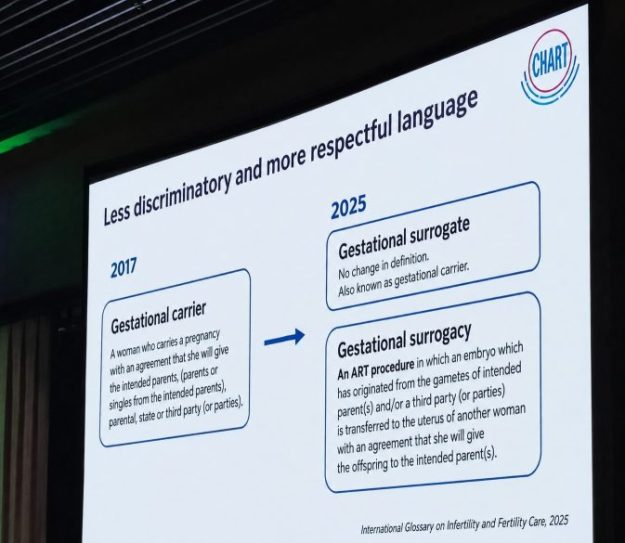
In essence, he was explaining that the 348 terms now considered internationally acceptable in the fertility industry for 2025, has an updated version of the original 2017 glossary, which contained 283 terms.

Photo of screen showing updated Glossary language.

The glossary is intended “for all stakeholders, including policymakers” and the latest update is designed to “reflect contemporary scientific knowledge, changing social needs and more inclusive definitions, while standardising language across clinical practice, research, policy and the public domain.”

The speaker was Dr Fernando Zegers-Hochschild, Professor Emeritus at the Faculty of Medicine at Diego Portales University in Santiago, Chile, and a prominent figure in reproductive medicine and assisted reproductive technologies. Reading straight from the trans-ideology playbook, he rattled off terms such as ‘assigned at birth’, ‘gender identity’, ‘cisgender’, ‘Not aligned with the sex at birth’, ‘gender dysphoria’ and ‘gender reassignment’.

What struck me was hearing a man in his late 70s delivering a presentation using the language of Gen Z identity politics – particularly terms such as “inclusive definitions” and “social needs” – to an auditorium packed with highly educated medical professionals. The contrast was striking, and, frankly, rather surreal.

Dr Fernando Zegers-Hochschild, a speaker at the ESHRE expo.
Dr Fernando Zegers-Hochschild

His closing remarks called for ‘open dialogue’ and ‘mutual respect’  and the importance of avoiding language that might offend, yet in the same breath, he referred to surrogate mothers as “gestational carriers”. When it comes to the commodification of women’s bodies in the fertility and surrogacy industry, it seems the person whose dignity and feelings are given the least consideration is the woman herself.

Walking around the exhibition hall, I was struck not only by the sheer number of delegates from every corner of the world, but by the spectacular scale of the stands themselves. The largest belongs to Ferring Pharmaceuticals. Owner by billionaire Swedish owner, Frederick Paulsen,  Ferring Pharmaceuticals Ltd. has donated £1.43 million to the Liberal Democrat party over the past six years through the UK subsidiary of his Switzerland-based company. (Ferring is also one of the world’s leading makers of the puberty-blocking drug, triptolen, which halts puberty by suppressing sex hormone production in boys.)

The BSV Bioscience stand was also huge and boasted its positioning as a market leader in theIndian women’s health and fertility drug market . There was a corporate display of the operational footprint map including developing countries such as Afghanistan, Guatemala, Ethiopia and Mauritius. Very few poor nations have not been mined for their resources and potential benefit to the global fertility industry.

Walking across to the London Egg Bank stand, there were smiling faces of women featured on it’s posters. The young hostesses were eager to greet you for a chat. I wondered whether they were fully aware of who their employers are exploiting. Despite being the first and only ‘UK egg bank’, it was criticised for targeting students as potential egg donors at a welcome event at King’s College London in 2020 and at Kent and Canterbury Christ Church University in 2018. (photo)

Everywhere I turned I was bombarded by pictures of babies and glossy adverts for same sex parents to obtain babies via surrogacy. Cyromate who ‘proudly serve lgbtq families around the world’ (photo) showed 3 men on the back of their leaflet along with their clearly marked position that they ‘believe everyone has the right to parenthood’.

Human beings are apparently something you are entitled to create no matter your circumstances or sex, and you can play human pick-and-mix with women who donate their eggs by choosing the eye colour, hair colour for a potential child and even weight and occupation of your chosen DNA provider (under the assumption that you would want an educated and high-IQ take-away human).

The London Sperm Bank, which obviously focuses on lesbian couples and single women, eagerly touts a free demonstration of its online sperm-choosing software portal. I was given a flyer for a ‘Queer and ethically-driven surrogacy journey’ for a french podcast called ‘Surrogacy Daddy’ which can be heard on Spotify and Youtube. Based on a gay French couple, each episode explores their journey to the USA to obtain a baby. (picture). Episode – 12 – A Tale, Some Doubts details their surrogate’s serious hemorrhaging a few days after giving birth and describes this horrendous medical emergency as “a difficult trial”. (This event resulted in a hysterectomy for the woman involved.)

The BMJ (2024) states that ‘surrogates seem to have a higher risk of developing complications such as postpartum haemorrhage and severe pre-eclampsia and are more likely to give birth prematurely. This was not something that was ever mentioned in the podcast.

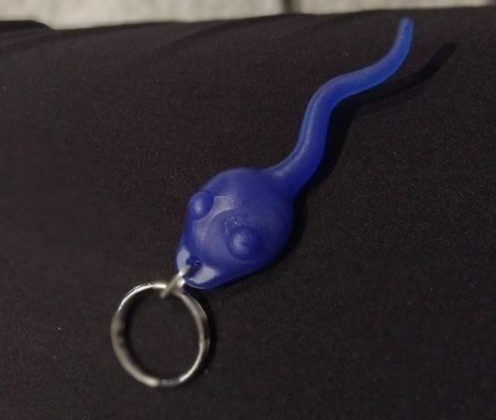
Despite the endless freebies (cartoon sperm bags, keyrings, pens and notepads galore) and the relentless promises of increasing populations, there was remarkably little acknowledgement of the effects of modern feminism, social media and poor education on women’s relationship with their bodies. Women’s bodies are still ruled by biology.

I was left with a rather sad reflection. With all the science, technology and supposed progressiveness of modern society, particularly here in Europe, women in 2026 are still being commodified and advertised. Their bodies are treated as resources to be used to fulfil other people’s needs and desires, like privatised medical machinery sold to the highest bidder.

Europe’s largest fertility expo is doing nothing to help challenge these regressive and misogynistic ideals, and instead is doing everything they can to perpetuate them.

Why more women are questioning Surrogacy

I feel increasingly uneasy about the direction in which reproductive technologies and surrogacy are taking place in society. My perspective does not come from infertility, fertility treatment, or involvement in surrogacy arrangements. It comes from a lifetime of reflecting on family, motherhood, belonging and the consequences of human vulnerability. As a daughter, granddaughter and as a mother, I carry a personal history shaped by displacement, sexual abuse and physical abuse. Those experiences have made me deeply aware of how power operates and how people facing hardship can become vulnerable to exploitation, even when exploitation is presented as opportunity or empowerment.

Discussions around surrogacy are often framed around the hopes and desires of adults who wish to have children but much less attention is given to the growing number of women who are drawn into surrogacy, but it is their bodies, their mental health that is at risk.

Because I have not walked the path of infertility I approach the subject with humility. I recognise the profound grief and soul-searching that can accompany the inability to conceive a child. Yet compassion for that suffering does not remove the need to ask serious ethical questions around the solutions being offered. For many women, concern about surrogacy is not rooted in hostility towards those who long for children. Rather, it comes from a sense that something fundamental about human relationships is being altered in ways we have not fully considered.

At the centre of every surrogacy arrangement is a pregnant woman and the child growing within her. Pregnancy begins with a unique relationship between the mother and her child. Family members relate to the unborn child, children observe their mother’s pregnancy and begin to understand that they, too, once began life in the same way. Pregnancy is the first chapter of a story of belonging.

Surrogacy introduces a different reality. The child is intentionally conceived with the expectation that they will be separated from their mother who carried them. When that separation occurs as part of a contractual arrangement, many women find themselves asking questions that are rarely discussed openly. What does this mean for the child? How will future generations understand the meaning of motherhood, kinship, and origin? What are the emotional and existential consequences when the earliest human bond becomes subject to a transaction?

These concerns are not always easily expressed because they touch on dimensions of life that modern culture often struggles to discuss: identity, attachment, meaning and the spiritual significance of human relationships.

For some women, concern extends beyond the surrogate pregnancy itself to the wider fertility industry. They question the creation of multiple embryos, the fate of embryos that are not implanted and the growing use of donor conception. They worry about a system that increasingly treats human reproduction as a process that can be organised, managed, bought and sold.

There is also unease about the commercial pressures driving this industry. While surrogacy is often presented as an act of generosity there are economic inequalities that underpin these arrangements. Wealthier individuals are able to access ‘reproductive services’ provided by women whose financial circumstances are limited. This imbalance raises questions about consent, autonomy and whether genuine freedom can exist in these conditions.

Increasingly, some women fear that society is moving towards a view of reproduction in which technology and market forces take precedence over human relationships. I am one of those women. We see the normalisation of reproductive outsourcing as part of a broader trend towards viewing the human body, fertility and even children through the lens of production – almost one of manufacturing when you consider egg harvesting and pre-implantation testing alongside capitalism and consumerism.

Whether one describes this concern in moral, philosophical or spiritual terms, the underlying question remains the same: what does it mean to be human and what responsibilities do we owe to the most vulnerable among us?

These questions are not anti-child, anti-family, or anti-compassion. They emerge precisely because of a desire to protect human dignity. As public debate continues, there is a growing need to create space for perspectives that are often overlooked. This includes the voices of surrogate-born people, donor-conceived individuals, women who regret being surrogates mothers and those who simply feel compelled to question the ethical implications of an expanding global industry.

For many women, this conversation is ultimately about more than surrogacy. It is about preserving a vision of humanity grounded in relationships rather than transactions, belonging rather than abstraction and human dignity over commodification. 

If we are to move forward responsibly, we must be willing to engage in deeper reflection, not only on what is technologically possible, but on what kind of society we wish to become. 

~ V.V

Regulation is not the answer

Supporters of surrogacy often argue that the answer to the myriad of ethical concerns regarding surrogacy is better regulation. Supporters claim that regulation protects and safeguards women and children from exploitation and abuse. They are wrong. Increasingly, we see countries apply regulatory models that still fail women and children.

America’s commercial model remains the preferred option for British commissioning parents as the USA has taken the number one spot for surrogacy for over a decade. Asian Businessmen are a popular cohort within the USA’s commissioning parents group. 

One study in the United States found that of the 40,000+ embryo transfers to a surrogate mother performed between 2014 to 2020, 32% were for international commissioning parents. These foreign nationals were more likely to be male, older than 42 years, and ‘identify as Asian’. The father of Olympic medalist, Alyssa Lui, Arthur (Junguo) Liu, is an attorney and former political activist. Having always wanted a large family he obtained has five children (Alysa, a younger sister, and triplets), all born via surrogacy and anonymous egg donors.

Another Chinese commissioning parent, billionaire video-game executive Xu Bo, claimed in 2025 that he has “a little over 100” children born via surrogacy in the U.S – though his ex-girlfriend, Tang Jing, claims the number is closer to 300 children worldwide – to obtain ‘high quality sons’ as for him, boys are “superior” to girls for leadership roles.

Now, take the extraordinary case of American businessman Greg Lindberg. This former billionaire built what has been described as a “baby project” involving dozens of egg donors, surrogate mother mothers, fertility clinics, lawyers and staff. Through a network involving at least 25 women, he fathered numerous children using ‘donor’ eggs and surrogate mothers, all whilst facing criminal investigations, imprisonment and financial collapse.

Although Lindberg was based in North Carolina where surrogacy is permitted and enforced through contract law, many of the surrogacy pregnancies occurred in other states. This type of interstate arrangement is common in the United States, as commissioning parents often pursue surrogacy in jurisdictions with more favorable legal frameworks. State laws generally do not prevent residents from entering surrogacy arrangements elsewhere and then returning home with the child. A similar dynamic exists in the UK; residents may engage in commercial surrogacy overseas and return to the UK with the child, even though commercial surrogacy is illegal.

The states where Lindberg’s surrogacy pregnancies occurred each had their own legal frameworks for gestational surrogacy. For example, in Illinois the surrogate mother must be at least 21 years old, have given birth to at least one child, pass medical/mental health screening and at least one commissioning parent must be genetically related to the child. Lindberg met this criteria.

In Florida, enforceable gestational surrogacy contracts are generally limited to married couples when a physician determines that the commissioning mother cannot safely carry a pregnancy. As an unmarried man, Lindberg would not meet those statutory requirements but Florida law provides alternative parentage pathways, including preplanned adoption agreements.

New York is often cited as having the strongest surrogacy protections in the United States. The law requires surrogate mothers to be at least 21 years old and guarantees their right to make all medical decisions during pregnancy and mandates that commissioning parents pay for independent legal representation, comprehensive health insurance, and life insurance. The state also requires either the surrogate mother or at least one commissioning parent to have been a New York resident for six months. Together, these protections are frequently described as the gold standard but you’ll notice that no such checks or investigations apply to the commissioners. Regulation is designed to put the woman under the magnifying glass, not the person or people who walk away with a newborn.

Clinics, agencies, lawyers and professional bodies were all involved in obtaining children for Greg Lindberg, yet despite these layers of oversight, numerous women reported experiences of manipulation, deception and coercion. Several women who ‘donated’ their eggs described being recruited through romantic relationships. Some were promised marriage, a family life and substantial financial rewards. Others believed they were helping an infertile couple. Some women said they were unaware that multiple other ‘donors’ and surrogate mothers were being recruited simultaneously.

The existence of safeguards, legal contracts, life insurance, or psychological screening did not prevent this deception. In fact, many of the women signed legal agreements relinquishing rights to their eggs and any resulting children. 

Greg Lindberg’s girlfriend has been given the pseudonym ‘Anya’. Anya has reportedly not seen her son Oliver in nearly four years as allegedly Lindberg used legal contracts signed by Anya during the IVF process to claim she was merely an “egg donor” and to cut her out of her son’s life. Regulation may have ensured paperwork was complete, but consent was not freely given as his intentions were kept hidden. 

One problem with regulation is that it is not court-ordered, “tell the whole truth and nothing but the truth”. It is a flimsy form of red tape, built by stakeholders, none of which can force someone to be honest about their plans. For Lindberg, the truth came out when he was prosecuted – not for lies and deception in surrogacy and IVF fraud, but for a multibillion-dollar insurance fraud and a high-level public corruption plot. The money paid to buy children is neither here nor there. The purchase and sale of human beings is not a crime in surrogacy, it is the central purpose and not an illegal act under ‘regulation’.

The truth is there is a fundamental weakness in the regulatory approach to surrogacy. Those who manage it are the ones who benefit. Can we trust those who are so invested in the industry to say no when it is needed and work in the best interests of the woman, or even the child? Many agencies are run by commissioning parents or surrogate mothers. 

Regulation tends to focus on procedures: contracts must be signed, medical tests completed and counselling offered. Boxes can and will be ticked, but exploitation often occurs in the human relationships surrounding the process. A woman may technically consent while being emotionally pressured, financially induced or misled about the circumstances. No amount of paperwork can fully eliminate risks of exploitation or the medical risks involved in surrogacy. 

The role of fertility clinics here is troubling. According to the investigation, just one clinic declined to work with Lindberg. Others reportedly continued accepting ‘donated’ eggs and surrogate mothers despite concerns raised by staff. Some women ‘donating’ their eggs alleged that warning signs were ignored. Former employees reportedly questioned whether women were being rushed through screening processes.

Whether every allegation can be substantiated is ultimately a matter for the police and judiciary. There are no public reports on the location of the children and who is caring for them now that Lindberg is back behind bars. Perhaps this is for the best so the children can maintain their anonymity and grow up without the spectre of the Baby Project looming over their childhood.

However, the broader point remains: regulation did not stop the system from functioning in this way. The professional guidelines that were supposed to provide safeguards did not prevent the Lindberg Baby Project.

Shamefully, this case is not an isolated example. In 2025 the Arcadia Surrogacy scandal revealed how dozens of women across multiple U.S. states were misled by a Californian surrogacy agency operated by commissioning parents. Silvia Zhang and Guojun Xuan had more than twenty-one children born through surrogacy arrangements across the United States. The case came to light after a two-month-old infant in their care was hospitalised with serious injuries, prompting police and child protection authorities to investigate. Officials later discovered all the very young children living in their mansion. 

Multiple surrogate mothers came forward claiming they had been misled or not told that other surrogacy pregnancies were occurring simultaneously. All of the children were placed into protective custody whilst their welfare and long-term arrangements were assessed. (A further six children were born after investigations began.)

Most surrogacy regulation focus heavily on getting a live child and establishing legal parental rights. Far less scrutiny is applied to their long-term welfare. These cases highlight how regulatory systems fail at the point of consent – as clinical protocols do not prevent deception or unequal power dynamics – and again similar shortcomings occur after the children are born. This second level failure happens when surrogacy arrangements produce multiple children under legal frameworks, but there is limited safeguarding for the child.

Some children were born while Lindberg was in prison despite staff reportedly expressing concern about future childcare considering the ongoing financial difficulties, yet embryos continued to be created and implanted.

It’s clear that wealth can overwhelm safeguards. Lindberg reportedly spent over $15.4 million in direct payments to women and another $12 million on “reproductive services”. He also paid for rent, child care and cosmetic dentistry for some of the women involved.

Wealthy commissioning parents can hire lawyers, consultants, recruiters and clinics to facilitate their plans, significant sums of money are involved. Financial incentives compete with ethical concerns. Clinics charge fees. Agencies earn commissions. Lawyers are paid for their services. In such circumstances, the best interests of women and children are not the primary consideration.

Advocates of surrogacy frequently argue that problems arise because regulation is insufficient. Yet the Lindberg case suggests a deeper issue. The problem was not an absence of rules. It is the assumption that a market involving reproduction, money and unequal power can be made fully safe and the expectation, or naive belief, that regulation will be applied as the law says it will be.

Women may still be pressured. Children are the result of adult desires rather than individuals with independent interests. Industry professionals have financial incentives and determined individuals will find ways to manipulate the system.

Regulation, however extensive, does not seek to protect women from exploitation or children from being commodified. If a network of clinics and lawyers cannot prevent exploitation from taking place, policymakers should be cautious about claims that surrogacy can simply be made safe through better regulation.

Before expanding markets in reproduction, governments should ask a more fundamental question: are some risks inherent to the practice itself, and therefore beyond the reach of regulation?

This blog was written by Kallie Fell, Executive Director of the Center for Bioethics and Culture Network and Lexi Ellingsworth, Founder of Stop Surrogacy Now UK.

October 2023 ~ Lexi Ellingsworth

From Liverpool, to Glasgow and back to London. October was a busy month for me. I was honored to be asked to be a member of the panel at fringe event at the Labour conference for Labour Women’s Declaration, and to debate ‘The Morality of Surrogacy’ at the Battle of Ideas (footage on that soon). I had some fascinating conversations at both events and at FiLiA and I was greatly comforted by the volume of support we had at the march led by Glasgow Tactical Feminists.

The women of Scotland came in their numbers to support us against reform of surrogacy laws and the police did a fantastic job in facilitating our safe passage through the streets to the River Clyde as we gathered under La Pasionara.

It’s safe to say that our tiny, single issue campaign has swelled with support since it’s conception in 2019, in fact this year it has doubled in size with the launch of Surrogacy Concern! We proudly campaign together as we draw more and more interest and understanding of our position on law reform.

Throughout the month I spoke to many in person, via webinars, by phone and on email. My currently croaky, faded voice is testament to the number of conversations I had! I spoke to those who thought surrogacy was simply a way to have a family with assistance (they hadn’t heard about the proposals), others had heard a just a bit but hadn’t thought about them in any detail and what they mean for women and children.I spoke to gay men who reject surrogacy, young women who felt preyed upon by egg donor adverts and to women who have come across surrogacy through friendships or through their jobs, but hadn’t been able to put their finger on what it was that bothered them about it.

The gay men spoke about their desire to be fathers and their acceptance that it may not happen for them. One man spoke about his friends who have a surrogate born child and he noted the absence of a mother. A young woman told me of her shock that surrogacy has become so commonplace and her worries about what this means for women in the future. One young man I spoke to told me about sperm donation and the lack of support he had when he was rejected. I found all of these conversations insightful and painful at times, with the emotion these people shared with me and I felt lucky.

Every single engagement I had, long or short, left me with the concept of how complex and multi-layered surrogacy is. Having been elbow-deep for four years I confess I had lost some perspective. It was refreshing and invigorating, tracing my steps back to when I tumbled down this particular rabbit hole.

So what’s next? Well I’m back, there’s lots to do, lots more ground to cover and action to take. We have been inundated with emails and direct messages and myself, Liz and our small group of volunteers will be responding as soon as we can.

The pumpkins are disintegrating, the treats are all gone and soon it will be Christmas. But October was pivotal and we’re just getting started.

Egg Donation and Surrogacy – Guest Post from Kat Howard

After being a three-time egg donor through a British based egg clinic, and whilst preparing for my fourth round, I recently withdrew from the donor programme. Why? I had a few reasons – questionable treatment of my health by doctors, concerns over my own health, a changing attitude towards egg donation – but most of all, the support by egg donation clinics of surrogacy.

To provide some background, I became a first time egg donor at the age of 24. Whilst I admit freely my main motivation was money, I saw the decision as something positive, a choice I was making that would help another woman somewhere in the country. And I will acknowledge that the British egg donation process is far more transparent and far less exploitative than other countries. At all stages of the donation process, I had the probable risks explained to me, both long and short term. I was given genetic counselling, to make sure I fully understood the implications of egg donation should my eggs be used successfully. And whilst I know I donated for the money, egg donation in Britain carries a flat fee- £750. A good amount, yes, but nowhere near the exploitative amounts that egg donation can reach in countries such as America, where donations can be paid by amounts upwards of $7,500. Women are also limited in how many times they can donate- with 10 being the maximum. So yes, you can earn £7,500 in all, but this would be over a number of years, and few women donate this many times. I can honestly say I left my first egg donation cycle feeling happy with the process, and proud of what I had chosen to do, and I planned to donate the full 10 times (naïve, I know).

So why did I change my mind? I mentioned above a number of reasons, some of which have been spoken about by others. The long-term health risks for example are raised often by organisations, given that there have been links suggested between the egg donation process and increased risks of breast cancer due to the ovarian stimulants used in the process. Egg clinics and egg donation centres have attempted to argue against these, citing poor studies or external factors, but the potential for risk remains, given that there are few to no long term studies. In addition, my changing attitude towards egg donation has been one shared by many other feminists. I recognised it more as exploitative, especially in countries outside of the UK, where women can be coerced into the process either through external pressures, or financial means. These are often young women for whom the money may be a lifeline during a difficult time, and so feel they must donate despite the health risks. I noticed also how this was true even in the UK, with egg clinics targeting their adverts towards young women, some as young as university age.

On a more personal level, I felt increasingly uncomfortable with how my own physical health had been treated during the egg donation process. The average number of eggs usually taken per cycle is 12-16 I was told, yet during my first cycle I had 24 eggs taken. This left me so dehydrated that I had to be put on a drip, and the half-hour recovery time I had been scheduled for turned into 2 hours. The clinic needed no additional written permission to do this, I was simply deemed a ‘good donor’. During my second cycle, my heart rate dropped so much in the surgery that I had to be woken from the anaesthetic. This was only after however the surgeon debated putting me back under, so all the eggs available could be collected. This was decided against eventually, so I was sent home with only one ovary having had the eggs collected. The experience left me with a sense of guilt, as if I was responsible for this surgical failure. I remember breaking down in tears after they let me leave. Physically meanwhile, my body had to get rid of the other eggs in my next period, resulting in a far more painful and heavy experience than usual.

But the fundamental reason I am no longer an egg donor is the link between egg donation and surrogacy. In the UK, you cannot ask your donated eggs to be withheld from use in surrogacy. When you initially donate, you are told that you can ask for your eggs to not be used in any case, as long as it does not contravene the Equality Act 2010 protected characteristics. Yet, when I asked just before I planned to start my fourth cycle, if I could withhold usage from surrogacy, I was told no.

Well, not quite ‘no’ initially. I was actually initially told I could restrict the usage of my donated eggs. It was only when my partner (going through the process for the first time) asked and received a contradictory answer, that it became clear that there had been a ‘mix-up’ or ‘unintentional miscommunication’ in letting me know that I could restrict how my eggs are used, something that I suspect was an attempt to get me through a fourth cycle before letting me know.

Apparently, to withhold from surrogacy would be ‘indirect discrimination’ towards male homosexual couples, and single men. This is despite the fact that single men are not a protected characteristic, and it is not discrimination to be opposed to surrogacy. Being opposed to surrogacy is in no way a reflection of how I view gay parents (or single male parents, or heterosexual couples, all of which access surrogacy) but a moral stance against a practice that can have immense harm on women. I believe there is a huge difference between egg donation in the UK and surrogacy, the latter of which carries much greater risk to the woman carrying, emotionally, mentally and physically, and it should not be automatically assumed that all egg donors are supportive of such a harmful practice. The refusal to separate these two is incredibly alarming- women are ‘recruited’ into being egg donors through the promise of helping a fellow woman, and are at no point informed their eggs may be used for surrogacy unless they directly ask (as I chose to). Many women would feel less comfortable being egg donors knowing this means they would be supporting the practice of surrogacy, and this I believe is why this is not mentioned during discussions with egg donation clinics.

I would not complete an egg donation cycle again, and am in the process of having my eggs destroyed by the clinic so they cannot be used in future. It’s hard to say if I regret the process. I like to think I have helped women somewhere be able to have the child they want, and if so I wish them well. I would certainly not advocate for egg donation, or ever tell another woman to go through the process themselves however. It carries far too much risk, and actively supports the narrative that women’s bodies and their reproductive capabilities are consumerist products, and that is not a narrative that can exist in a world of sex equality.