Tag Archives: global industry

Bought this way: What is the Global Surrogacy Industry is normalising? – Guest post from Elena de la Vara

In recent days, actress Lena Dunham and singer Lady Gaga’s new ‘motherhood’ have once again thrust the issue of surrogacy into the internet spotlight. The debate has once again highlighted aspects that clearly illustrate the arguments used by proponents of this industry. Surrogacy contracts are ‘regulated’ in widely varying ways around the world; while some countries – the majority – ban the practice entirely, others permit it with various safeguards and on a non-profit basis or treat it as a free-market activity.

The central argument hinges on the notion of “individual freedom” as a kind of divine power – one that stands above good and evil and exists outside any meaningful material context. It is an idea exhausted and hollowed out by U.S. culture, an increasingly powerful global force, which remains tethered to economic theories that invariably prioritise money over any collective social interest.

Yet, looking beyond the marketing narrative: what are we actually discussing when we talk about surrogacy? Can we truly speak of freedom? Is contractual freedom sufficient to take precedence over everything else?

First, we must consider the context, as this is not a contract that exists in isolation from an industry. This type of business involves agents external to the two primary parties who are almost invariably conveniently left out of the equation. Surrogacy agencies are enterprises that in turn involve large legal teams, geneticists, gynaecologists, and pharmaceutical companies – a vast conglomerate that benefits numerous other industries globally and generates over $14 billion in annual worldwide revenue. It is important to bear this in mind, as these entities, rather than the “gestating” women, are the primary financial beneficiaries of such practices. Furthermore, this business does not operate solely at the national level but functions globally, targeting impoverished nations in an act of modern imperialism; the most common source of labour comes from women in vulnerable social backgrounds and classes. The countries most frequently utilised have consistently been those where the compensation paid to women is lowest and where there are fewer ‘scruples’.

In other words, wealthy nations exploit the resources and populations (in this instance, women and their children) of colonised countries. This industry spares no expense on the propaganda needed to consolidate and expand its business; it also operates as a lobby within various international bodies to push for legislation that establishes the legal certainty required to safeguard clients’ investments. No one is going to spend tens of thousands of euros or dollars without a guarantee that they will receive the object of their investment in perfect condition. To this end, it is necessary to ensure that states have the minimum legal frameworks in place to support the security of such businesses, given that they involve issues like the international recognition of documents, court rulings, and so forth.

In this regard, they are the first to promote advertising designed to foster a social mindset that empathises with this practice, viewing it not as exploitation or human trafficking, but as an act of altruism and the fulfilment of dreams.

The idea of ​​”women’s freedom” is constantly presented to us as a legitimising factor, while the entire preceding context is ignored. A context of socioeconomic vulnerability, classism, racism, imperialism, multi-million-dollar industries and structural inequality. Added to this is propaganda designed to recruit women by appealing to emotion and the notion that this is “an act of infinite kindness aimed at achieving a greater good.” There is no direct coercion in the legal sense, there is no loaded gun being pointed, yet structural inequality acts as a decisive conditioning factor. 

Acknowledging this is not paternalism, nor does it curtail freedoms; rather, it is a recognition of how abuse operates. If those who claim to champion women’s freedom by defending this practice were truly sincere, they would ensure that a woman could – at any time – change her mind and keep her child, or make any other decision regarding her physical integrity, without facing any financial penalty. Instead, her freedom seems to matter only if it serves as a pretext to bind her and hold her accountable for a contract that strips her of that very freedom. The freedom of the “gestating” woman is relevant only because it guarantees the legal certainty required for the contract to function.

It is also common to encounter the hackneyed argument of “altruism”, a hypothetical scenario in which women, without any financial compensation, decide to enter into these types of contracts to help someone become a parent. These arrangements usually involve family members or friends. It is important to note, however, that in countries where this model exists, such cases account for a small proportion of surrogacy. The lobby uses these rare instances to portray surrogacy as a sincere act of love and generosity. What they fail to mention is that this model is necessary to provide the aforementioned legal certainty to their contracts in impoverished countries where payment is involved.

Finally, regarding these cases, I would like to reflect on the “altruism” trap. Why do we consider the abuse to be less severe simply because there is no financial compensation? Is the act itself not the same? Is the newborn child not also removed at birth? Why do we believe that taking advantage of a woman’s love is more legitimate than paying a woman to do it? We are witnessing yet another example of the classic use of love to exploit women, sanctioned by the institutions of family or friendship.

Another argument used to legitimise such practices is the denial of the pregnant woman’s motherhood or biological connection to the baby, based on the claim that the infant’s genetic makeup is not hers. The first point to address is whether the baby’s genetic material actually belongs to either of the contracting parties, given that it is common practice to use embryos created from gametes provided by third parties – gametes deemed genetically more “suitable” to the paying party’s preferences. This argument is striking, as it effectively denies the biological motherhood of women who give birth using a donor’s egg. Realistically, it appears that what truly determines “ownership” of the baby is not genetics, but rather who pays for its creation.

This argument stems from a fundamentally patriarchal mindset that is harmful to women, as it reduces a biological process as complex as pregnancy to that of a mere “oven” – rendering women themselves inconsequential to the process. It is the same notion that has underpinned the concept of patria potestas for centuries – traditionally functioning as a father’s property right over his children while virtually excluding any rights the mother might have over them. It is the idea of ​​the woman as an inactive, passive being who simply hosts the development of a life actually created by the person who implanted it within her.

Today, we know that pregnancy is not a passive process. We know that the pregnant woman plays a crucial role in fetal development, a process that would unfold differently with a different woman or under different circumstances. We understand the mechanisms of epigenetics and the phenomenon of fetal microchimerism; we recognise the profound changes that occur in a pregnant woman’s brain during pregnancy and the postpartum period; and we acknowledge the direct bond between mother and baby at birth. This connection that has nothing to do with any predetermined genetic makeup.

We have known about the existence of ova for a very short time in historical terms, and that knowledge has never been a requirement for a woman to be considered the mother of the human being she gave birth to. It is not without reason that maternal filiation is determined by childbirth in the majority of legal systems worldwide. Denying this reality constitutes violence against women and children. It means dehumanising our most complex, intimate and vulnerable processes in order to place them at the service of profits and third parties.

Finally, I cannot conclude without focusing on the babies. Human beings turned into contractual objects for which a sum of money is paid. They are literally torn away from their mothers simply because companies and commissioners have paid money and have decided to do so. We are not talking about paying money to achieve a pregnancy; we are talking about paying money to secure the handover of a live baby (often meeting agreed-upon “quality” standards). The concern here goes beyond emotional and psychological harm; it directly involves their safety and human dignity. By leaving the determination of a minor’s legal parentage to contractual agreement, we are jeopardising their well-being and development. We are not granting parental rights to individuals through an adoption process involving judicial and social safeguards; instead, we are handing over babies as products based on the contracting party’s desires rather than the best interests of the child – the principle upon which all relevant legislation should be centred. In doing so, we fuel the trafficking of minors and the assembly-line production of children. We are monetising the human body beyond anything an advanced, functioning, fair society would recognise.

It is worth noting that this practice is outlawed in much of the world and given that minors are involved, it’s a matter that cannot simply be settled by private agreement between the parties. 

Surrogacy is merely another example of an abusive, multi-billion-dollar imperialist business built on the exploitation of poor women and children for the benefit of the wealthy. It’s an industry backed by a massive advertising machine that exploits women’s reproductive capacity and our capacity for love, and the profound pain of infertility to garner sympathy for the wealthy celebrity who has bought a baby, rather than for the woman and child who are the victims of surrogacy.

Inside ESHRE: Where Women’s Bodies are Big Business – Guest Blog from Mel Daley

The EXcel Conference center in East London was recently host to the European Society of Human Reproduction and Embryology’s huge international expo, focussing on AI use in IVF, surrogacy, the genetics of ovarian response and the success rates of Embryo Transfer.

ESHRE’s vast expo was laid out over 90,000 square feet, featured over 220 exhibitors, with sponsors from 140 countries – all because quite simply, for the global surrogacy and fertility market, the ongoing ruthless commodification of women’s bodies continues to be big business. I attended not as a doctor, embryologist or delegate, but as part of the events team helping to organise the four-day congress. During our briefing, we were told that the Belgium-based organisation was focused on fertility treatments both within and beyond Europe. We were expecting around 12,000 delegates – although event managers later said attendance had reached over 14,000.

Delegates arrived from across the globe, including representatives from former Soviet republics such as Georgia, Kazakhstan, Armenia and Belarus, as well as Islamic countries including the United Arab Emirates, Kyrgyzstan and Turkey. (Women earn considerably less in these countries than women do in Western Europe). Our role was to highlight the ‘missions and visions’ featuring research on human reproduction and embryology to the general public, scientists, clinicians and patient associations and were told that ESHRE “collaborates with politicians and policymakers throughout Europe.”

Dr. Bart Fauser, a renowned Dutch reproductive endocrinologist and Professor Emeritus at Utrecht University, declared in his speech on the first session that there is a critical global decline in fertility, most notably across Europe. He noted that women are increasingly delaying motherhood and shifting away from prioritising traditional maternal roles. While countries such as France, Hungary, Sweden, and the United Kingdom provide at least one free IVF treatment, these measures remain insufficient to alter demographic decline, even as global IVF births exceed 20 million.

In Denmark, IVF conceived children comprise roughly 10% of total births, with 30% of assisted reproduction therapy is for LGBTQ+ individuals. Within this framework, access to reproductive ‘therapies’ encompassing post-mortem conception, surrogacy, and care for HIV-positive or transgender couples, is treated as a universal right, broadening the definition of infertility treatment to all individuals regardless of reproductive capacity. He also added that Australia is the only country that has data on lesbian couples, single men, and gay men who cannot have children without the involvement of the opposite sex.

In the Sunday session Dr Fauser said to a packed audience “It was once the hetrosexual couple, usually married, that wanted to be together forever and have children and if it didn’t work out they would come to us. Now they are in a minority so the term has changed from INFERTILITY care to FERTILITY care – because we are treating people that are not infertile. Until very recently the World Health Organisation did not want to have anything to do with infertility. Again, why? Because there are too many people in this world – and I’ve been discussing this with them for quite some time and they say we know there are maybe in some parts of the world too many children – but it doesn’t make their pain any less. It’s about means and individuals.”

These ‘means and individuals’ include womb transplants from young or deceased donors (Womb Transplant UK reported more than 65 healthy babies worldwide in 2025, with more live births to be recorded in 2026), as well as finding countries where it is easy to obtain donor eggs, i.e. those with looser regulations.

Across the four days, there were more than 80 sessions, alongside pre-congress courses, keynote lectures, and numerous oral and poster presentations held in huge suites. And they all came with a little bit of controversy. The coordinator of ESHRE is Professor Antonio Capalbo, who is also a member of the Italian Society of Human Genetics. Antonio’s presentation entitled ‘Debate: Back to Basics or Back to the Future’, featured slides of various political leaders (Trump, Meloni and Nawrocki) who stand against embryo testing and surrogacy.

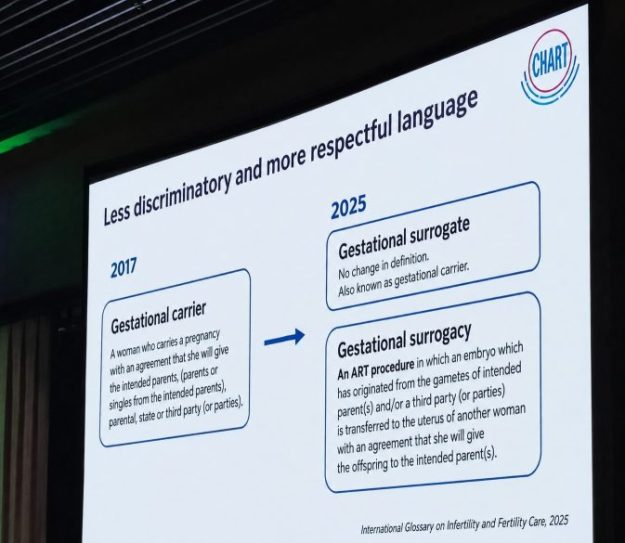
Irene Cervelló, who specialises in Cell Biology, Somatic Stem Cells and Reproductive Medicine, discussed research in which pig and rabbit wombs are stripped of their cells, leaving the natural biological scaffold of the uterus to be processed into biomaterials for potential use in regenerative medicine (accompanied by lots of cute animal pictures). And the Ukrainian-UK obstetrician and gynaecologist Evangelia Katsika greeted her audience with her national flag and took an impromptu photoshoot with pictures of a bombed Kyiv before her presentation. But the pièce de résistance was a speaker from Chile presenting to a packed auditorium on the “International Glossary on Infertility.”

In essence, he was explaining that the 348 terms now considered internationally acceptable in the fertility industry for 2025, has an updated version of the original 2017 glossary, which contained 283 terms.

Photo of screen showing updated Glossary language.

The glossary is intended “for all stakeholders, including policymakers” and the latest update is designed to “reflect contemporary scientific knowledge, changing social needs and more inclusive definitions, while standardising language across clinical practice, research, policy and the public domain.”

The speaker was Dr Fernando Zegers-Hochschild, Professor Emeritus at the Faculty of Medicine at Diego Portales University in Santiago, Chile, and a prominent figure in reproductive medicine and assisted reproductive technologies. Reading straight from the trans-ideology playbook, he rattled off terms such as ‘assigned at birth’, ‘gender identity’, ‘cisgender’, ‘Not aligned with the sex at birth’, ‘gender dysphoria’ and ‘gender reassignment’.

What struck me was hearing a man in his late 70s delivering a presentation using the language of Gen Z identity politics – particularly terms such as “inclusive definitions” and “social needs” – to an auditorium packed with highly educated medical professionals. The contrast was striking, and, frankly, rather surreal.

Dr Fernando Zegers-Hochschild, a speaker at the ESHRE expo.
Dr Fernando Zegers-Hochschild

His closing remarks called for ‘open dialogue’ and ‘mutual respect’  and the importance of avoiding language that might offend, yet in the same breath, he referred to surrogate mothers as “gestational carriers”. When it comes to the commodification of women’s bodies in the fertility and surrogacy industry, it seems the person whose dignity and feelings are given the least consideration is the woman herself.

Walking around the exhibition hall, I was struck not only by the sheer number of delegates from every corner of the world, but by the spectacular scale of the stands themselves. The largest belongs to Ferring Pharmaceuticals. Owner by billionaire Swedish owner, Frederick Paulsen,  Ferring Pharmaceuticals Ltd. has donated £1.43 million to the Liberal Democrat party over the past six years through the UK subsidiary of his Switzerland-based company. (Ferring is also one of the world’s leading makers of the puberty-blocking drug, triptolen, which halts puberty by suppressing sex hormone production in boys.)

The BSV Bioscience stand was also huge and boasted its positioning as a market leader in theIndian women’s health and fertility drug market . There was a corporate display of the operational footprint map including developing countries such as Afghanistan, Guatemala, Ethiopia and Mauritius. Very few poor nations have not been mined for their resources and potential benefit to the global fertility industry.

Walking across to the London Egg Bank stand, there were smiling faces of women featured on it’s posters. The young hostesses were eager to greet you for a chat. I wondered whether they were fully aware of who their employers are exploiting. Despite being the first and only ‘UK egg bank’, it was criticised for targeting students as potential egg donors at a welcome event at King’s College London in 2020 and at Kent and Canterbury Christ Church University in 2018. (photo)

Everywhere I turned I was bombarded by pictures of babies and glossy adverts for same sex parents to obtain babies via surrogacy. Cyromate who ‘proudly serve lgbtq families around the world’ (photo) showed 3 men on the back of their leaflet along with their clearly marked position that they ‘believe everyone has the right to parenthood’.

Human beings are apparently something you are entitled to create no matter your circumstances or sex, and you can play human pick-and-mix with women who donate their eggs by choosing the eye colour, hair colour for a potential child and even weight and occupation of your chosen DNA provider (under the assumption that you would want an educated and high-IQ take-away human).

The London Sperm Bank, which obviously focuses on lesbian couples and single women, eagerly touts a free demonstration of its online sperm-choosing software portal. I was given a flyer for a ‘Queer and ethically-driven surrogacy journey’ for a french podcast called ‘Surrogacy Daddy’ which can be heard on Spotify and Youtube. Based on a gay French couple, each episode explores their journey to the USA to obtain a baby. (picture). Episode – 12 – A Tale, Some Doubts details their surrogate’s serious hemorrhaging a few days after giving birth and describes this horrendous medical emergency as “a difficult trial”. (This event resulted in a hysterectomy for the woman involved.)

The BMJ (2024) states that ‘surrogates seem to have a higher risk of developing complications such as postpartum haemorrhage and severe pre-eclampsia and are more likely to give birth prematurely. This was not something that was ever mentioned in the podcast.

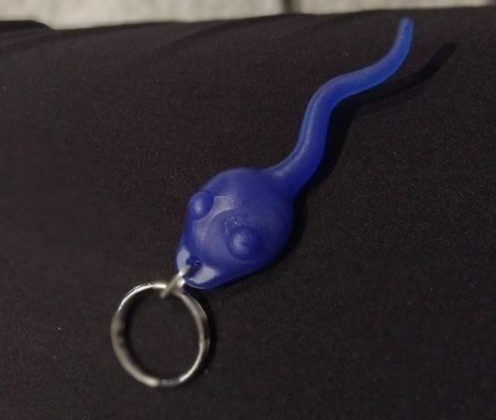
Despite the endless freebies (cartoon sperm bags, keyrings, pens and notepads galore) and the relentless promises of increasing populations, there was remarkably little acknowledgement of the effects of modern feminism, social media and poor education on women’s relationship with their bodies. Women’s bodies are still ruled by biology.

I was left with a rather sad reflection. With all the science, technology and supposed progressiveness of modern society, particularly here in Europe, women in 2026 are still being commodified and advertised. Their bodies are treated as resources to be used to fulfil other people’s needs and desires, like privatised medical machinery sold to the highest bidder.

Europe’s largest fertility expo is doing nothing to help challenge these regressive and misogynistic ideals, and instead is doing everything they can to perpetuate them.