Tag Archives: women

Celebrity Surrogacy: Buying babies is in fashion – Guest Post from Susan Calvin

In recent years the trend of celebrities buying babies has grown exponentially. We now regularly hear stories of well-known figures becoming parents ‘through surrogacy’ and see announcements on social media of their newborn’s arrival, usually accompanied with a stylized photo of the babies’ feet. Headlines like “Celebrity becomes parent” is commonplace with Paris Hilton, Amber Heard, Cameron Diaz, Rebel Wilson, adding to the trending list on Twitter. The birth mother rarely gets a mention and perhaps this is to protect her identity, but we are told by these same news stories what a wonderful thing it is to be a ‘surrogate’ so why not fully celebrate the wonderful, altruistic act a surrogate mother has done for someone less fortunate?

Most of these articles normalise surrogacy, presenting as it no different from buying a mansion or signing a business contract. We may see claims of ‘fertility issues’ as a reason to justify the practice of commercial surrogacy or – as with Priyanka Chopra and Nick Jonas – a ‘busy schedule’ is to blame for the lack of natural conception. How that same busy schedule allows time for raising a child is best left to our imaginations.

There is no room to bring ethical issues to the forefront, the glossy magazines will tell us it was the surrogate mother’s choice, so it is justified. Under the auspices of body autonomy and ‘choice feminism’ we must respect that a woman selling her child for money is to be respected and never questioned. ‘Her Body Her Choice’, a slogan once used to fight for legal abortion and further access to safe terminations has been rebranded, but this time disingenuously. If we were more honest it would be Her Body My Choice.

Choice Feminism

When a woman engages in surrogacy, we may hear talk about “free choice”, it is something a woman chooses to do. Ok, but when most surrogate mothers engage with surrogacy due to financial need, must we accept this without question? Did we ever see a celebrity renting her womb to “help” other women fulfil their desire to become mothers?

No financial need is a free choice; it is a necessity, survival. When there is a need, there is no room for free choice. There may be 100 different types of cereal on the shelves, but you can only afford the cheapest one for your children. Is that choice? If you rely upon benefits or welfare, can you use that money to buy a designer handbag if that is what you choose? We can only make free choices after our basic needs are covered. Most women engaging as surrogate mothers do not have their basic needs covered; they usually have children, a family to support – can any of these news articles tell us how a wealthy, famous woman has rented their womb out to “help” another women less fertile than herself become mother?

Celebrity Culture

This has long been held up as aspirational, for their wealth, popularity, appearance and glamourous lifestyles. Teenagers may become infatuated with a particular singer, looking to emulate them or heartbroken when their favourite band splits up. Those who once influenced fashion trends now flood the market with their own brands, from clothing and make-up brands to a shape underwear, all with a ‘name’ on them. When a Birkin bag is seen on the arm of a Oscar Winning actress, coffee cup in her other hand, the item will not only fly off the shelves but there will be a long waiting list for the next batch of bags to be delivered. The counterfeit markets are booming from cheap fakes just so those on a medium income can mimic a celebrity and, as it is with surrogacy, is not the factory workers making the big bucks.

When the of surrogacy cost is reduced and access made possible we can all have what a wealthy celebrity has, a fake designer bag can be very convincing. Kim Kardashian once paid more for a handbag than she did for a surrogate-born child. (The average cost of a surrogacy pregnancy is $90,000, depending on the US State, it is far cheaper in Ukraine, Mexico, Columbia, etc where poor women can be exploited for their eggs and womb rental.) But contrary to jokes from an Oscar Wilde play or BBC Correspondent’s tweet, babies are not handbags and not should they be carried around in one.

The comments sections of news article on this topic may see people promoting the idea that everyone as a “right to be parents”, though no human rights law even mildly suggest this. Others argue that “adoption” is not easy for gay couples in some countries, so surrogate mothers should be provided for them to realise their dreams of a biological family. This is done in place of fighting for better adoption conditions.

Infertility and Social or Situational ‘Infertility’

Fertility issues and advancing years mean it is difficult for many women to conceive and deliver a healthy baby, but neither are a reason to use women as a ‘proxy’ to deputise and carry the risks of pregnancy and labour to produce a child. Human beings have health problems, something inherent to the human condition. Some maybe lose their vision, a leg, an arm, teeth, or feet. Are these people entitled to a new human part to supplant their health problems? Many will agree that it is not reasonable and that organ trafficking is horrific. Nevertheless, when it comes to renting a womb it is a solution to ‘infertility’. Why did that speech change? Why is buying a healthy liver from a poor, vulnerable person abhorrent, but renting a woman’s womb and paying for a newborn is acceptable? Could it be that society normalized using women as commodities and that renting one is just not that bad?

Homosexual celebs couples with ‘situational infertility’ are well-known for renting wombs to fulfil their desire to make a family, and in cases like Nacho Palau and Miguel Bosse, who, after breaking up, separated their children, taking each one their biological boys according to the paternity. This decision left no room for sibling bonding between the four boys. In other cases, like Jeff Lewis and Gage Edwards, who’s acrimonious split after the birth of their surrogate-born daughter, now co-parent and arguments over remaining frozen embryos were tame in comparison to the law-suit from the birth mother of Monroe. Ricky Martin and his partner, Jwan Yosef, received backlash when these two men said they were “pregnant”…how many women were involved to produce their family of four? Though surrogacy scandals are not limited to homosexual couples. Actress Jamie Chung has the ‘social’ type of ‘infertility’ and claimed pregnancy would hurt her career so she outsourced it. Zheung Shaung hoped to cancel the baby order she placed with two women when she split from her boyfriend. The babies she had commissioned became inconvenient and she wanted these women, each seven months pregnant at the time, to get abortions.

Parenthood as a Human Right

From ‘fertility privilege’ of heterosexual couples and women without fertility struggles, to the claims of gay equality rights to IVF, there is a move towards a ‘right to parenthood‘. In country law and human rights in general, there is no right to become a father or a mother, it falls in the wish or dream category. To be a mother or father is a hope, a desire, not a human right.

Commodities, not humans

The discussion about surrogacy ignores a vital element—the children. Nobody addresses what biological, psychological, or developmental consequences impact these luxury babies. There is not enough research and no interest in figuring it out. However, specific facts prove that children are not the priority since, in many cases,” like in many cases in Ukraine and Thailand. In these cases, the law and contract policies with the agencies did not consider the fundamental right of the children to be protected as human beings but instead treated them as mere ‘things’. No parent in any country is entitled or has the right to abandon their children if they are born with a disability since this is a crime but babies bought as a ‘faulty product’ are rejected and abandoned for not being perfect.

As adults, knowing they were the product of surrogacy may be a traumatic discovery. Jessica Kern, a ‘product’ of commercial surrogacy asks why her mother gave her away but kept other children, she too asks why her commissioning and legal parents bought her and of decision makers, why this is permitted. Is Jessica the only surrogate-born child, who in her adulthood is asking this question? No.

Children in the surrogacy trade are not considered human beings but commodities, a social media tool, and now this celebrity ‘luxury item’ is available to the general public via the law-makers affording access and with the media usefully promoting it. There are more and more justifications for surrogacy in the media, but only a few truly explore even the most basic questions. The fact that it is already allowed demonstrates the direction we are going in. A society where money and power can buy anything, where a adult wish, realised through cold hard cash, has more weight than the rights of babies. Children are now the new Birkin. Through the popularisation of this questionable practice facilitates the increase the trade of children and the exploitation of women.

Normalising the buying and selling of babies and women as a tool to solve ‘infertility’ is not acceptable.

Motherless doesn’t exist

I was pleased to see coverage of a recent surrogacy dispute in the mainstream media last week. Pro-surrogacy lobbyists say these cases are rare but we cannot be sure of this. The family court is closed to the public and it is only with the judges’ permission that details of a case be released to the press. It was Julie Bindel who sought permission to write on the case of Z (the child) and her article was published in The Critic in June, with the mainstream press picking it up in The Times, The Telegraph and the Daily last week, so it it feels like a good time to revisit this particular case.

I am limited in what I can share for obvious reasons, but I can say that I am honoured to know and support the surrogate mother from when we met 3 years ago to today. She is the picture of dignity and strength in incredibly challenging circumstances.

When such disputes happen there are lifelong consequences for all involved. Perhaps what pro-surrogacy lobbyists mean is that it rare for judges in the family court to rule in favour of the surrogate mother. Such as this case where the commissioning parents were not entirely honest about a condition one of them suffered from and the surrogate mother wanted to withdraw her consent as she considered them to be unsuitable parents. The child was placed in foster care.

Or the case of a surrogate mother who, as she already had a large family and with no genetic connection to the child, the judge decided that the commissioning couple should retain custody. The surrogate mother is allowed to visit the child 6 times a year. (Significantly, in this case, the court notes state that a parental order “tells one nothing about what the best welfare arrangements for the child will be after birth.”)

We know of UK cases where there is significant pressure on a surrogate mother to agree to the parental order and situations when her consent is not forthcoming it can be ‘dispensed with’. Marie Anne wrote of her experience and told us that counsel for commissioning parents argued that because a UK surrogate mother had tragically died and was therefore unable to give her consent, so should she, a very much alive surrogate mother, have her consent dispensed with. (It’s likely that the wider public wouldn’t believe this unless they read about it in the papers or heard it on the news, but coverage of Marie Anne’s case was wholly positive at the time.)

These cases are complex and I am not a lawyer, but my reading of the case of Z it is that the commissioning parents had the early intention to remove the mother from their lives once they got what they wanted; the child. It was never their intention to have her as an extended family member, despite what they promised. The court proceedings made it clear that commissioning couple didn’t want a mother in Z’s life, there was “no vacancy to fill” and G, the surrogate mother was referred to as “just an egg donor”.

By applying this reductive, dehumanising language and failing to acknowledge reality and her role as mother, their aim to sever the connection with her child was made starkly clear.

Some say that G could have changed her mind and kept her son but once ‘signed up’ to surrogacy, it is very difficult to back out. It’s not a matter of simply changing your mind. You are pregnant with child you are told is not yours.

Whilst within the legal limits, a surrogate mother can access an abortion in the UK, but an article from New Zealand, where the laws are similar to ours, a woman terminated her surrogacy pregnancy and a politician (with now two surrogate born babies) put forward a private members Bill. The wording of which alludes to access for abortion in a surrogacy pregnancy possibly coming under threat.

“Labour MP Tāmati Coffey, who, with his partner Tim Smith, welcomed their son Tūtānekai by surrogate in 2019, currently has a members’ bill in ballot calling for modern laws for modern families. It includes reform of birth certificates, providing a way to enforce surrogacy arrangements and creating a register of potential surrogates.”

Outrageously, accusations of homophobia were made of G. In my view this (along with a legal argument of human rights) this was done to garner sympathy, claim victimhood and tarnish G as bigoted. If a woman was homophobic would she seek to engage in having a baby for a same-sex couple? No.

Whilst social services were in support of the two men the clinical psychologist in the case said “The fathers…claimed that they are a ‘motherless’ family” and it is from here we get the title of this blog: “Motherless’ doesn’t exist.”

Ultimately the judge ruled in the best interests of the child and that was for the child to know his mother and have an ongoing relationship. It is an unprecedented decision where “free and unconditional consent that is required by section 54(6) of the Human Fertilisation and Embryology Act 2008” was central to the ruling.

Had all parties stuck to the original agreement then the situation would undoubtedly be entirely different for the adults and more importantly, very different for the child. But the State cannot legislate to force a friendships in any form and this case demonstrates how the ‘friendship’ was temporary, one sided and transactional. It was not based on the natural-founded and enduring friendships we are led to believe is common in surrogacy.

Readers should be reminded that reform proposals seek to introduce a model of commercial surrogacy where a pre-birth order transfers the parental rights at birth. The mother gives her consent to transfer her parental rights before the birth but she is not required to confirm her consent afterwards. The Law Commissions of England and Wales and Scotland found this to ‘disrespect’ her autonomy:

“A requirement for further consent after birth also suggests that the surrogate’s consent before conception is not adequate, which does not respect her autonomy.” ~ Law Commission’s Core Report, Page 37.

But as we know from this case, a lot can change between conception and birth.

With the ‘cooling-off period‘ (which I use deliberately as a contractual term) much reduced from 6 months to just 6 weeks after the birth, a surrogate mother has much less time to raise the alarm, decide to try to reclaim her parental rights or instruct lawyers. Under the Law Commission’s preferred model her name has already been removed from the birth certificate. Her name, rights and role in the child’s identity documents, knowledge of their relatives and experience of their family has been erased from the outset.

Thankfully, this is not the case for Z who will know his mother but it would have been very different had reform been in place at the time.

We would like to thank the legal team who supported G and we invite anyone who is or knows a surrogate mother with regret to contact us

“I made the biggest mistake of my life, all to help someone”– Guest Post from Marie Anne Isabelle

Ten years ago I was a gestational surrogate for a family member on the understanding that I would have ongoing contact with the child that I would give birth to. Naively, I did not realise that this would not be a guaranteed in our arrangement.  Had I known that it would not be guaranteed I would never have agreed to be a surrogate. I believe I was lied to, manipulated and exploited because somebody needed my uterus.

Surrogacy – being pregnant and having drugs injected into you daily for three months – is not an easy or pleasant experience at all. It inflicts enormous physical demands onto the body and the psychological damage is irreparable. My experience is testament to that. From the moment I was pregnant I was made to feel as though my body was no longer mine and I had no control over it. I was told what to eat and the freedoms around some of my daily routines were completely destroyed. But the worse was yet to come.

As soon as the child was born, I was abandoned by the very people I had helped and was made to feel utterly irrelevant to the child I had given birth to. This whole process had a devastating impact on my mental health to the point I was admitted into psychiatric care.

Anybody would have thought it would have been at this point that support and help would have been given to me, but no, instead the laws allowed for my mental health to be used against me, I was  silenced and my consent disregarded so that parental order could be granted.

Unfortunately for those that tried to undermine me, a psychiatrist was employed to ascertain as to whether I had the capability to consent. My ability to consent was established but by this time, after all the abuse I had sustained, it was now difficult for me to give my free and unconditional consent.   

I asked for a contact order but was told I would not be granted one as this would have deemed this as a condition. But the condition was central to the original understanding. It didn’t matter. I was then threatened with paying Child Maintenance by CAFCASS if I did not consent to the parental order. (I do not believe CAFCASS should ever be involved in surrogacy cases.) After being threatened, bullied and given endless false promises I relented, as my mental and physical health could take no more. I gave my consent and my parental rights were transferred to her and her husband. To this day I have never seen the child I gave birth to. 

This continues to have a devastating impact on my life, I am not sure how I can live without giving birth to a child I will never see. It is not a situation I had ever envisaged I would be in as I would never had agreed to be her surrogate if this was the arrangement. I do not agree with surrogacy, I believe it should be banned completely as there is no pathway for it to ever be safe.  It destroys lives and the cost not only to myself, but to many others, has been too great.

The amount of money spent on this by the tax payer should not be ignored either.  I have not been able to work, I have been under the care of the NHS for ten years. All of that expense has never been directed to the commissioning parents. It has come from you, the very people who are reading this.  That is completely unacceptable.

The Law Commission recent recommendations make no reassurances that what happened to me could not happen to someone else.  Instead, they make it more likely. Surrogacy needs to be banned around the world, before more people are exploited and it needs to happen now.

Surrogacy – a new job opportunity?

Pro surrogacy lobbyists will say that surrogacy isn’t a job but when it is compared to forms of labour it is always to the riskier jobs. Comparisons are made to say, being a firefighter or police officer, but comparisons are never made to other service providers such as being a dentist or a cleaner. We know those roles are low-risk, so it’s subtle but we recognise there is an inherent risk in engaging in pregnancy for others.

With risky employment comes training, health and safety equipment and sometimes a significant risk allowance. If surrogacy was to be thought of as a job then there would be some health and safety guidelines, checks and an uptick in salary. And being pregnant is 24/7 with no breaks and jobs with long hours, like truck divers, rest breaks are scheduled for health and safety. Also, the riskiest jobs in the world have an element of knowingly putting yourself in harm’s way and this becomes part of the deal, and perhaps part of the draw.

With limited research in this area we rely mostly on anecdotal evidence and we have observed some common trends. Surrogate mothers will often have former careers in childcare, teaching, midwifery or nursing, and it seems to be fairly common for surrogate mothers to go on to become deeply involved in surrogacy ‘community’ and subsequently switch careers.

A small 2022 study * from a pro-surrogacy Academic, Dr Kirsty Horsey confirms that most surrogacy ‘teams’ meet through an agency as strangers and though only 47 surrogate mothers completed the survey their careers included midwifery, teaching and nursing:

“Regarding occupation, 12 surrogates identified as being in nursing, midwifery, or health care, seven were in teaching or childcare professions, and 11 in business administration, management, or accounts. Three were solicitors. Other roles included civil servant, police staff, a registrar, a hotelier, a retail role, two students, and two ‘stay-at-home moms’.”

The survey summarises that “Most responses (85%) indicated household incomes below £70,000. Four surrogates said their household incomes were above £80,000.” But it’s worth pointing out that 44 respondents answered that question and a quarter (25%) said they were on a joint income of less than £29k and another 30% said there were on a joint income of between £29k-40k. So that’s over half (55%) who are on significantly less than 70k. The footnotes for this suggests is was badly worded.

And there is a disclaimer: “Given the different professions identified, it is unclear if all respondents gave an answer reflecting personal or household incomes, suggesting that both should have been asked for in the survey. Because of this, it is unclear what weight can be given to these answers.” (Footnote 31.)

These trends bear out in real life further, these example shows that surrogate-mother-to-agency-employee pipeline is real. Take Gina Kinson for example. Having worked in nursing, Gina, a two-time surrogate mother, later became a Co-ordinator for My Surrogacy Journey. Or Sarah Jones, now CEO of Surrogacy UK, Sarah is an Early Years Educator and has had 5 babies for others. Another is Dawn Allen, a surrogate applications and agreement Co-ordinator for Surrogacy UK. Initially inspired to have babies for others after watching a documentary, Dawn came out of ‘retirement’ to have a baby for a couple at the age of 49 whilst working at Surrogacy UK.

So it appears common that a surrogate mother’s career will centre, at least for some, around care-giving and providing a service and having had a baby for others can result in becoming more deeply involved in the industry.

If surrogacy is a vocation where you provide a service in exchange for money, it’s a regular job like any other and one you can retire from. It’s not just ‘favour’ you do for a friend or family member, not least because women are having babies for strangers they are matched with. Surrogacy is no longer what we thought it was when it began back in the 80s. (You may have seen #changingthelandscape used on pro-surrogacy posts and they are not wrong, the landscape has indeed changed.)

In risky jobs we assess and name the risks using clear language in the job description so applicants know what the role entails. (Prostitution isn’t a job, but we have seen it be more commonly referred to as ‘sex work’, as a way to normalise and rationalise the act of using a woman’s body for paid rape as job she chooses to do or a ‘vocation’.) Now there are subtle shifts in language in surrogacy too. Agencies now refer to ‘compensation’ rather than the legal term of ‘reasonable expenses’.

Pregnancy and labour is unpredictable and carries risk. We don’t currently consider surrogacy as a form of employment in the UK, as ‘contracts’ are not enforceable (though that’s a whole different blog), but monetising women’s bodies is a slippery slope.

If you have concerns about surrogacy becoming more widespread, the impact on women and children and what proposed reform in the UK would lead us, please get in contact.

** With 47 respondents to this 2022 survey, this could be roughly just 10% of parental orders as 449 Parental Orders were granted in 2022.

Words from a Midwife: Part Three – The Unspoken

There has been an interesting response to the Royal College of Midwives (RCM) webinar on Surrogacy. Perhaps it’s not surprising that those ‘with women’ wanted to offload their or share what they themselves have witnessed when supporting patients through pregnancy, birth ‘and beyond’.

Midwives got in touch with us to tell us of their shock at when they heard their union was considering hosting a webinar on surrogacy. We later heard from the women who attended that it was far from a the ‘neutral’ presentation they were promised.

Parts One and Two of this short blog series are direct accounts from RCM Members who attended and who remain anonymous and other midwives gave us permission to share their personal perceptions of surrogacy in their day-to-day jobs.

A Community Midwife noticed how the glossy images a surrogate mother posted online which promoted surrogacy as a wholly positive experience hid the very raw and real realities of her birth injuries.

Another midwife said something similar about a woman who had a baby for a family member. The commissioning mother was posting on social media about how amazing her ‘journey’ was, but this midwife knew the reality for the birth mother. It was filled with gestational diabetes (which can lead to higher risk of diabetes in future), obstetric cholestasis which is a liver condition (that can causes liver disease and other issues in the future) and high blood pressure. This risky pregnancy ended in a C section. The truth was this woman was devastated after the birth as she would never have another child of her own due to these complications. It put a strain on her own marriage as her husband, while initially supportive, didn’t realise the enormous negative affect this had on his wife’s health and the future of their own family. This desperately sad reality was not shared on social media.

Another midwife commented on the late maternal age of two surrogate mothers she cared for and she expressed concern that there are no upper age limits in proposed reform. Both of the surrogate mothers she supported were in their 50s. She felt that as the pool of women available for surrogacy was ‘slim pickings’, women with a complex obstetric histories may be considered by the commissioning parents as their options were limited. This was nothing to say of the risk to the baby.

And finally there was one patient that stayed in the mind of a midwife we spoke to by phone. She told us how she supported this woman through four surrogacy pregnancies. The midwife knew she had lost touch with all but one of the families she was pregnant and gave birth for. During these pregnancies the commissioning parents were her “best friends” but once the baby had been delivered, the surrogate mother was “ghosted” and she then grieved the loss of the lifelong friendship she was told she could rely on.

In sharing their experiences these midwives has a sense of release, as if they had to keep to the official line outwardly, but inwardly there was worry and anger building as they were unable to talk freely. In our conversations these women were able to air their concerns about the direction of travel of surrogacy in the UK. Several felt badly let down by their union as women and as midwives.

We were left with a distinct observation that midwives are on the ‘front line’ of surrogacy. Any legal disputes may end up in the court room but they begin on a maternity ward. It is the midwives and other healthcare professionals who will have to navigate the practicalities on the ground around consent, the removal of the newborn and ongoing mental and physical health problems as a result of surrogacy births.

Words from a Midwife: Part Two – Guest Post from Anonymous

After we published Part One of this blog last week, a number of midwives got in touch with us to tell us more about Royal College of Midwives’ webinar on surrogacy. Part Two is a another written account from a Midwife who attended the webinar who also wishes to remain anonymous. If readers wish to get in touch with us, please use the contact form .

Prior to the webinar I sent the RCM a complaint regarding how inappropriate it is to platform an organisation that offers material incentives such as Ann Summers vouchers and apple watches to potential surrogates. Following my complaint and complaints from other midwives, the RCM sent out a standard response stating that the RCM is neither for or against surrogacy. They said they were neutral on the subject. The webinar panel was then amended to include other speakers such as Louisa Ghevaert, a family lawyer and Sarah Jones, surrogate mother and representative of Surrogacy UK, the largest surrogacy agency in the UK. 

The webinar started with the host informing everyone that it would not be a debate on the pros or cons of surrogacy and it would be an educational ‘safe space’. It soon became apparent with the lawyer’s presentation that the webinar was heavily pro surrogacy. Louisa spoke at length about the law reforms proposed which included removing surrogates’ rights to be the legal parent at birth. This element was glossed over so I asked a question about whether this included surrogates who were genetically related to the baby and whether that means it completely removes the surrogate’s ability to change her mind following the birth. I also commented in the chat that this scenario would mean midwives would have to remove babies from birth mothers and hand them over to commissioning parents and asked how we could be expected to do this? Both my question and comment went unanswered. Louisa continued to focus on how wonderful law reform will be as it provides criminal history and safeguarding checks for all involved. She insinuated that although the government had stated it will not be taking up this reform that this was just a formality and it will be back on the table in a month’s time. 

Sarah Jones was next to present and she spoke at length about her personal journey of being a surrogate and her motivations for surrogacy. Sarah did answer my question, she admitted that she had undertaken both types of surrogacy ‘host’ and ‘straight’, meaning she had given away her own genetic children. She stated that any commissioning parents involved with Surrogacy UK had to agree to having an on-going relationship with the surrogate after birth. Although, she failed to mention how this would be enforced. In my professional experience the surrogates I have cared for have both been ‘ghosted’ by the commissioning parents following the birth and have no on-going contact. (In those cases the surrogate born child was not genetically related to the surrogate mother.) 

Sarah spoke about how she is ‘bonded’ with the children she was a surrogate for but no mention of how the children feel being born by surrogacy or how her other children feel knowing they have siblings out there who do not live with them. 

Michael and Wes were next to speak. This was the most difficult part of the webinar for me as I find their whole organisation to be completely unethical. They offer membership ‘benefits’ which include Apple watches, Gousto vouchers, Merlin entertainment vouchers and Ann Summers gift cards. I asked them if they thought offering these benefits blurred the lines into commercial surrogacy. I was not expecting a reply to that particular question, however Michael did reply:

“All of the membership benefits were created from three years of research to the surrogacy community. Every membership benefit has a health, nutrition or support benefit to all our members.”

I struggle to understand what support benefit an Ann Summers or Lovehoney voucher brings to a pregnant woman. It highlights to me how loosely regulated the remuneration for surrogacy is. On the surface it may seem that the UK has an altruistic model of surrogacy but in reality we have a system of commercial surrogacy in disguise with unknown sums of ‘expenses’ being paid. I have also witnessed expensive gifts exchanging hands. I commented about how I felt it was unethical to set up a surrogacy agency in a developing country such as Mexico which has high levels of poverty. This comment went ignored. 

What stood out to me the most throughout the whole webinar was the complete lack of discussion regarding the children born through surrogacy. The focus was on how midwives should support both surrogates and commissioning parents. There was also a complete lack of understanding from all presenters about the role of the midwife and who the midwife owes a duty of care to. I asked Louisa about what should midwives do following the breakdown of a relationship between the commissioning parents and surrogate. Instead of getting the correct answer that midwives only have a legal duty of care to the surrogate I got a very long spiel about being compassionate and kind to the commissioning parents! 

It is difficult to understand how the RCM can claim to be neutral on surrogacy and then put on a webinar with only pro surrogacy speakers, there to give rose-tinted glasses spin on surrogacy and the law. It was biased and far from neutral. 

Disappointingly, most of the attendees seemed to be in favour and left gushing comments about how wonderful it all is and how fabulous they think Michael and Wes are. It goes against everything we are taught as midwives regarding the mother and baby dyad, during pregnancy and following the birth. It seems the rights of anyone wanting a child for themselves supersedes all ethical and biological considerations. 

We know the relationship between mother and child starts in the womb, we are monitored on our discussions with women by the ‘baby friendly initiative’. We must inform women that their babies can hear them in the womb, that they will recognise their voice and the bond starts before they are born. 

Is this all forgotten when someone is commissioning a woman to have a baby for them?

Words from a Midwife: Part One – Guest Post from Anonymous

Following the Royal College of Midwives webinar on Surrogacy last week, a Midwife got in touch with us to share her experience and her concerns about what the promotion of surrogacy in midwifery means for her. To protect her identity we share the following without sharing her name.

As an RCM member for the past 28 years, I’ve always felt my union has had my best interests at heart. I’ve felt confident of their support and on the very few occasions I’ve needed their assistance, they haven’t let me down. But now I feel things may be starting to change, and I’m deeply concerned.

I attended their webinar last week which was advertised online as a discussion on surrogacy and how we, as midwives can support parents of babies born of surrogate mothers. The subject of surrogacy troubles me but the content shocked me.

Since I was a teenager at the start of my training, it is embedded into the heart of what it is to be a Midwife and that is to be ‘with mother’. Our role is to be her closest carer and her biggest advocate – yet here we were being told in this new way, she is not a mother, but a ‘carrier of a baby’. A baby who is to be given away at birth, and not only that, our care as midwives should be transferred over to these ‘intended parents’. 

It was very clear as soon as the webinar started that this was not a discussion or a debate on surrogacy, but well thought-out propaganda on the wonders of surrogacy, with stories from a surrogate mother and two parents of children born through surrogacy. 

There are no official stats on how many children are born through surrogacy in the UK. There is no disclosure on prospective parents and we know just by reading the news, that people from the UK are traveling abroad to buy babies. Although women in the UK are not paid for their ‘reproductive service’ there are incentives and ‘independant journeys’ (private arrangements) are being made online. If you’re lucky you get an Apple Watch and Ann Summers vouchers among other goodies from an agency. When someone in the chat questioned the ethics of this, they were told by the owners (two men) that it’s nice for the surrogate to have the Ann Summers vouchers to spice things up with her partner as she can’t have penetrative sex when pregnant. Oh how we laughed, does anyone want to tell them? Questions that criticised this controversial practice largely went unanswered.

The surrogate mother and CEO of another agency, Surrogacy UK, told her story of carrying 5 babies for other people, some her own eggs, some not and once during COVID. She was asked if she was concerned for her own health and well-being due to the risks of the amount of IVF pregnancies she’d put her body through. She said she made fully informed decisions by speaking to her obstetrician and was aware of the risks and happy to take them. It’s worth noting that the long term implications cannot be known but that multiple cycles of IVF have been shown to increase the risk of ovarian and uterine cancers. Not to mention the risk of vaginal/rectal/cervical prolapse in later years following so many pregnancies. Along with her other children this woman had a total of 8 pregnancies and births including 2 c sections.

The two men who were advocates for surrogacy having had two children by arranged births and egg donation and they have their own agency and have recently expanded into Mexico City. Promoting surrogacy and offering the incentives discussed, they talked about the horrendous experience they had of the surrogate being called the mother by a Midwife and that their name could not appear on the ID band of the baby in hospital. It’s worth noting that unless a couple have the same surname, the baby will always have the mother’s name on the ID band. This is not to offend or irritate but for the basic security and safeguarding of the baby in case of a mix up or kidnapping. They were quite proud to announce that the health board crumbled at their request and they got to put their names on the ID band. Who cares about safeguarding for babies anyway eh?

My biggest concern is the long term implications for the birth mother and the baby. A baby who has known nothing but their mother’s heartbeat, her voice, her body for 40 weeks, only to be taken away and placed with strangers. And for the mother, who needs her child close to her for both their wellbeing, to regulate temperature and heart rate, to stimulate feeding instincts, to contract the womb, minimise bleeding and to release oxytocin to reduce the risk of postnatal depression and complications. 

I know there are instances where this is unavoidable, but we shouldn’t as midwives, be promoting this as the norm. I don’t provide postnatal care to adoptive parents or to foster parents, so why am I being asked to treat these ‘intended parents’ as if they are the ones who have given birth? That is not my role as a midwife.These people are not my patients.

I am heartened by the fact that the student midwives I’ve spoken to feel that surrogacy is a problem in modern society. This seems to be due to the boom in celebrity surrogacy where it is clear the rich and famous are exploiting poor and vulnerable women, using them as a ‘vessel’ to carry a baby to avoid putting their own bodies through the trauma of childbirth. And the grotesque fad of lying on a hospital bed, as through they have just given birth themselves, is doing nothing to convince our new recruits that this transaction is anything other than a horrendous experience for the mother who has just given birth, and for the baby who has been removed from his or her mother literally seconds after being born. Sickeningly, there are numerous photos of babies still attached to the umbilical cord with the placenta still inside the womb, as the smiling commissioning parents hold this newly delivered baby that is crying out for their mother.

I have been taught a research-based approach throughout my career and to apply critical thinking whenever there is discussion or debate. Yet there was no other side to this webinar and the questions examining the other side were ignored. No known long term implications to the child born of surrogacy were discussed, no evidence of a long term follow up for women who have given their bodies and their babies to others. And no matter if surrogacy is commercial or altruistic, arranged on facebook or through an agency, if the mother uses her own egg or if the embryo has been conceived with a donor’s eggs, the social and moral outcome is the same. 

A baby has been taken from his or her mother at birth.

Regulating the international trade in babies

In just a few short weeks we have noted surrogacy scandals in China, Greece, Vietnam and Georgia. These illegal operations are investigated by the police, often for long periods of time, arrests are made and those involved are punished.

You would think that this would be a deterrent, given the likely prison sentences, but still it continues and appears to be happening more and more frequently. I know this as I have been monitoring the media exposure of such crimes since 2019 when I came to the subject of surrogacy reform.

In the 4 years since then I have heard all the arguments for regulation. Many argue that banning surrogacy completely sends the process underground; they say it cannot be stopped as people want to have a baby and this is their only option. They argue that the best way is to build a legal framework so surrogacy can happen safely, even ethically.

Following the return of the the Irish Dail from summer recess, it is likely that the Assisted Human Reproduction Bill will be heard this Autumn. Currently at Stage 3 for amendments, the Bill looks at regulating “the provision of any treatment or procedure, including such treatment or procedure for the purposes of surrogacy within the State, that involves the handling of gametes or embryos, or both, for the purposes of establishing a pregnancy”.

The recommendations of the Special Joint Committee on International Surrogacy will probably be included and the Bill has a lot of support from both Senators who have personally benefited from surrogacy and from the general public who have been fed the media line that for infertile couples in Ireland, there are no other options.

The recommendations include that surrogate mothers overseas will be required to sign an affadavit and that surrogacy arrangements are “fairly and ethically compensated”. Whilst politicians in Ireland may be confident of this there is no way they can be certain. What surrogacy agencies and lawyers advise in say, Ukraine,  is outside of their jurisdiction. What they can be sure of is that upon landing back on home soil, Irish citizens can secure parental rights through a legal framework: this is the goal, this is what this law will secure.

Historically the treatment of women and children in Ireland shows that motherhood and the rights of women have not always been respected. From the scandals of the Magdalen Laundries and the obstetric violence of Symphysiotomies, Ireland has a shameful history and the leigitimisation of buying babies from women in other countries fails to demonstrate a departure from these outdated ideas of women serving a purpose.

It is right that people committing crimes should be punished. It is not right to legalise the importation and trade in children by exploiting vulnerable women for their ‘reproductive services’.

If you are a resident in Ireland, please write to your TD, you can use our suggested points and resources here to help.

Surrogacy Reform – Letter to MPs


As a small, grassroots campaign we have no funding and no method of receiving any, so we kindly ask for support with your time, not money. As we await the report from the Law Commission which will form the basis for a draft Bill, please write to your MPs to share your concerns about potential reform of the 1985 Surrogacy Act.

To help we provide some suggested text but please tailor it to make it personal by mentioning the areas of reform you are most concerned about, we provide a list of ten to choose from below.

If you do send an email or letter to your MP we would appreciate being informed so we can track them. We would be very interested to hear from you if you receive a reply. Thank you!

Template Letter

[Your Name and Street Address]
[Your City and Your Postcode]


[Month, Day, Year]

Dear (insert MP’s name which you can find here),
I understand that the Law Commission are expected to release their report soon on proposals to reform the 1985 Surrogacy Act. There is a meeting on 14th March and I ask that you attend.

My concerns are as follow:

  1. Parental rights at birth – this moves the UK towards a commercial model and erases the birth mother on the birth certificate. CAFCASS are the key body involved in supervising the welfare of children in a surrogacy arrangement. It is perverse to go against their advice as well as that of the UN Special Rapporteur.
  2. No limits on age – no consideration has been given to the impact of this. A single woman of 18 will have little life experience on which to base a decision. Age restrictions should be similar to that of adoption on both women engaging as a surrogate mother and commissioning parents.
  3. No limits on number of pregnancies – doctors may give advice but advice can be ignored. A woman should be prevented from entering into serial surrogacy arrangements for health reasons, both physical and mental. Surrogate mothers have spoken about the addictive nature of surrogacy and the obstetric risks and potential cost to the NHS should be explored.
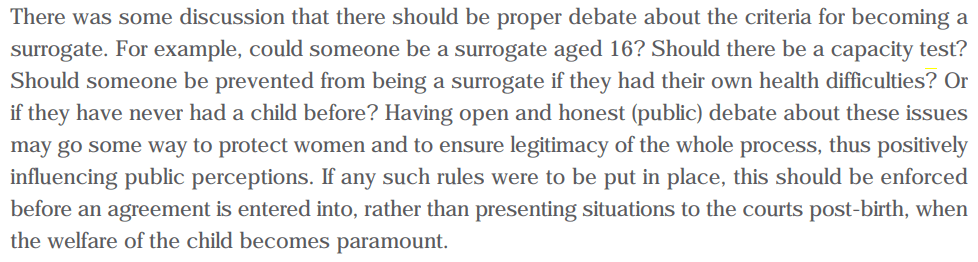
  4. Capacity assessment for 16 year mentioned in APPG sessions – the question of a capacity assessment for children to become surrogate mothers is sickening and it highlights the direction of travel for surrogacy in the UK. The UN Convention the Rights of the Child applies to children up to age 18. This move would exploit children. (See attached image below.)
  5. Light touch background checks – again, as a form of state sanctioned parenthood there should be a similar framework to adoption, to suggest otherwise ignores safeguarding of children.
  6. ‘Out of pocket’ expenses – the Law Commission gives an average of £15,000 which is unusually high given the actual cost of pregnancy and our free-at-source medical provision in the UK. This will effectively bring commercial surrogacy in through the back door by claiming for ‘lost earnings’ or other items which are not strictly ‘pregnancy expenses’. This is an area where surrogacy reform could target those in dire financial situations, a serious concern given the cost-of-living crisis. (Commissioning parents can also be exploited through this method of payment.)
  7. Advertising ban – poor women, single mothers etc could be targeted for the ‘womb rental’, again a serious concern given cost-of-living worries shared by millions.
  8. Integrity of implications counselling – this needs further exploration as to the integrity of the counselling surrogate mothers receive. It is also not compulsory and surrogacy arrangements can be made online with no framework of support for the woman for this significant and potentially life-changing decision.
  9. Influence of lobby groups on consultation and secretariat – Surrogacy UK lobbies hard for reform and have influenced the Law Commission, as have controversial lobby groups such as Stonewall. Surrogacy UK leads the Secretariat on the APPG for Surrogacy. This results in undue influence over the APPG.
  10. Double donation – as the HFEA announces a consultation with a view to lift anonymity on donated gametes from birth, surrogacy reforms suggest that double-donor conceived children could be also be surrogate-born, therefore removing the current requirement to have at least one genetic relationship between the child and their legal parent. This ignores and exacerbates genealogical bewilderment, a well-known suffering of children which extends into adulthood. What is the difference between surrogacy of donor conceived children and trafficking in human beings which is a violation of fundamental rights? The UN Convention on the Rights of the Child states: “contained in this treaty is a profound idea: that children are not just objects who belong to their parents and for whom decisions are made, or adults in training.” The proposed changes place the child last, not first.

Please also refer to the Convention on the Elimination of All Forms of Discrimination against Women, Human Rights (ENC 326/396 Official Journal of the European Union 26.10.2012) and the UN Convention on the Rights of the Child when considering surrogacy reform.


I have outlined several detailed problems with proposed changes which together show the fundamental problem with surrogacy. This practice has been banned in several countries including France, Germany, Spain, Portugal, Italy, Bulgaria and Poland. Indian banned commercial surrogacy on the basis that Indian women being exploited. The Ukrainian Children’s Ombudsman has called for a ban based on child safety.


The European Parliament – in its report on the impact of the war against Ukraine on women it officially condemns surrogacy. The report states that “sexual exploitation for surrogacy and reproduction is unacceptable and a violation of human dignity and human rights”.

Finally, I ask that you might consider becoming a member of the APPG on surrogacy or submitting a Parliamentary question on proposed reform.

Thank you for taking the time to read this email. I am very happy to talk to you about this in more detail and appreciate your support on this matter. I’d also be very happy to come and visit you at one of your surgeries to discuss this in more detail.

Kind regards

[insert your name]
[Insert your address – this is essential]
[Insert your contact details (phone and email) -optional]

Attachments: Screenshot from APPG Evidence session report