Tag Archives: reform

Words from a Midwife: Part Two – Guest Post from Anonymous

After we published Part One of this blog last week, a number of midwives got in touch with us to tell us more about Royal College of Midwives’ webinar on surrogacy. Part Two is a another written account from a Midwife who attended the webinar who also wishes to remain anonymous. If readers wish to get in touch with us, please use the contact form .

Prior to the webinar I sent the RCM a complaint regarding how inappropriate it is to platform an organisation that offers material incentives such as Ann Summers vouchers and apple watches to potential surrogates. Following my complaint and complaints from other midwives, the RCM sent out a standard response stating that the RCM is neither for or against surrogacy. They said they were neutral on the subject. The webinar panel was then amended to include other speakers such as Louisa Ghevaert, a family lawyer and Sarah Jones, surrogate mother and representative of Surrogacy UK, the largest surrogacy agency in the UK. 

The webinar started with the host informing everyone that it would not be a debate on the pros or cons of surrogacy and it would be an educational ‘safe space’. It soon became apparent with the lawyer’s presentation that the webinar was heavily pro surrogacy. Louisa spoke at length about the law reforms proposed which included removing surrogates’ rights to be the legal parent at birth. This element was glossed over so I asked a question about whether this included surrogates who were genetically related to the baby and whether that means it completely removes the surrogate’s ability to change her mind following the birth. I also commented in the chat that this scenario would mean midwives would have to remove babies from birth mothers and hand them over to commissioning parents and asked how we could be expected to do this? Both my question and comment went unanswered. Louisa continued to focus on how wonderful law reform will be as it provides criminal history and safeguarding checks for all involved. She insinuated that although the government had stated it will not be taking up this reform that this was just a formality and it will be back on the table in a month’s time. 

Sarah Jones was next to present and she spoke at length about her personal journey of being a surrogate and her motivations for surrogacy. Sarah did answer my question, she admitted that she had undertaken both types of surrogacy ‘host’ and ‘straight’, meaning she had given away her own genetic children. She stated that any commissioning parents involved with Surrogacy UK had to agree to having an on-going relationship with the surrogate after birth. Although, she failed to mention how this would be enforced. In my professional experience the surrogates I have cared for have both been ‘ghosted’ by the commissioning parents following the birth and have no on-going contact. (In those cases the surrogate born child was not genetically related to the surrogate mother.) 

Sarah spoke about how she is ‘bonded’ with the children she was a surrogate for but no mention of how the children feel being born by surrogacy or how her other children feel knowing they have siblings out there who do not live with them. 

Michael and Wes were next to speak. This was the most difficult part of the webinar for me as I find their whole organisation to be completely unethical. They offer membership ‘benefits’ which include Apple watches, Gousto vouchers, Merlin entertainment vouchers and Ann Summers gift cards. I asked them if they thought offering these benefits blurred the lines into commercial surrogacy. I was not expecting a reply to that particular question, however Michael did reply:

“All of the membership benefits were created from three years of research to the surrogacy community. Every membership benefit has a health, nutrition or support benefit to all our members.”

I struggle to understand what support benefit an Ann Summers or Lovehoney voucher brings to a pregnant woman. It highlights to me how loosely regulated the remuneration for surrogacy is. On the surface it may seem that the UK has an altruistic model of surrogacy but in reality we have a system of commercial surrogacy in disguise with unknown sums of ‘expenses’ being paid. I have also witnessed expensive gifts exchanging hands. I commented about how I felt it was unethical to set up a surrogacy agency in a developing country such as Mexico which has high levels of poverty. This comment went ignored. 

What stood out to me the most throughout the whole webinar was the complete lack of discussion regarding the children born through surrogacy. The focus was on how midwives should support both surrogates and commissioning parents. There was also a complete lack of understanding from all presenters about the role of the midwife and who the midwife owes a duty of care to. I asked Louisa about what should midwives do following the breakdown of a relationship between the commissioning parents and surrogate. Instead of getting the correct answer that midwives only have a legal duty of care to the surrogate I got a very long spiel about being compassionate and kind to the commissioning parents! 

It is difficult to understand how the RCM can claim to be neutral on surrogacy and then put on a webinar with only pro surrogacy speakers, there to give rose-tinted glasses spin on surrogacy and the law. It was biased and far from neutral. 

Disappointingly, most of the attendees seemed to be in favour and left gushing comments about how wonderful it all is and how fabulous they think Michael and Wes are. It goes against everything we are taught as midwives regarding the mother and baby dyad, during pregnancy and following the birth. It seems the rights of anyone wanting a child for themselves supersedes all ethical and biological considerations. 

We know the relationship between mother and child starts in the womb, we are monitored on our discussions with women by the ‘baby friendly initiative’. We must inform women that their babies can hear them in the womb, that they will recognise their voice and the bond starts before they are born. 

Is this all forgotten when someone is commissioning a woman to have a baby for them?
October 2023 ~ Lexi Ellingsworth

From Liverpool, to Glasgow and back to London. October was a busy month for me. I was honored to be asked to be a member of the panel at fringe event at the Labour conference for Labour Women’s Declaration, and to debate ‘The Morality of Surrogacy’ at the Battle of Ideas (footage on that soon). I had some fascinating conversations at both events and at FiLiA and I was greatly comforted by the volume of support we had at the march led by Glasgow Tactical Feminists.

The women of Scotland came in their numbers to support us against reform of surrogacy laws and the police did a fantastic job in facilitating our safe passage through the streets to the River Clyde as we gathered under La Pasionara.

It’s safe to say that our tiny, single issue campaign has swelled with support since it’s conception in 2019, in fact this year it has doubled in size with the launch of Surrogacy Concern! We proudly campaign together as we draw more and more interest and understanding of our position on law reform.

Throughout the month I spoke to many in person, via webinars, by phone and on email. My currently croaky, faded voice is testament to the number of conversations I had! I spoke to those who thought surrogacy was simply a way to have a family with assistance (they hadn’t heard about the proposals), others had heard a just a bit but hadn’t thought about them in any detail and what they mean for women and children.I spoke to gay men who reject surrogacy, young women who felt preyed upon by egg donor adverts and to women who have come across surrogacy through friendships or through their jobs, but hadn’t been able to put their finger on what it was that bothered them about it.

The gay men spoke about their desire to be fathers and their acceptance that it may not happen for them. One man spoke about his friends who have a surrogate born child and he noted the absence of a mother. A young woman told me of her shock that surrogacy has become so commonplace and her worries about what this means for women in the future. One young man I spoke to told me about sperm donation and the lack of support he had when he was rejected. I found all of these conversations insightful and painful at times, with the emotion these people shared with me and I felt lucky.

Every single engagement I had, long or short, left me with the concept of how complex and multi-layered surrogacy is. Having been elbow-deep for four years I confess I had lost some perspective. It was refreshing and invigorating, tracing my steps back to when I tumbled down this particular rabbit hole.

So what’s next? Well I’m back, there’s lots to do, lots more ground to cover and action to take. We have been inundated with emails and direct messages and myself, Liz and our small group of volunteers will be responding as soon as we can.

The pumpkins are disintegrating, the treats are all gone and soon it will be Christmas. But October was pivotal and we’re just getting started.

What about the children? – Guest Post from Alan Neale

The Law Commissions’ investigation into UK surrogacy law reform came about in response to intense lobbying by surrogacy agencies and law firms. These organisations wanted reforms that would make the surrogacy process easier to navigate, and would encourage commissioning parents to use their services in preference to those of overseas agencies. The reform that the Law Commissions propose thankfully avoids the temptation to go for full commercialisation. It simplifies surrogacy arrangements for commissioning parents, but in doing so it sidelines surrogate mothers, and solidifies the fracturing of the mother/child bond that is inherent in all surrogacy arrangements.

The proposed reform centres on intended parents (as the surrogacy agencies want commissioning parents to be called) becoming the legal parents as soon as a child is born. These intended parents, not the actual mother who gives birth, would be recorded as the child’s parents on his or her birth certificate. Currently  at least one of the intended parents would have provided gametes (eggs or sperm) for conception, but under reform this is no longer a requirement. So not only would the birth certificate erase the mother who bore the child for nine months and brought him or her into the world, it would pretend that there was a biological connection between the child and his or her  ‘parents’ that didn’t necessarily exist.

Having a birth certificate that denies biological reality so to reinforce the legal status of commissioning parents does not avoid the problems that removing legal parenthood from mothers creates. Under the reform proposals, the surrogate mother will have had to consent, before conception, to give up her child at birth, even though she can’t have known what she will actually be feeling at this time. Some mothers, experiencing a connection with the child that is growing in their womb, will not be able to resist developing a natural bond, and will start to have second thoughts. To preserve the pretence of informed consent, a surrogate mother will be allowed to object, but in a time frame that is ridiculously small (within 5 weeks of birth for Scotland and 6 weeks for England and Wales). She will be intensely vulnerable at this time, and likely being pressured by the intended parents to seal the deal. These are not circumstances conducive to a considered decision, let alone to her long-term mental health. A surrogate mother may agree to forgo legal parenthood on the understanding that she will be able to maintain some contact with her child, but the written surrogacy agreement that she and the commissioning parents would have agreed before conception is unlikely to have mentioned this, and she would have no right to contact in any case.

If the proposed reform gives minimal recognition of the surrogate mother’s feelings, its consideration of the possible feelings of the child as it grows up is almost non-existent. The Law Commission consultation document repeatedly stressed that the welfare of the child must be paramount, but they just assumed that they knew what would be in the child’s best interests, and that these would correspond with those of the commissioning parents. They quoted research, based on a tiny sample of families created via surrogacy which found no adverse effects on children up to the age of 14, to deny that there might be any problems now or in the future. They accepted as a fact of life the likelihood that intended parents will severely limit, or possibly even bar, contact between the child and his or her mother. The proposed reform partially mitigates this by allowing children access to their birth records when they reach 18, which would enable them to learn the bare facts of the circumstances of their birth. The birth certificate would only show the names of the parents or parent who commissioned them, with no mention that the birth resulted from a surrogacy arrangement. But adult children would also be able to access an additional Register of Surrogacy Arrangements, if they knew to look there. This record would name the ‘surrogate’ (no mention of the word mother), the legal parents, and ‘any other gamete donors’ – a document that would reveal, perhaps for the first time, the parties to the agreements that commissioned their existence.

It is understandable that the Law Commissions could not provide direct evidence from the children of surrogate mothers as to what would be in their best interests. Surrogacy in the UK only really took off after 2008 (when the Human Fertilisation and Embryology Act was passed) so as yet there are few adults whose mothers were surrogates. But, although the Law Commissions recognised similarities between surrogacy and adoption, they didn’t consider that the experience of adoptees might be relevant in assessing how children who are the product of a surrogacy agreement might be affected by the break with the mothers who gave birth to them. Nor did they consider the experience of donor-conceived children, and how they are affected by discovering how they were conceived.

The experience of adoptees

My late wife, Angela Hamblin, founded an organisation in 1975 that brought together first mothers like herself and adult adoptees. That organisation, Jigsaw, was instrumental in winning for adult adoptees, the right to see their original birth certificate, revealing for the first time who their first mother was. Jigsaw was also a forum where first mothers and adoptees could share their experiences. For the mothers, it was a chance to share with adoptees their pain at having to give up their children, and to explain the circumstances which had given them such little choice. For the adoptees, it was a chance to share the pain of not knowing their origins, and to express the feelings they had for the mothers they were taken from. For many adoptees, it had only been when they themselves became mothers or fathers that the full extent of the trauma of being separated from their mothers had really hit home. These feelings of loss, it was clear, occurred just as much when their adoptive family was a happy one as when it was less so.

Access to birth records at 18 eases the trauma of separation, but it does not take it away, even when the result is a successful reunion. This was demonstrated in the eloquent testimonies of adoptee witnesses to last year’s Inquiry into forced adoption by the UK Parliaments’ Human Rights Committee.

Angela drew on her experience in Jigsaw in her response to the Law Commissions’ consultation on surrogacy law reform. She referred to the unacknowledged pain, common in both adoption and surrogacy, that comes when you separate a mother and child. She concluded: “I wonder whether in our cavalier and superficial rush to reduce motherhood to merely a transaction between an egg, sperm, and a rented womb we have any idea what we are storing up in the future for those who will be the product of it.”

In 2022 the UK Parliament’s Joint Committee on Human Rights published its report into The violation of family life: adoption of children of unmarried women 1949-1976. Their report concluded that “The adoption practices we have heard about lacked humanity and had a profound impact on the family lives of all involved….The evidence from mothers and from adopted people vividly demonstrates the struggles that individuals continue to face every day in living with these brutal and cruel processes.

Earlier this month, the UK government responded with less than a full apology, It did acknowledge, however, that “These adoption practices were wrong. We recognise the pain and distress that occurred as a result and are profoundly sorry that so many people have suffered due to these practices.”

Read more on this on my substack here.

The experience of donor conceived children

Psychiatrist Erich Wellisch observed as early as 1952 that “lack of knowledge of their real parents and ancestors can be a cause of maladjustment in children…This problem deserves special studies and attention”. This maladjustment, later called ‘genealogical bewilderment’ was thought to affect adopted children in particular. More recently, It has been seen to apply to donor-conceived children as well. The advent of DNA testing has led to a massive rise in the number of people exploring their ancestry. One unanticipated result is that significant numbers of people are finding that a parent is not who they expected.

A study in the journal Biotechnology, published in April 2021, explored the feelings of 143 individuals who were donor-conceived. More than three quarters of them experienced a shift in their sense of self on discovering they were donor-conceived, and around a half sought support so to process these revelations.

“A total of 143 responses were collected. Approximately 94 percent were conceived anonymously and almost 85 percent reported a shift in their “sense of self” upon learning about the nature of their conception and about half sought psychological help in order to cope. Nearly 74 percent said that they often or very often think about the nature of their conception and 62.2 percent felt the exchange of money for donor gametes was wrong. Almost 43 percent believed that genetic testing companies ought to offer more complete information about using their products even though 90.2 percent believed being fully informed was impossible.”

Is the government about to change the law on surrogacy in such a way as to contravene the right to family life and to disregard the best interests of the child? Will that risk, at some future date, being subject to a report on human rights abuse, and a call for a government apology? Perhaps it would be wiser to avoid the human rights abuses in the first place.

Surrogacy Reform – Letter to MPs


As a small, grassroots campaign we have no funding and no method of receiving any, so we kindly ask for support with your time, not money. As we await the report from the Law Commission which will form the basis for a draft Bill, please write to your MPs to share your concerns about potential reform of the 1985 Surrogacy Act.

To help we provide some suggested text but please tailor it to make it personal by mentioning the areas of reform you are most concerned about, we provide a list of ten to choose from below.

If you do send an email or letter to your MP we would appreciate being informed so we can track them. We would be very interested to hear from you if you receive a reply. Thank you!

Template Letter

[Your Name and Street Address]
[Your City and Your Postcode]


[Month, Day, Year]

Dear (insert MP’s name which you can find here),
I understand that the Law Commission are expected to release their report soon on proposals to reform the 1985 Surrogacy Act. There is a meeting on 14th March and I ask that you attend.

My concerns are as follow:

  1. Parental rights at birth – this moves the UK towards a commercial model and erases the birth mother on the birth certificate. CAFCASS are the key body involved in supervising the welfare of children in a surrogacy arrangement. It is perverse to go against their advice as well as that of the UN Special Rapporteur.
  2. No limits on age – no consideration has been given to the impact of this. A single woman of 18 will have little life experience on which to base a decision. Age restrictions should be similar to that of adoption on both women engaging as a surrogate mother and commissioning parents.
  3. No limits on number of pregnancies – doctors may give advice but advice can be ignored. A woman should be prevented from entering into serial surrogacy arrangements for health reasons, both physical and mental. Surrogate mothers have spoken about the addictive nature of surrogacy and the obstetric risks and potential cost to the NHS should be explored.
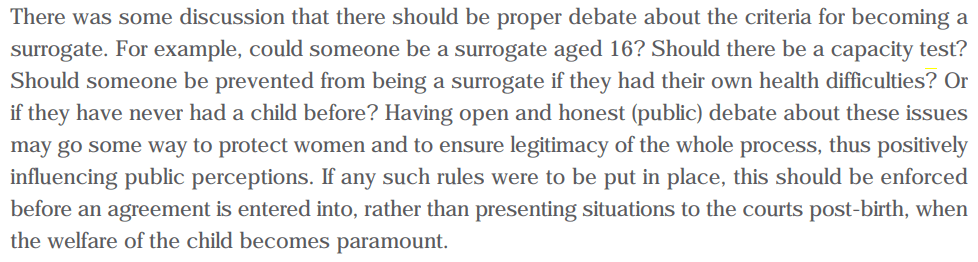
  4. Capacity assessment for 16 year mentioned in APPG sessions – the question of a capacity assessment for children to become surrogate mothers is sickening and it highlights the direction of travel for surrogacy in the UK. The UN Convention the Rights of the Child applies to children up to age 18. This move would exploit children. (See attached image below.)
  5. Light touch background checks – again, as a form of state sanctioned parenthood there should be a similar framework to adoption, to suggest otherwise ignores safeguarding of children.
  6. ‘Out of pocket’ expenses – the Law Commission gives an average of £15,000 which is unusually high given the actual cost of pregnancy and our free-at-source medical provision in the UK. This will effectively bring commercial surrogacy in through the back door by claiming for ‘lost earnings’ or other items which are not strictly ‘pregnancy expenses’. This is an area where surrogacy reform could target those in dire financial situations, a serious concern given the cost-of-living crisis. (Commissioning parents can also be exploited through this method of payment.)
  7. Advertising ban – poor women, single mothers etc could be targeted for the ‘womb rental’, again a serious concern given cost-of-living worries shared by millions.
  8. Integrity of implications counselling – this needs further exploration as to the integrity of the counselling surrogate mothers receive. It is also not compulsory and surrogacy arrangements can be made online with no framework of support for the woman for this significant and potentially life-changing decision.
  9. Influence of lobby groups on consultation and secretariat – Surrogacy UK lobbies hard for reform and have influenced the Law Commission, as have controversial lobby groups such as Stonewall. Surrogacy UK leads the Secretariat on the APPG for Surrogacy. This results in undue influence over the APPG.
  10. Double donation – as the HFEA announces a consultation with a view to lift anonymity on donated gametes from birth, surrogacy reforms suggest that double-donor conceived children could be also be surrogate-born, therefore removing the current requirement to have at least one genetic relationship between the child and their legal parent. This ignores and exacerbates genealogical bewilderment, a well-known suffering of children which extends into adulthood. What is the difference between surrogacy of donor conceived children and trafficking in human beings which is a violation of fundamental rights? The UN Convention on the Rights of the Child states: “contained in this treaty is a profound idea: that children are not just objects who belong to their parents and for whom decisions are made, or adults in training.” The proposed changes place the child last, not first.

Please also refer to the Convention on the Elimination of All Forms of Discrimination against Women, Human Rights (ENC 326/396 Official Journal of the European Union 26.10.2012) and the UN Convention on the Rights of the Child when considering surrogacy reform.


I have outlined several detailed problems with proposed changes which together show the fundamental problem with surrogacy. This practice has been banned in several countries including France, Germany, Spain, Portugal, Italy, Bulgaria and Poland. Indian banned commercial surrogacy on the basis that Indian women being exploited. The Ukrainian Children’s Ombudsman has called for a ban based on child safety.


The European Parliament – in its report on the impact of the war against Ukraine on women it officially condemns surrogacy. The report states that “sexual exploitation for surrogacy and reproduction is unacceptable and a violation of human dignity and human rights”.

Finally, I ask that you might consider becoming a member of the APPG on surrogacy or submitting a Parliamentary question on proposed reform.

Thank you for taking the time to read this email. I am very happy to talk to you about this in more detail and appreciate your support on this matter. I’d also be very happy to come and visit you at one of your surgeries to discuss this in more detail.

Kind regards

[insert your name]
[Insert your address – this is essential]
[Insert your contact details (phone and email) -optional]

Attachments: Screenshot from APPG Evidence session report