Tag Archives: surrogacy

Ending Digital Violence in Surrogacy

In the digital age, social media platforms have become a sprawling landscape for connection and community but for every well-meaning and helpful group there is a flip-side. Online groups occupy the dark corners of the internet where bad actors take advantage of the vulnerable. As the annual 16 days for the Elimination of Violence Against Women and Girls (EVAG) draws to a close, we turn our attention to social media surrogacy groups as this year UN Women calls for an “End to digital violence against all women and girls”.

The alarming escalation of violence against women found online extends to surrogacy as this harmful practice is a form of violence against women, as clarified by the UN Special Rapporteur for VAWG in her report this year. Here, I examine the risk posed by online groups, primarily on Facebook. 

These groups are dangerous for several reasons. They perpetuate the illusion of empowerment through bodily autonomy with subtle language which encourages women to help others and create ‘positive change’ in the world. Women are told they can (and should) share their fertility, spread the joy of family and ‘give a gift’ of a baby to someone, somewhere who cannot, for whatever reason, have a baby themselves. 

For many women considering surrogacy, the prospect of helping others whilst providing a solution to financial difficulty is a no-brainer. The promise of financial ‘compensation’, coupled with the chance to help a family achieve their dream of parenthood, presents surrogacy as a noble act of altruism, the ultimate kindness. But these groups are predatory and deceptive as they hide the deeper exploitative practices. Clinics and agencies entice women in and then make direct approaches, often switching to Direct Messages to dictate the terms and conditions. One woman who got caught up in these groups told us that she wanted to offer herself to a couple abroad as she trusted legal systems in other countries, more than those in her own. 

This single mother was offered money for a positive pregnancy test, more than double that for the heartbeat, more money again for accommodation, transport, a ‘feeding allowance’ and lastly, vastly increased sums for a twin or triplet pregnancy. At no point were the known risks discussed. 

“I really wanted to do it all for my child to have a better life…after helping a family I’d come back to run my business” recognising her narrow escape in a country fraught with exploitation she told us, “I may have been used for a human trafficking scam”. 

Advertising for surrogacy in the UK is illegal but these online groups present a loophole. Where would this illegal action be prosecuted, the UK where the post was viewed or in the country where the platform is registered? How and where should these groups be reported? I have personally reported several predatory groups to Facebook and no action has been taken. A journalist in Nigeria has had better luck. Simbiat Bakare’s investigation resulted in closures of several surrogacy Facebook groups (and we encourage readers to report any concerning posts, particularly those that offer a payment plan, by reporting under the category of ‘sexual and human exploitation’ and then selecting ‘exploitation of people under 18’).

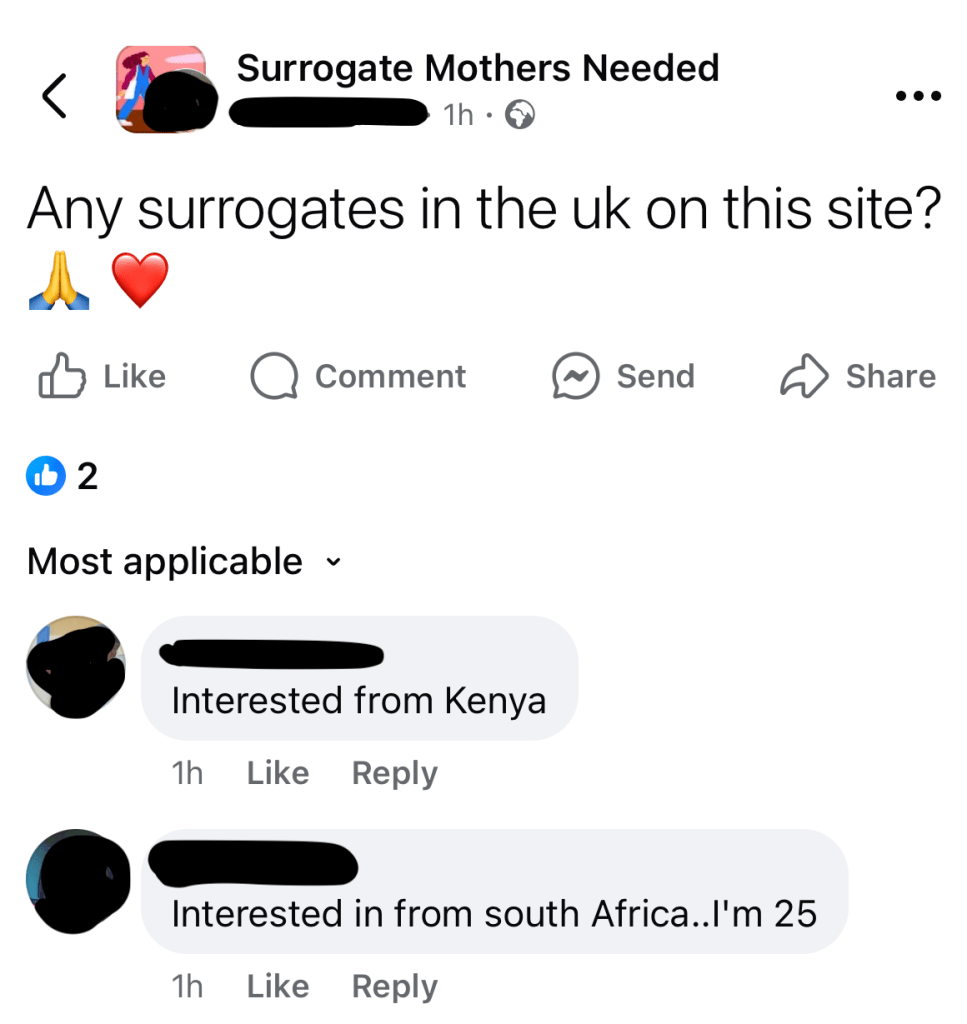
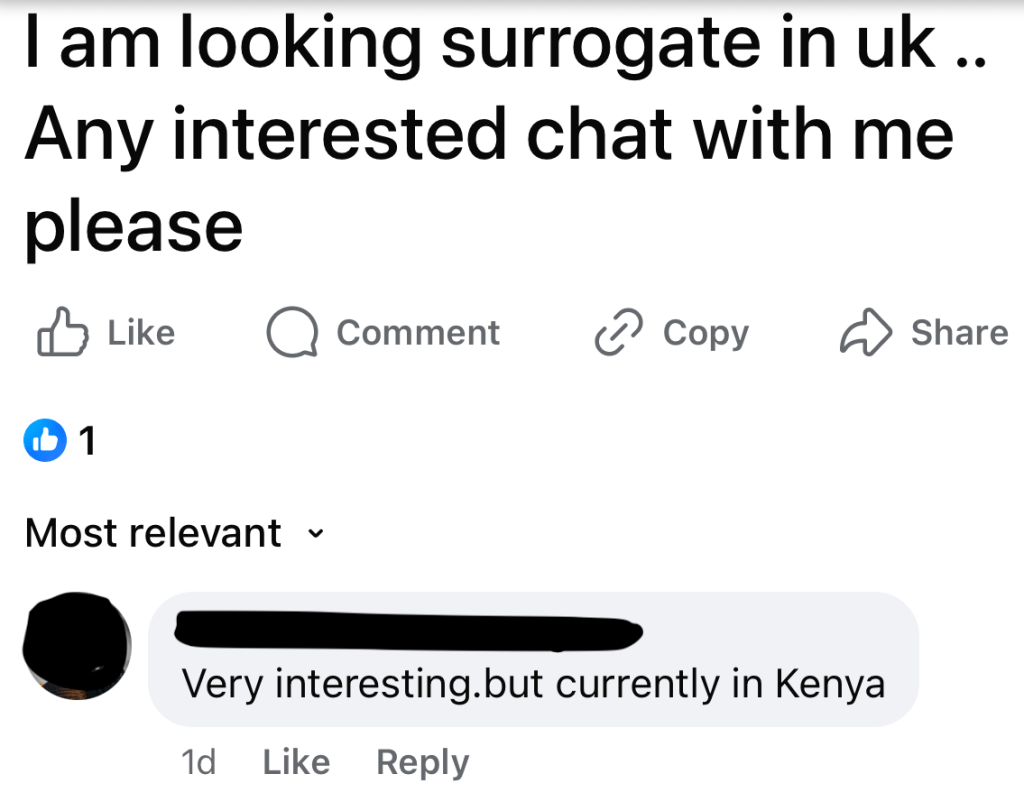
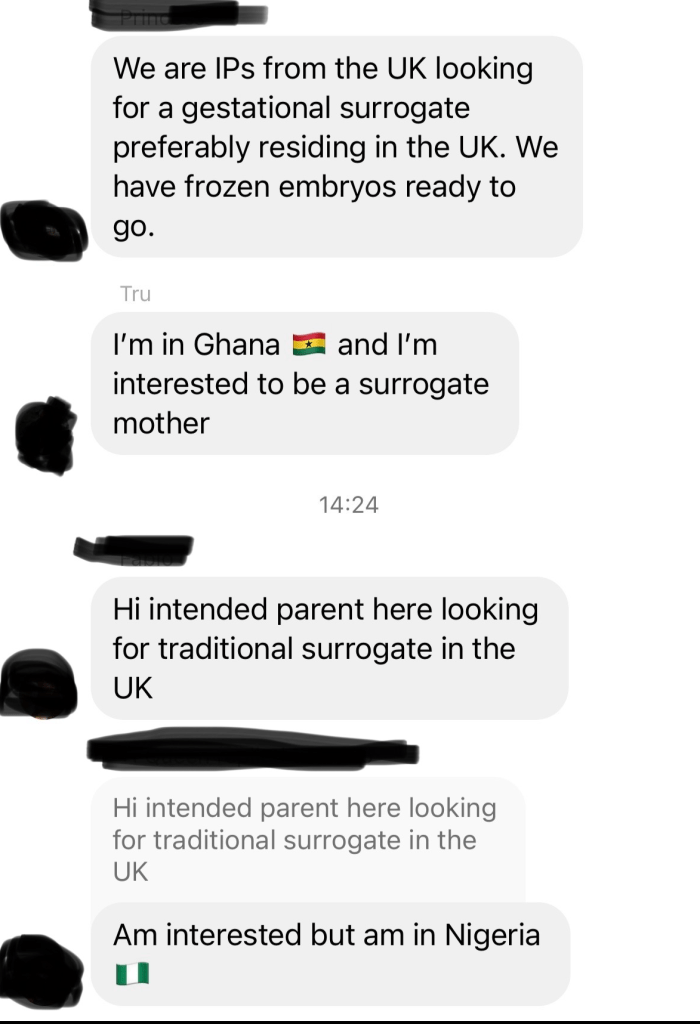
Both couples and single people can post about their desire to be parents and invite potential candidates to message them directly. Professional ‘matchmakers’ have private groups and we often see vulnerable women who are already navigating financial challenges, leap at the chance of being able to earn money this way. By making an arrangement with strangers online a woman can go through a pregnancy, birth and give up parental rights for her newborn in order to support the children she already has.

We understand why this is attractive and have seen countless replies to adverts, mostly from women in Ghana, Nigeria and South Africa, who intend to travel abroad to earn large sums that are simply not available to them at home. The possession of a passport and willingness to travel is mentioned in their replies. 

In surrogacy, women are reduced to mere vessels that meet the desires of wealthier individuals or couples, this power imbalance is plain to see from the thousands of screenshots I have seen personally and it exposes a troubling reality. Here are just a handful of examples. 

The allure of money overshadows the real emotional and physical risks involved in carrying a child for someone else. Playing on their vulnerabilities, agencies and brokers will dress this up as making someone’s dreams come true. How wonderful it must be, to be making wishes a reality for a hopeful couple who badly need your help. You have something they don’t and they are willing to pay for something that comes relatively easily to you. And by doing this lovely, selfless act, you can support your family and even work your way out of poverty.

It’s a harmless win-win for all! But the agencies brokering deals never mention the risks.

I was reminded recently of how it took decades for warnings to be attached to cigarette packets and tobacco companies were marking their own homework as they provided the ‘research‘. (The predictable outcome of these ‘studies’ resulted in more sales and profit for Big Tobacco as the risks were hidden so smokers thought they were safe to carry on.) 

Facebook groups also foster personal narratives that create a false sense of sisterhood (more on this soon) that also downplay the real dangers. The idealised version of surrogacy minimises the significant risks and the transactional nature of these arrangements reinforces this power dynamic and rather than challenging them, these online communities allow surrogacy to fester and grow, unchecked. 

We must remain vigilant against those that seek to commodify women’s bodies for profit and challenge the predatory nature of these exploitative groups. Instead of arguing for surrogacy as a reproductive right, that it is an act of generosity made possible with bodily autonomy, we should say no to it all, so vulnerable women do not take risks with her own lives, their own fertility and their own wellbeing for true empowerment without the biased influence.

Handmaid’s Tale, Chanel 4 – Season 6
(The irony of this image is not lost on me.)

Words from a Surrogate Mother – Part 4: Clara*

My name is Clara* and I am from Argentina. I have two daughters who are studying at a university in Argentina. Since 2023, I have been fighting to regain my place in my son’s life, with the help of my solicitor. This is my story.

In 2022, a very close friend of mine, whom I will call ‘G’, whom I met in 2007 when I was studying English, called me. He works in Europe and lives with his partner. They are both very wealthy.

At the time, I had recently separated, lost a child a few years earlier, and was not feeling well. During our conversation, G asked me to become the mother of his child. He said that the three of us would form a family. I was happy to help them become parents, and to become a mother again myself. I accepted this wonderful project. He mentioned the possibility of marrying me to make it easier for them to obtain papers in France. We would be a family of three in Europe. I would live on one floor of their large house and they would live on the other; we would raise the child together.

I know it may sound strange, but it felt strange to me at first too. I won’t lie — I didn’t want to upset him. I thought to myself, ‘Well, the world is changing so much that I’m going to become a mother this way.’ They brought me to France on a tourist visa. As I was in the early stages of menopause, they arranged for in vitro fertilisation in Spain using my friend’s partner’s sperm and donor eggs. The doctor suggested a donor with dark skin, like mine. However, ‘G’ insisted on a donor with fair skin and blue eyes. I refused.

It was a high-risk pregnancy: I was 41 years old at the time and had been diagnosed with high blood pressure and hypothyroidism. During the pregnancy, I had to go to hospital four times.

From the outset of my pregnancy, I found it extremely challenging to coexist with them. They argued a lot and started behaving very coldly towards me, as if it were a job. Gradually, the idea of a happy family life together disappeared. They decided that I should live in the neighbouring town and that I would only see the baby at weekends after he was born. G took my passport, but fortunately returned it to me four months later. I no longer recognised him; he had become a completely different person.

However, I thought I had to carry on since, after all, they were the parents and I was the mother, and we were going to start a family. I told myself that I had to put up with things, which unfortunately only got worse.

 The delivery was difficult and a caesarean section had to be performed. When the child was born, G presented himself to the hospital staff as my partner. They prevented me from holding my son, saying that I was tired. They told the nursing staff that I couldn’t breastfeed him because I was going back to work. That wasn’t true. They forced me to express milk. I agreed because I thought that if the baby became too dependent on me, it would cause him distress later on. There was also the €300 they sent every month for my daughters. I had no job and no connections. I didn’t speak French yet either. I had no money. They paid all my expenses, but my visa had expired, so I couldn’t go out without being very discreet. I couldn’t ask for help, and I had to keep my word.

When I dared to protest, the tension between us increased. They made me write a curriculum vitae and told me that they could no longer support me. I had not yet recovered from my caesarean section, so I asked them for a little more time as I was still finding it very difficult to walk. However, without consulting me, they organised my departure to Spain, where I knew nobody except a vague Facebook contact in Murcia. It took five car changes via BlaBlaCar and a bus journey to get there — a distance of 1,500 km. ‘G’ accompanied me to the bus in Barcelona to Murcia, then flew back immediately.

The person I stayed with helped me and put me in touch with a solicitor. By leaving my son like that, I risked being accused of child abandonment. I called ‘G’, begging him to let me return to France. I naively told him that I risked being prosecuted for child abandonment. I then learned that they had immediately filed a complaint against me for child abandonment.

While in Spain, I was put in touch with solicitors Ambroselli and Montesinos. They organised my repatriation to France and have supported me in all my efforts, including with paperwork, work and legal action to regain custody of my son.

Thanks to their efforts, I can now see my son for two hours every fortnight under social services supervision. However, for me, this is only a first step: I hope to be reunited with my son, who is now two years old, one day.

This speech was read by Clara* at FiLiA in Brighton on 11th October 2025. Clara* has used a pseudonym due to ongoing legal action.

Words from a Surrogate Mother – Part 3: Julie*

By 2019, I had been dreaming of having a child for a long time. This desire was deep and long-standing, but I lacked the financial means to raise a child alone. It was essential to me that the future child should know their origins and never be cut off from me. As an LGBTI+ activist who cares deeply about the cause of the oppressed, I also wanted this project to align with my political beliefs. Ethical, altruistic or humanitarian surrogacy, as it is presented and ‘sold’ today, seemed to me to be the perfect solution: it would fulfil my desire for motherhood, allow a male couple to become parents, and right an injustice. At the time, I believed that the ban on surrogacy (and assisted reproductive technology) in France was unjust.

In my search for ‘intended parents’ — in other words, commissioning parents — I was contacted by people from all countries and of all sexual orientations. I systematically refused all offers of remuneration, including those from abroad and from heterosexual couples. I would never have accepted the child having any mother other than me. We envisaged ‘traditional’ and ‘artisanal’ surrogacy without the involvement of clinics, agencies or excessive costs, apart from the initial medical tests. We agreed on homemade artificial insemination, and I insisted on registering the child with the civil authorities. I refused to give birth anonymously, as I did not want my baby to have a start in life marked by abandonment. The agreement was clear: they would raise the child in their home, and I would remain close to them. The child was always to know me and consider me a member of his family. It was an underground surrogacy arrangement which, at the time, I considered to be a ‘solidarity project’ operating on the fringes of the law. There was no written contract, only a verbal agreement, a ‘contract of trust’.

The pregnancy was much more difficult than I had imagined. I went through it all alone, with no support from the couple, my family or my friends. During the last month, they began to put pressure on me by imposing their concerns and medical choices. On the day of the birth, I realised that, in their eyes, I had never had any human dignity or maternal role. I was nothing more than a body responsible for ‘delivering’ the baby. They wanted to watch the birth from the front, despite the fact that I had no intimate relationship with any of them. The biological father preferred a caesarean section to the use of a vacuum extractor. Fortunately, the obstetrician did not listen to him. He insisted that the baby be placed in the nursery for the first night and that my stay in the maternity ward be shortened, despite my repeated objections. In the delivery room, a paediatric nurse, unaware of our surrogacy plans, said, “Don’t try to separate the mother and child.” She understood better than I did what was at stake. My stay was so difficult that the staff thought I was a battered woman. They sent me a psychologist and promised me postnatal care, but ultimately, nothing was done.

I had given my word, and when I left the maternity ward, I entrusted my baby to them. I couldn’t afford to raise him, and I believed that they would keep their promise just as I had kept mine. I never asked for any money; in fact, I gave them the social security benefits I received so that the child would have everything he needed.

Very quickly, however, the initial promises evaporated. They organised a birth party without telling or inviting me. To their relatives, they maintained the pretence that they had conceived the baby alone. The regular visits they had promised me during the first year became rare and sporadic. News and photos were slow in coming. Then, in 2022, I discovered that they were planning to move to the other side of France. Whenever the local social services intervened, they moved again. The stability that I had hoped the child would have – and which had motivated my choice of them – was not forthcoming. They also hid information about the child’s health from me. I learned from a doctor that my son had been diagnosed with autism six months earlier and that they had portrayed me as absent and unstable.

Finally, they settled in the Gard region, where social services stopped investigating. Three months later, the biological father died of aggressive cancer at the age of 37. Legally, I remained the sole holder of parental authority and was entitled to regain custody of my son, as the second commissioning couple had no biological or legal connection to him. I had resisted the pressure they had put on me to give up my rights or agree to adoption.

Naively, and in the interests of the child, I suggested to the stepfather that we arrange shared custody. However, he told me that he wanted to return to the Paris region, so I moved back there and rented a one-bedroom flat for my son. Meanwhile, he was initiating several legal proceedings against me, including temporary and long-term placement, total and exclusive transfer of my parental rights and custody, and even child maintenance. The judges granted all his requests.

The second commissioning person, who is legally nothing to my son, refused to return the family record book to me, with the approval of the magistrates. The public prosecutor in Nîmes described me as nothing more than a ‘procreator’. Social services were extremely accommodating, refusing to treat me as a parent for a year and explaining that they were there to ‘support the gentleman in his parenting’. The Departmental Child Welfare Services (ASE) even asked the Children’s Judge to remove my visiting and accommodation rights, which were already extremely limited, and this was ordered. Whenever this man prevented a meeting, phone call or video call between me and my son, social services covered for him.

To top it all off, the stepfather remarried another man, becoming my son’s ‘second stepfather’. This man obtained parental rights. Now, social services and magistrates are asking me to recognise this second stepfather as my child’s ‘father’. Both my son’s genetic father and my own family have been removed from his life.

Although the judge ordered visitation rights, I was unable to see my child from 31 July 2023 to 11 May 2024 – almost ten months in total. I received no updates and was reprimanded when I dared to ask for any. Social services cited being overloaded or the fact that I no longer had parental rights. Even the juvenile court judge acknowledged off the record that this should not have happened.

A complaint for incitement to child abandonment was filed against them in the Alpes de Haute Provence. All parties recognised the surrogacy, including social services and the surviving stepfather. In court, he openly admitted to this illegal surrogacy, knowing that he would not be punished, but rather that it would allow him to obtain exclusive rights and full custody of the child. The penalty in France is derisory: a €7,500 fine. If the sponsors knew this, none of them would pay for surrogacy abroad. Women’s bodies are being sold in France. Despite the evidence and confessions, the public prosecutor in Digne-les-Bains dismissed the child abandonment complaint. No judge wanted to investigate or simply apply the law. I appealed to the Attorney General in Aix-en-Provence, but he dismissed the case too.

I have now been fighting social services and judges for two years, and I am due to appear in court again on 9 October. I am fighting to be recognised as a mother and for my son to recognise me and be reunited with his maternal family. After eight months with no visiting rights, followed by supervised and semi-supervised visits where we had to ‘meet’ like strangers under the watchful eye of social services, I finally regained my visiting and accommodation rights. However, I still haven’t regained my parental rights or any prospect of custody. Social services keep telling me that their role is to ensure that the child has his father, as if the father were the child in need of protection.

For each visit and hearing, I travel 1,500 km. It requires a huge time, energy and financial commitment. Currently, I have custody of my son for half of the school holidays at my home and one and a half days per month during the school year, but I have to spend these periods in the Gard region. Needless to say, the stepfather has never moved to be closer, which makes shared custody impossible.

I had hoped this story would be one of friendship, solidarity and justice. Instead, it has become a tragedy; the biggest mistake and source of shame in my life. The state has stolen my son, as well as my dignity as a woman and a mother. Even today, I am not recognised as a parent. At school, at the doctor’s, with insurance companies or solicitors, I am nobody. I am fighting so that one day my son will truly be part of his maternal family, and so that he can forgive me — perhaps even love me. I am fighting so that no other woman will be treated as I was, and so that no other child will be torn away from their mother and maternal family. No one should have to go through what I am going through.

This speech was read by Julie* at FiLiA in Brighton on 11th October 2025. Julie* has used a pseudonym due to ongoing legal action.

Words from a Surrogate Mother – Part 2: Christian

Thank you for having me here to speak and share my story. I was first matched with a couple who were referred to as ‘VIP’ Intended Parents by a surrogacy agency I had approached. 

My children are my world and I cannot imagine a life without them. I had love in my heart and truly wanted to help. I believed I was going to help them complete their family but I was lied to and betrayed in the worst way possible. 

I was told that they already had a child, but as they lived in a country where there was a one child policy it was not possible for them to achieve their dream of having a bigger family. As it took time for them to settle in America the commissioning mother grew older and was then unable to become pregnant. Even this was a lie as she was pregnant by the time I conceived. I was told of their plans to have another surrogate mother so we could be ‘sister surrogates’. Like one big happy family on a fun ‘journey’ together but I had no idea how deceived I would be.

I signed a contract with a well known agency, agreeing to have an egg donor surrogacy pregnancy. I was not informed about the risks  nor was it explained to me that the child was in fact not ‘intended’ for this couple but for a wealthy businessman in England, where I later travelled to for the court case. 

Agencies are supposed to carry out background checks. If background checks were done at all they failed to keep me and the future child safe. It was not him I was having a baby for. I still feel violated as a woman being made to carry a child for an unknown male through deception. The ‘intended parents’ were frauds, bad actors…employed by this stranger who invaded my body. He was a father with several children, divorced from his wife after his affair and he lived in another country where there was no one child policy. I would never have agreed to this had I known the truth.

I was motivated to help others but I was also hoping to earn money to help pay legal fees as my husband was in a custody battle for his children. The ‘compensation’ from the surrogacy was going to go towards the legal bills. It felt like a mutually beneficial agreement where I was helping them complete their family and they would help me keep mine together. 

It was much later that I discovered that I have something called Toxic Empathy which is where I will help others to my own detriment. When it came to the money, I gave it all away. I could not keep a dollar of it. It was dirty and having it in my pocket, in my bank account, sickened me. 

Physically, I experienced sub chronic haemorrhaging due to the shots and had to receive weekly blood transfusions for two months before giving birth.

I was induced at the end because of preeclampsia. The baby and I were in distress, so they performed an emergency C-section. I believe it took a toll on both of us. Preeclampsia is a frequent complication with IVF surrogacy pregnancies and leads to an immediate C-section to save the mother.

I was vulnerable and no one stood up for me and in the end I wasn’t able to fight any more than I did. I didn’t give my consent to the adoption – it became an adoption as conditions for it to be a parental order in surrogacy were breached – but still my parental rights were removed. I wrote to the judge begging to have the child with us, to be raised in my family. I was reprimanded by my UK lawyer for this, like a naughty girl who won’t behave.

The court case was complicated, I had legal teams in the USA and the UK but neither of them represented my wishes or fought for my parental rights. I was not treated as a human being and it was deeply inconvenient for them and the court system that I had a mind of my own and wanted to keep the baby. 

My UK lawyers even tried to persuade me to give up my parental rights and upon my return to the USA my lawyers suggested I do it all over again! I was shocked that they could even say this out loud but I suspect they were trying to secure a new contract with an NDA clause to prevent me from speaking. But here I am today. Speaking to you all. 

I was told I had to enter mediation and I met the genetic father. He showered my family with extravagant gifts, designer scarves, a brand new iphone for my husband and ipads for my children. He had reconciled with his ex- wife and she was pregnant. 

In the court I was treated like a suspect for a crime. I don’t believe that my representatives or the court system operated in my best interests or in the best interest of the child at all. I don’t even know if the child knows he was born through surrogacy. 

He was referred to as a ‘project’ by the genetic father, like it was all a social experiment to see if it could be done, if the deception would be successful, if he could get away with it. I had to leave the UK earlier than planned as I had to get away. 

A mother bonds with the baby in utero and surrogacy teaches each of us to deny that natural bond. Surrogacy disrespects women with the dehumanising language and the monetisation of their bodies. Even in the contract stage, before the ink was dry, I was asked by the  fraudulent ‘intended’ parents if I would do this again like a baby making robot. I was not seen as a human being.

Surrogacy is ugly, the surrogate mothers have good intentions and people take advantage. I did my research and joined a well established agency that pride themselves as a “ gold standard agency who deliver a premium service”.

The service is pregnancy, the child is the product. But the child I gave birth to is 6 years old now and he is a person, not a project.

Children born through surrogacy arrangements are innocent of all this. They do not ask for it and they have no voice to ask to stay with their mothers. I do not have contact with the child and as he doesn’t have my DNA, as a secret inside of him, even a DNA test wouldn’t reveal his true origins. He can find his genetic mother, if he is lucky, but he cannot find me, his birth mother. 

I don’t even know if he has been told he was born by surrogacy. The ex-wife of the genetic father may pretend that she is his mother. 

Science has no place in the family and I deeply regret agreeing to use my body in this way. I was once a strong supporter of surrogacy, as an empowering act women do to support and help others. I am now empowered by this movement, to ban surrogacy everywhere.

This speech was read by Christian at FiLiA in Brighton on 11th October 2025. 

Words from a Surrogate Mother – Part 1: Marie Anne

My name is Marie-Anne Isabelle and the surrogacy experience that I endured here in this country nearly killed me. My mission now is to ensure that nobody goes through what I did. I have made it my cause to expose this barbaric practice for what it is and to enact change. I am not looking for glory or sympathy I just want change.  

People hear about how wonderful surrogacy is, how it’s a beautiful gift and a positive experience. Then, you hear about the “terrible” surrogate who dares to ask for her child back.  It’s an all-too-common depiction in our modern fairy tale world.

I believed that fairy tale when I agreed to help a family member by carrying her child.  At the time, I was happy to help because I loved her and did not want or need to be paid.  However, I made it clear that the child would be conceived using her egg and that I must be allowed to see and have contact with the child I would give birth to. That was the condition I would only do this under, if I could have regular contact with the child, as I could not live without seeing a child I would give birth to. 

I agreed to become a surrogate mother for my cousin. She was more like a sister to me.  She had been a significant presence in my life. We were a vital part of each other’s lives. I knew about her cancer. In 2009 she told me that she had created embryos and that she was researching surrogacy. 

One day, she came to my house with her sister, who is also my cousin and asked if I could help her. I told her that I would only help if she let me see the child. She looked me in the eye and said, “Absolutely. There’s trust.” We’re family, you know? Not for a minute did I think I’d actually need to get a lawyer and write a contract.

I think when she asked me, she knew I had no choice but to say yes. I think she exploited our relationship. As further information came out afterwards, it appeared that they couldn’t go ahead with a surrogacy abroad as it was deemed too expensive, so they were looking for a cheaper alternative. They kind of saw me as “Oh, she’ll do it for free.” A free and cheap option.

I was told there is trust. “You will be the child’s godmother.”  Those words would later come back to haunt me.  I don’t believe she knows what trust means. She made all sorts of promises to brainwash and coerce me into helping her.

It was a gestational surrogacy. They used IVF with their own biological material. I remember lots of injections and visits to the clinic for very obtrusive physical examinations. It was a very procedural process, and it was quite challenging, both emotionally and physically, to go through.  I’d had two normal, non-assisted pregnancies of my own and this pregnancy was nothing like those. This overmedication was purely to help these two people. 

The experience was bad enough. Having somebody else try to dictate what medical procedures you should endure, how you should give birth, and what you should eat was awful.  The list goes on. This affected me from the beginning of my pregnancy, yet there is still no specialized support for women going through surrogate pregnancies here in the UK.

In 2014, at the time of delivery, I made it clear that the commissioning father wouldn’t be present; it would just be her, me, and my partner. Everything went smoothly, and I felt in control. The hospital saw me as the mother. So, my wishes were taken into account; in how I wanted to do things. However, they wanted me to have an elective C-section. I refused, and my midwife backed me up by stating that C sections were not good practice. If someone doesn’t need one, they shouldn’t have one. They tried to force me and put pressure on me, saying, “Oh, it’d be better for you.”

I remember there being some confusion at the hospital. Even though the hospital had been told that it was a surrogacy, social services became involved. I thought, “This is awful. I’m trying to have a baby, and now I’ve got suspicious social services interviewing me.

The father came in after the birth because he wanted to have skin to skin contact. They had the baby. They were happy. They didn’t need me anymore so they told me to go home. However, the hospital staff did not agree. They wanted to see me walk out with the baby, carrying it according to their policy. I remember having to carry the car seat with the baby in it through the hospital in full view of the medical staff. Then, we had to do this strange exchange where I handed over the child in the hospital car park because, legally, the hospital was no longer responsible for the child once it was outside. 

After the birth, I was presented with all sorts of legal documents that I was forced to sign. The timing was awful, too, right when I was trying to recover from the birth. Imagine training your body and mind for nine months to believe that you are not the mother of the child you are giving birth to. Every surrogate woman has to do that. Then, after doing that, you are presented with a document stating that you are the mother, and you are forced to sign it. I was also threatened with financial and legal consequences if I didn’t sign it.  This is the dark side of surrogacy in the UK that nobody hears about because most women are given gag orders to prevent them from talking about it.

No payment was made.  I was only compensated for time off work. I remember them buying me maternity clothes and reimbursing me for transportation to the clinic. They wanted to pay for food, but I politely declined. I didn’t want to feel controlled by having someone tell me what to eat. I remember my dear cousin saying, “We’d like to pay for a kitchen for you,” and I said, “No, this is me helping you I am not doing this to get anything back in return.  For me to receive gifts would feel like I was being paid for a service.” I said no.

The court case started in 2014 and lasted two years. I didn’t start the court case. It was initiated by the commissioning parents because they wanted a parental order. A parental order legally transfers parental responsibility from the surrogate to the intended parents and ends the surrogate’s rights.

I had no idea about any of this. I didn’t even know there was going to be a court case. I just thought I would hand the child over and be done with it. None of this was made clear to me beforehand. Nobody told me. I gave birth, and suddenly, all of this legal process was forced upon me. I refused to sign because they reneged on their promise of allowing me contact and everything went downhill from there.

They attempted to obtain my consent against my will at the court, exploiting my mental health, which was irreparably damaged as a result of my experience. They tried to prove that I was incapable of giving consent.  However, through grit and determination—including psychiatric assessments proving I was capable of giving consent—I was permitted to remain involved in the court case and my consent was needed much to their dismay. Still, they continually tried to shut me out. Children’s Services even tried to use the case of a deceased surrogate mother. They said, “We can just use that case where someone died and pretend that’s happened here.” It was just appalling. It was made clear to me that the only way I had the best chance of having any contact was to agree to the parental order so in the end, I signed it to try and have contact with the child I gave birth to as I was promised. I have never seen the child to this day.

She was born in 2014. I haven’t seen her since I gave birth to her. 

I was promised on multiple occasions during the court case that I would see her, but each time, the appointment was cancelled the day before. They were playing games with me. I believe the promises were only for the benefit of the court.

They hinted that they used me as a cheap commercial surrogate and if it hadn’t been for their legal costs they would have been granted their wish. They constantly tried to remove any trace of me from their child’s life, which is another reason why they needed my silence. I believe their behaviour stems from their resentment of me as the child’s birth mother, and that is me being generous.

I have been diagnosed with complex PTSD and underwent EMDR to alleviate some of the trauma resulting from the surrogacy. I have a deep fear of hospitals, children, and babies, which does not work well with my career in education.  The damage done to me will never be repaired.  Constant panic attacks and a fear and distrust of people serve as constant reminders. There are many days that I still wish I wasn’t here just to be rid of this painful world that did this to me. 

The impact was not only on me, but also on my children. They took on the role of parents because I wasn’t able to take care of them. This happened ten years ago, and for the first five years, my children didn’t have a mother. They were taken away from me and sent to live with their father, which was traumatic for everyone. Then, the judge, when presented with evidence, came to the conclusion that this was not helpful to anyone and returned them to my care. Over the last five years, we have come together as a family and rebuilt our relationships, but for the first five years, we were a broken family. 

In trying to help another family, they broke mine.

When did a women’s right to have a child mean that it would take away another woman’s right to have contact with a child she gave birth to? We talk about women’s rights as if they are universal but surrogacy actually means you are choosing which woman deserves more rights. That is inequality. 

If leaders and law makers care so much about women’s rights why are they continuing to erode the rights of surrogate mothers?

Change needs to happen fast. Surrogacy in any form is wrong, not safe and harmful. It needs to be banned before any more women die as they already have. Listen to our voices and do not let us be silenced any more.

This speech was read by Marie Anne at FiLiA in Brighton on 11th October 2025.

Please share your thoughts with parliament – Deadline 5th October!

The Parliamentary Office of Science and Technology (POST) is an independent service that provides impartial research, analysis, and expertise on complex science and social science issues. They share their findings with Parliament to inform policy debates and decisions. Last month POST announced a new consultation on surrogacy law reform. This follows a public consultation in 2019 from the Law Commission of England and Wales and the Scottish Law Commission, which in total has already cost £945,000.

Any individual can contribute but POST encourages submissions from researchers and experts. Whether you are in a research position, have personal experience of surrogacy or have a view on surrogacy you’d like to share, we encourage you to submit using the form and our suggested guidance. The deadline is 23.55 on 5 October 2025.

Please use this form for your submission: 

After reading the Data Privacy Data Notice you will be asked for:

  1. Your name
  2. Your job title
  3. Your email address
  4. Your institution if relevant
  5. If you are submitting as an individual or as a group – please select individual
  6. If you are a researcher the form will ask for a link to your profile

Next, the form will show this text:

Approved work: Surrogacy: current practice and proposed reforms 

What reforms have been proposed to surrogacy law, and what are the ethical, social and medical considerations?

Many stakeholders consider UK surrogacy law (Surrogacy Arrangements Act 1985) to be outdated. In 2023, the Law Commission of England and Wales/ Scottish Law Commission published a report outlining proposed reforms to surrogacy law, including a new regulatory pathway for domestic surrogacy arrangements, and new rules on payments that intended parents may make to the surrogate.    

This POSTnote will describe current surrogacy practice in the UK, and suggestions for reform. It will consider research evidence and stakeholder views on surrogacy practice in the UK and internationally. It will discuss ethical, social and medical considerations, such as access to surrogacy, and the rights of surrogates, intended parents, and children.    

We welcome information on issues relevant to the project. To contribute to this research, please follow our guidance for contributors.     

Work will commence in September 2025, with publication expected in January 2026. The form for stakeholder contributions will close at 23.55 on 5 October 2025. We are trialing using an online form to make it easier for contributors to submit information to POST. If this form is not working, please send your submission to POST@parliament.uk   

For the guidance for contributors please click here:

https://post.parliament.uk/contributing-to-post-research-as-an-expert/#heading-2

You will then be asked a short series of further questions:

8. Please briefly explain how your research expertise is relevant to the POSTnote topic.

E.g. if you teach a course, or if you’ve published a paper linked to the topic.

Your answer for this cannot exceed 500 characters. (If you are not a researcher you may want to state your interest in this topic.)

9. What are the key issues relevant to the POSTnote that you would like to make us aware of?

Your answer for this cannot exceed 1,500 characters.

Here you can share your concerns about surrogacy. You may want to mention a few points from the following list but please keep the word count in mind:

  • The UN Report from the Special Rapporteur for Violence Against Women and Girls on surrogacy, published in August. You can read the report in English and refer to the 19 recommendations. You can get a breakdown of this here.
  • Human trafficking scandals – for more on this you can refer to this blog: https://stopsurrogacynowuk.org/2025/07/30/exploitation-of-women-through-surrogacy/
  • The number of Parental Orders for surrogate-born babies has more than quadrupled in the last 12 years and commissioning parent/s living in the UK are still allowed to undertake commercial surrogacy arrangements abroad, even though commercial surrogacy is banned domestically: risking financial exploitation of women in developing countries abroad and financial exploitation of working class and lower middle class women here in the UK too,
  • Surrogacy agencies in the UK must be ‘not for profit’, although several employ large numbers of staff; one is attached to a law firm, and another has opened a commercial branch in Mexico City, where surrogate mothers are paid under £12,000 per pregnancy. (Incentives used by one British agency to encourage women to become surrogate mothers include meal box vouchers, trips to theme parks for the surrogate mother’s existing children and Apple watches.) 
  • It is not a legal requirement that a woman has had her own child/ren before undertaking a surrogate pregnancy and surrogate mothers are permitted to use their own eggs in surrogacy,
  • There is no enforceable requirement that ensures a child has an ongoing relationship with their birth mother,
  • Surrogacy does not recognise the fact that babies bond in utero with their mothers, wanting her at birth, regardless of who’s egg used in the pregnancy. Surrogacy treats women as interchangeable incubators, exploiting their poverty and putting women at risk in higher-risk pregnancies. It is profoundly unethical as a way to treat a child, who recognises their mother and wants her at birth: nobody else, 
  • The UK is an outlier in allowing any form of surrogacy to take place at all: surrogacy is much more strictly limited or completely banned in countries such as France, Germany, China, Italy, Spain, Portugal, Austria, Poland, Finland and Switzerland. Commercial surrogacy is illegal across the EU where it is defined as child trafficking. President Macron of France condemned the practice of surrogacy in May 2024, and the UN Special Rapporteur on Violence Against Women and Girls has called for UN member states to move to ban the practice entirely.

You may share our concerns regarding law reform proposals already suggested by the Law Commission here. You may want to mention some of the following points:

  • The draft Bill published in March 2023 tips the balance of power away from the surrogate mother towards the commissioning parent/s: the “certainty” lawyers and commissioning parents say they want/need only benefits them at a huge cost to working and lower middle class surrogate mothers,
  • The current Government have said they do not intend to make time to take forward changes to British surrogacy law in this parliament: why are POST spending public money on exploring this topic when that statement was made relatively recently? 
  • The draft Bill reduces the time limit the surrogate mother has to change her mind to just six weeks after birth: even if she does change her mind, she is not guaranteed custody of her child but would need to apply for a parental order for her own baby, even if she has used her own egg, 
  • The draft Bill proposes to make the commissioning couple legal parents of the child at birth, meaning the birth mother would never be recognised in law or listed on the birth certificate. This is according to the Law Commission’s preferred model,
  • The draft Bill proposes a minimum age of 21 for surrogate mothers, and just 18 for commissioning parents. There are no upper limits suggested for commissioning parents or surrogate mothers, 
  • The draft Bill does not require a surrogate mother to have previously been pregnant, given birth or completed her own family. If she has not previously been pregnant or given birth, she cannot give informed consent,
  • ‘Expenses’ would continue to be uncapped for British surrogate mothers. These potentially total thousands and this provides a real financial incentive to many women from lower socio-economic backgrounds, and disproves the myth that the UK surrogacy is genuinely ‘altruistic’. There is a categorisation proposed under reform but no upper limits. We believe the average ‘expenses’ in a British surrogacy arrangement may now significantly exceed £20,000 per pregnancy: exploiting women’s poverty in a cost of living crisis,
  • The draft Bill continues to allow people to bring babies to the UK who have been conceived and carried through commercial surrogacy abroad, despite significant, well-known problems of exploitation and coercion in the global commercial surrogacy market (see link below for the market value),
  • The draft Bill allows for open advertising to attract and recruit surrogate mothers in the UK, likely leading to an explosion in the numbers of women from lower socio-economic backgrounds agreeing to undertake the practice out of financial necessity, rather than genuine desire,
  • The draft Bill enables surrogacy agencies to become Regulated Surrogacy Organisations (RSOs) with power to determine which commissioning couple or individual can enter a so-called Surrogacy Pathway (with power to grant legal parentage without oversight of the Family Court or CAFCASS, as is the case now): this is a conflict of interest and gives power to organisations who have financial incentives and an ideological commitment to surrogacy and who are not experienced in meeting the ongoing burden of regulatory obligations. RSOs would be overseen by the HFEA, a role the HFEA have made clear they do not welcome and do not have necessary skills or expertise in to adequately supervise,
  • The Law Commission’s plans take social workers and CAFCASS out of arrangements on the new Surrogacy Pathway. The proposals remove the current practice of CAFCASS assessment for arrangements on the new Pathway, putting surrogacy on the Pathway completely at odds with UK adoption legislation and practice. 

This question also asks for relevant policy documents, or statistics that relate to the topic.

These are the links to the studies you may want to share:

  1. A 2024 study that confirms that surrogacy 3x increased risk for severe pregnancy complications – Severe Maternal and Neonatal Morbidity Among Gestational Carriers: A Cohort Study https://www.acpjournals.org/doi/10.7326/M24-0417
  2. A study published in July revealed an increased risk in new onset mental illness in surrogate mothers – New-Onset Mental Illness Among Gestational Carriers https://jamanetwork.com/journals/jamanetworkopen/fullarticle/2836835
  3. Mater Semper Certa Est? Human Rights Violations in Surrogacy Arrangements https://ojs.academicon.pl/tkppan/article/view/9178

10. Where possible, please provide links to sources for any statements you make.

You can link to:

The 2024 European Parliament’s directive on preventing and combating trafficking in human beings, including surrogacy: https://www.consilium.europa.eu/en/press/press-releases/2024/05/27/fight-against-human-trafficking-council-strengthens-rules/#:~:text=Resources-,Council%20of%20the%20EU,in%20case%20of%20aggravated%20offences. 

Surrogacy breaches the UN Convention on the Rights of the Child and many of the issues within surrogacy can be addressed by centring children and their human rights. https://www.unicef.org.uk/wp-content/uploads/2016/08/unicef-convention-rights-child-uncrc.pdf

Surrogacy is a global trade estimated to be worth approx. $201bn by 2034 https://www.gminsights.com/industry-analysis/surrogacy-market?gad_source=1&gad_campaignid=20434039883&gbraid=0AAAAACuPGhVpE62Z3S7ihCgE5Cmo9mnXe&gclid=Cj0KCQjwh5vFBhCyARIsAHBx2wxibmyT1w8HO8bFvSgXZ8Im6jRhtQGVR5dWjcjERbh97u9FoL5IFqQaAt1MEALw_wcB

11. Are there other individuals or organisations you think would be interested in contributing to this POSTnote? Please only share publicly available information.

Your answer for this cannot exceed 300 characters

If you wish, you can name:

Stop Surrogacy Now UK, Surrogacy Concern, Nordic Model Now and Object Now. International organisations include the International Coalition Against Surrogate Motherhood and Casablanca Declaration.

12. Please select which stakeholder group best represents you (or the organisation you are representing).

Please select No affiliation if submitting as an individual.

Finally:

13. Where did you find out about this opportunity to contribute to POST’s research?

Please answer how you found out about this consultation, we expect this to be via the X/Twitter accounts of Stop Surrogacy Now UK and Surrogacy Concern.

When all fields are completed within the character limit you can submit. Once submitted you can print your answers. Please let us know when you have submitted your response by emailing stopsurrogacynowuk@gmail.com.

If you would like to contact the POST team directly, their general enquiries email is: post@parliament.uk

Thank you!

Exploitation of Women through Surrogacy

Today, Wednesday 30th July, we observe World Day Against Trafficking in Persons to raise awareness about the increasing exploitation of women through surrogacy. The United Nations reports that the number of victims being trafficked globally continues to rise each year and the responses from criminal justice systems worldwide remain inadequate in addressing this rapidly evolving crime.

From 2020 to 2023, over 200,000 known victims were documented globally; however, the true numbers are believed to be significantly higher. This alarming statistic highlights the urgent need for comprehensive action against human trafficking and its often-overlooked connection to surrogacy.

When we began our campaign, it was soon clear that surrogacy was not the happy alternative to ‘family building’ seen in puff pieces from commissioning parents, soap operas and women’s magazines, and instead surrogacy and human trafficking are intrinsically linked. The scale of this exploitation can vary; it may occur in smaller, more individual cases or on a large scale.

In June 2020 a couple were discovered smuggling 13 people (adults and children) into the United States. Dubbed the ‘smugglers next door,’ the couple admitted to smuggling a girl into the country to make her their ‘surrogate’, claiming she had consented. In the same month, three individuals were arrested in Agrar, India for attempting to sell babies, further illustrating the grim realities of this global industry over a few short weeks.

Earlier this year, the Daily Mail exposed a surrogacy and egg harvesting farm in Georgia, where approximately 100 women were “treated like cattle”. The article confirms that the women  “were lured in by a job offer on Facebook, promising them a salary between 11,500 and 17,000 euros (£9,600 to £14,100) to work as surrogates for Georgian couples who could not have children.” 

A scandal of larger proportions hit the news in 2023. News reports said that 169 women from Romania, Ukraine, Moldova, Albania, Bulgaria and Georgia were trafficked to Crete for egg harvesting and surrogacy. Babies were sold for between 70,000 and 120,000 euros each.

Reports of human trafficking in surrogacy have surfaced with increasing frequency. Women are targeted by social media, moved across bordes, forced to become pregnant and made to surrender their babies to those who can well afford to pay for them. Just this month scandals broke in California, Indonesia and Vietnam and Greece, Argentina, Kenya, the Philippines, Cambodia and China have all featured in similar human trafficking news reports in recent years.

Over the last 12 months we have witnessed a significant rise in activity on social media platforms, particularly Facebook, where private surrogacy arrangements are being made ‘off the books’. While some may refer to these as ‘independent journeys’, the reality is that vulnerable women are being targeted by wealthier individuals seeking to exploit their desperation. When women respond to such posts, their consent is assumed, with little consideration given to the motivations behind their ‘choices’. Facebook has been mentioned in several surrogacy scandals but groups, private messages and online baby sales continue. 

In April, we highlighted three UK court cases that underscored the exploitation occurring within surrogacy arrangements and in April 2024, Unseen, the UK’s modern slavery line, reported on forced surrogacy in the UK for the first time. The following month, the EU issued a directive addressing the same issue, recognised surrogacy as a form for human trafficking and the report from the European Parliament which officially condemns surrogacy as sexual exploitation for surrogacy and  reproduction is unacceptable and a violation of human dignity and human rights”.  

Organisations such as the Hague Convention on Private Law formed to discuss global surrogacy regulations, their aim is to harmonise and normalise this contentious practice in legal frameworks across the world. With the focus on the child’s citizenship and parental rights for the child, little consideration is given to the women who are the mothers of these children.

Closer to home, UK agencies are working together to pressure this government to take law reform proposals forward with some interesting language surrounding this, for example, saying ‘travelling surrogates’ rather than trafficked women.

As exploitation and human trafficking in surrogacy is happening right now, somewhere in the world, stakeholders and benefactors seek to rationalise through regulation. We remind readers that there are no plans to change the current parental order system that allows British residents to go abroad and buy babies and reform proposals actively argue for this model to remain in place alongside the ‘new pathway’.

But there has been some progress recently. We welcome the extended ban on surrogacy in Italy and the new restrictions put in place in Spain, and we appreciate efforts made by the UN Special Rapporteur for Violence Against Women and Girls and eagerly anticipate her report on surrogacy due out this Autumn. 

As news reports of human trafficking continue to circulate more and more people are waking up to what surrogacy actually is.

Take action and write to your MP to reject international surrogacy. Use this template from our co-campaigners, Surrogacy Concern. It will take just a few minutes to register your concerns with law-makers.

Surrogacy: A risky Business

As a new study from Dr Velez was just published, I review this and revisit the study from 2024. In doing so I quote both studies verbatim, despite the dehumanising language.

2024 Study

Published in September 2024, Severe Maternal and Neonatal Morbidity Among Gestational Carriers: A Cohort Study looked at over 863,000 births in Ontario, Canada over a nine year period (1st April 2012 to 31st March 2021).

The study concluded that surrogacy pregnancies are 3 times the increased risk, with severe postpartum hemorrhage, severe pre-eclampsia, and postpartum sepsis given as the medical risks. This is an alarming statistic but one we have seen from previous studies and it is important to understand the approach.

Firstly, Dr Velez (et al) created a baseline by making certain deliberate omissions.

  • 405,876 pregnancies were excluded because of history of cancer, miscarriage or abortion as well as invalid insurance, high risk diagnosis and the application of Intrauterine insemination (IUI) for conception.
  • 130 twin pregnancies for surrogate mothers were excluded. This amounts to 16% of the total sample of surrogacy pregnancies (806) but only 2.3% in the unassisted conceived pregnancies. It is worth noting that had multifetal (twins or triplets, etc) pregnancies been taken into account, the risk would have been even higher. Twins are common in surrogacy as multiple embryos are implanted, “surrogate pregnancies more likely to result in twin pregnancies: 33% vs. 1%.” ( Woo et al, 2017)
  • Home births were excluded and these make up around 1% of pregnancies in Ontario – Data was gathered Better Outcomes Registry & Network (BORN) Ontario database which holds 99% of all birth records. 

Secondly, following the omissions, 3 comparison groups were created. A group with Unassisted (natural) Conception, IVF conception and ‘Gestational Carriage’ or surrogacy.

The group of surrogate mothers were not categorised further into ‘gestational’ (IVF) and ‘traditional’ (conceiving with the surrogate mother’s own eggs) and was small within this study – at only 806 of the overall group (0.09%) – but it remains the largest study of surrogate mothers in the last decade and it draws out several interesting observations.

  1. A significant number of women (290) who undertook surrogacy pregnancies had a high BMI as the study measured that 36% of surrogate mothers were obese.

“Before weighting, gestational carriers were more likely to be parous, reside in a lower-income area, and have higher rates of obesity and chronic hypertension.”

Dr Velez weighted the obesity in surrogate mothers against obesity in women who were became pregnant naturally, but did not explore why surrogate mothers are almost twice as likely to be obese, though she notes that surrogate mothers are more likely to have already given birth and live in poorer areas. The surrogate mother group also had high blood pressure which can be linked to several underlying health conditions and can be a sign of stress.

  1. Nearly 10% (8.9%) of “gestational carriers” were first time surrogate mothers. This is disturbing for two reasons. Firstly it means that of the 806 births for surrogacy, nearly 90% of women had done this before. This could be for a ‘sibling journey’ or for multiple different commissioning parents. These women were likely to be undertaking the increased risk of a surrogacy pregnancy when they have children at home to care for. Secondly, we do not know if the women who became surrogate mothers for the first time already had the experience of labour and childbirth so we cannot know if they gave informed consent. 
  1. In maternal morbidity, across the 3 groups, the study assessed the risks to be 2.3% for unassisted pregnancy, 4.3% for IVF pregnancy, and 7.8% for surrogacy. This means that surrogacy is nearly double the risk of Severe Maternal Morbidity (SMM) than that of IVF. 

A different study involving in-depth interviews of 96 surrogate mothers in the USA published in 2022 found complications or adverse effects including:

“high blood pressure during pregnancy, preeclampsia or eclampsia, gestational diabetes, hemorrhage, infection related to pregnancy, pre-term labor, hyperemesis gravidarum, anemia, ectopic pregnancy, placenta previa, placental abruption, ovarian cysts, miscarriage, postpartum depression, and high blood pressure in the postpartum period. Not all surrogate pregnancies resulted in complications or adverse effects. The most complications that one woman faced during her surrogate pregnancy, that she did not experience during her non-surrogate pregnancy or pregnancies, was seven.”

A meta analysis of similar studies over the last decade  (with smaller cohorts and different methodologies) shows that the medical risks in surrogacy pregnancies are 3 times the risk, so this supports the findings of the 2024 study.

2025 Study 

The latest study coming out of Canada looked specifically at maternal mental health. “New-Onset Mental Illness Among Gestational Carriers” published in the Journal of the American Medical Associated, an established and well regarded peer review journal, uses the same data from the 2024 cohort and Dr Velez concludes that “gestational carriers were more likely to be diagnosed with mental illness during and after pregnancy.” 

The number of pregnancies assessed initially drops from 863,017 in the 2024 study to 767,406 in the 2025 study. The additional omission is key. Women with a history of mental illness were omitted. Within these numbers, 758 eligible pregnancies were for surrogacy purposes. 178 women were surrogate mothers with a previous mental health condition and these women were initially excluded from the study but not from surrogacy. It’s important to understand that across Canada, a psychological screening of both the surrogate mother and the commissioning parents is required prior to conception. This is not a legal requirement but is considered mandatory according to the study.

(The UK model for so-called ‘altruistic’ surrogacy is broadly followed in Canada. Agencies here require a psychological assessment but suicidal thoughts or depression will not exclude women from undergoing a surrogacy pregnancy, or even several surrogacy pregnancies arranged through an established agency. ‘Independant Journeys’ – agreements made outside of the agency framework – are permitted.) 

The study suggests “that gestational carriers were more likely to be diagnosed with mental illness during and after pregnancy” as it measured that a “new-onset mental illness occurred in 236 ‘gestational carriers’.”

Remember the 2022 study of 96 surrogate mothers? This found that surrogate mothers were “significantly more likely to experience postpartum depression following the delivery of surrogate born children than their non-surrogate born children.” Given the omissions and that if you experience post natal depression you are likely to experience it again in any future pregnancies, we are glad that some further analysis was done. 

Dr Velez reintroduced the group of 178 surrogate mothers (19%) with a prior mental health condition..

“In the current study, 19.0% of gestational carriers had a documented diagnosis of mental illness before pregnancy. Among these, 10.7% had a prior history of mental illness diagnosed through an emergency department encounter or a hospitalization, which might have precluded them from being an eligible gestational carrier.”

But it didn’t preclude them. Importantly, a prior known mental health condition involving either an emergency assessment or a stay in hospital did not prevent 19 women proceeding under the psychological assessment and becoming pregnant for others. 

So if you didn’t have a mental health condition, a surrogacy pregnancy could mean you go on to develop one and if you did have a mental health issue before, you could still be cleared for surrogacy, despite the regulation in place which applies the ‘altruistic’ only model.  

The 2025 study appeared in The Guardian newspaper two days ago, quoting Dr Velez who said:

“Our findings underscore the importance of adequate screening and counselling of potential gestational carriers before pregnancy about the possibility of a new-onset mental illness, or exacerbation of a prior mental illness during or after pregnancy.”

But with medical risks measured at 3 times the risk and the increased likelihood of a new mental health issue occurring during or after a surrogacy pregnancy (43% compared to 29% in pregnancy not for surrogacy), is this not the time to consider the dangers for women and ban surrogacy, instead of calling for ‘adequate screening’? 

Surrogacy can never be ‘safe’ nor can it ever be ethical. It involves taking a newborn from their mother at birth. The study also found that:

“The findings of additional analysis suggest that some gestational carriers may experience grief from relinquishing the newborn, such as that described after adoption or removal of the child into foster care—something that needs detailed study.”

I welcome further research in surrogacy but don’t we already know enough to say, let’s just not do this anymore? We could just not put women through the physical and mental health risks to make other adults happy.

Do be quiet!

Last month we received a ‘cease and desist’ letter from a law firm on behalf of their clients, My Surrogacy Journey.

This UK agency wanted us to stop talking about them and the law firm representing them issued a SLAPP – a Strategic Legislation Public Participation. Frowned on by the Solicitors Regulatory Authority, a SLAPP aims to intimidate and silence opponents. It sends a message to recipients that speaking further may land them in legal trouble. 

Since I have not done anything illegal I will continue to write about this agency and their connected businesses such as their new clinic, their foundation, their agency in Mexico and the Modern Family Show which is paused as they await the birth of their third child, born to a woman in Mexico this time. 

But I am not at all surprised that an agency operating under the UK model of so-called ‘altruistic’ surrogacy whilst running a commercial operation in Mexico, might not appreciate my words in this article, which inspired the letter. No, I am not surprised at all as we have seen the active silencing of women who speak up about surrogacy before. 

Several surrogate mothers who were signed up with Surrogacy UK have told me they were removed from groups after raising doubts, concerns or for expressing feelings doutb, reluctance or regret. As this doesn’t align with their narrative they were ejected and blocked. These women can no longer access the social networks designed to support them, they have no one to talk to outside of their own friendships and family, and as surrogacy is presented as a unique and alternative way to have a family, many do not understand the intricate and complex emotions that come to a head in a surrogacy pregnancy and postpartum.

We supported a surrogate mother through part of her legal ordeal which was thankfully successful in ‘setting aside’ the parental order she signed under judicial encouragement. The judgment handed down prevents her from speaking publicly and she is not the first, nor will she be the last. 

Another surrogate mother has been threatened more subtly, by calling her character and reputation into question and should she continue to speak out her credibility will be undermined. Others may want to speak but they don’t have the freedom to discuss their experiences and this is not a new experience. Surrogate mother’s in the USA fear being sued if they speak out. A 2015 UK court case saw a surrogate mother banned from speaking to the press after a judge’s decision saw her baby  placed into the care of the genetic father, and his partner, against her wishes:

“The court order preventing the mother from speaking out about the decision, which has been reported on the front page of today’s Daily Mail, has been described as “totally disproportionate”.

Similar gagging orders are issued in other countries that apply the so-called ‘altruistic’ surrogacy model. A 2017 case in Canada saw a rapid agreement following an online meeting and a contract that prevented her from speaking out:

“the couple offered her $500 to forego legal advice in order to speed things up….The document was also written to make the arrangement appear completely altruistic on the part of the surrogate, even though she would be paid a set amount of money whether or not she actually incurred expenses.”

Alison Motluk writes “But what bothered me most was that she was strictly forbidden from revealing any of it. The contract contained a gag order.”

Alison Motluk has written on the regularity of surrogate mothers being ‘gagged’ and shares lines from contracts detailing where surrogate mothers cannot share anything about their ‘journey’.

In some countries the threats go beyond a legal letter or a court ruling. Some surrogate mothers are threatened with the loss of their lives. An international contact of ours who wishes to remain anonymous told us:

“Mothers are afraid to speak because agencies are very powerful and there are countries where it is very easy to make a woman disappear, because their lives are worth nothing. Earlier this year a 25 year old woman acting as a surrogate mother bled to death in an illegal clinic. This happened in a country where surrogacy is legal. The mafia are threatening the family to keep silent, forcing them to delete social media posts and stay silent after the death of their loved one.” 

We are often asked, why don’t these women say something, but is it any wonder as to why you don’t hear their stories when legal rulings, contracts, agencies and legal threats prevent them from sharing what happened to them?

We are one of only a handful of organisations in the UK representing the other side of surrogacy. We are not funded, we do not charge for membership and we do not receive donations. We do not have money to pay lawyers but we do have is an abundance of time to listen to surrogate mothers. 

I invite all surrogate mothers with regret, doubts or concerns, to reach out to us by email (or DM us on Twitter/X) to share your stories with us in confidence. We understand why you have not been unable to speak and we are here to listen to you and what your experience of surrogacy has been.

And the cease and desist letter? Well, when someone wants you to stop talking about them as you’re making them look bad, that’s reason enough to carry on and perhaps shout even louder.

Law reform will not proceed!

The Times confirmed today that this government will not proceed with law reform of the 1985 Surrogacy Act, as is proposed. We are thrilled to hear this news!

Reform proposals were first jointly shared in the 2019 public consultation from the Law Commission of England and Wales, and the Scottish Law Commission. It is why this campaign formed as we stand against surrogacy because of the harm it brings to women and children.

The legal model for surrogacy in the UK is meant to be based on ‘altruistic’ surrogacy only, but ‘reasonable expenses’ are paid like a monthly salary and the total fee averages between £16,000-20,000. These are numbers from the surrogacy agencies themselves. UK agency, Brilliant Beginnings states “In the UK, which is often described as having an ‘altruistic’ surrogacy framework, surrogates typically receive £12,000 to £35,000 as expenses (which is less than in the USA, where surrogacy is commercialised and surrogates typically receive compensation of $40,000 to $90,000).”

The number of people commissioning a child in England and Wales has quadrupled. A study from Dr Kirsty Horsey, Law Professor at Loughborough University (previously a Senior research Associate at London Women’s Clinic) and My Surrogacy Journey shows that Parental Orders – where a mother transfers her parental rights to the commissioning parents or parent – rose from 117 in 2011 to 413 in 2020.

Now, approximately 500 applications for parental order go through the courts each year, and roughly half of these PO applications are for babies born abroad.

Commissioning couples or individuals living in the UK are allowed to undertake commercial surrogacy arrangements abroad and bring a child back to this country, despite commercial surrogacy being illegal here. UK Adoption laws prevent international adoption from countries due to safeguarding and exploitation risks, such as Nigeria, Cambodia, Guatemala, Nepal, Haiti, and Ethiopia – but there is no such list for surrogacy. Minimal safeguards are applied and we are aware of several examples where a convicted child sex offender obtains a child through a commercial surrogacy arrangement abroad and others who planned to obtain a child through surrogacy for the purposes of abuse.

Whilst the Law Commissions jointly acknowledge that international surrogacy “can bring a greater risk of exploitation of women and children” there were no proposed changes to the ‘old pathway’ which would continue to allow babies to be removed from their mothers abroad and brought into this country. It is worth remembering that children who are conceived and carried this way will likely never see their mothers again.

In fact, there is a section in reform that argues or Parental Orders to remain and operate alongside the ‘new pathway’ as “some surrogacy teams may still choose to make agreements outside of the new pathway. Closing off the parental order process to them would mean that a decision by the court about the legal parental status …would be unavailable.”

As a reminder, the ‘new pathway’ under reform would see:

  • The introduction of pre birth orders – so commissioning parents would secure parental rights a birth, as practiced in countries that apply the commercial model.
  • Lower age limits of 18 years for commissioning parents and just 21 years old for surrogate mothers – there were no proposed limits for the upper age for either of the adult parties and there were no limits for the number of pregnancies a woman could have for others.
  •  There is no requirement for a woman to have previously given birth or completed her own family before embarking on a pregnancy for others and proposals would to continue to use surrogate mothers to have a baby for others, conceiving with her own egg – meaning at the point of handover the child is removed from their genetic mother who is also their birth mother.

(For more on what the proposals mean, read this blog or watch the video.)

So what next for us, with this news today? We are hugely grateful to the Government for this step and, with Surrogacy Concern Nordic Model Now, Object Now and our co-campaigners in Scotland, Ireland, America and internationally (Casablanca Declaration and the International Coalition Against Surrogate Motherhood), will continue to fight for a ban on this controversial, harmful practice here and around the world.

Finally, we would like to thank everyone who sent a letter to their MP using the template from Surrogacy Concern, we truly appreciate your support. Every single email sent, every conversation, every tweet or post counts. We could not do this without your support.

Surrogacy is an inherently risky and exploitative practice which needs to end.

So let’s begin.