Tag Archives: women

Words from a Midwife: Part One – Guest Post from Anonymous

Following the Royal College of Midwives webinar on Surrogacy last week, a Midwife got in touch with us to share her experience and her concerns about what the promotion of surrogacy in midwifery means for her. To protect her identity we share the following without sharing her name.

As an RCM member for the past 28 years, I’ve always felt my union has had my best interests at heart. I’ve felt confident of their support and on the very few occasions I’ve needed their assistance, they haven’t let me down. But now I feel things may be starting to change, and I’m deeply concerned.

I attended their webinar last week which was advertised online as a discussion on surrogacy and how we, as midwives can support parents of babies born of surrogate mothers. The subject of surrogacy troubles me but the content shocked me.

Since I was a teenager at the start of my training, it is embedded into the heart of what it is to be a Midwife and that is to be ‘with mother’. Our role is to be her closest carer and her biggest advocate – yet here we were being told in this new way, she is not a mother, but a ‘carrier of a baby’. A baby who is to be given away at birth, and not only that, our care as midwives should be transferred over to these ‘intended parents’. 

It was very clear as soon as the webinar started that this was not a discussion or a debate on surrogacy, but well thought-out propaganda on the wonders of surrogacy, with stories from a surrogate mother and two parents of children born through surrogacy. 

There are no official stats on how many children are born through surrogacy in the UK. There is no disclosure on prospective parents and we know just by reading the news, that people from the UK are traveling abroad to buy babies. Although women in the UK are not paid for their ‘reproductive service’ there are incentives and ‘independant journeys’ (private arrangements) are being made online. If you’re lucky you get an Apple Watch and Ann Summers vouchers among other goodies from an agency. When someone in the chat questioned the ethics of this, they were told by the owners (two men) that it’s nice for the surrogate to have the Ann Summers vouchers to spice things up with her partner as she can’t have penetrative sex when pregnant. Oh how we laughed, does anyone want to tell them? Questions that criticised this controversial practice largely went unanswered.

The surrogate mother and CEO of another agency, Surrogacy UK, told her story of carrying 5 babies for other people, some her own eggs, some not and once during COVID. She was asked if she was concerned for her own health and well-being due to the risks of the amount of IVF pregnancies she’d put her body through. She said she made fully informed decisions by speaking to her obstetrician and was aware of the risks and happy to take them. It’s worth noting that the long term implications cannot be known but that multiple cycles of IVF have been shown to increase the risk of ovarian and uterine cancers. Not to mention the risk of vaginal/rectal/cervical prolapse in later years following so many pregnancies. Along with her other children this woman had a total of 8 pregnancies and births including 2 c sections.

The two men who were advocates for surrogacy having had two children by arranged births and egg donation and they have their own agency and have recently expanded into Mexico City. Promoting surrogacy and offering the incentives discussed, they talked about the horrendous experience they had of the surrogate being called the mother by a Midwife and that their name could not appear on the ID band of the baby in hospital. It’s worth noting that unless a couple have the same surname, the baby will always have the mother’s name on the ID band. This is not to offend or irritate but for the basic security and safeguarding of the baby in case of a mix up or kidnapping. They were quite proud to announce that the health board crumbled at their request and they got to put their names on the ID band. Who cares about safeguarding for babies anyway eh?

My biggest concern is the long term implications for the birth mother and the baby. A baby who has known nothing but their mother’s heartbeat, her voice, her body for 40 weeks, only to be taken away and placed with strangers. And for the mother, who needs her child close to her for both their wellbeing, to regulate temperature and heart rate, to stimulate feeding instincts, to contract the womb, minimise bleeding and to release oxytocin to reduce the risk of postnatal depression and complications. 

I know there are instances where this is unavoidable, but we shouldn’t as midwives, be promoting this as the norm. I don’t provide postnatal care to adoptive parents or to foster parents, so why am I being asked to treat these ‘intended parents’ as if they are the ones who have given birth? That is not my role as a midwife.These people are not my patients.

I am heartened by the fact that the student midwives I’ve spoken to feel that surrogacy is a problem in modern society. This seems to be due to the boom in celebrity surrogacy where it is clear the rich and famous are exploiting poor and vulnerable women, using them as a ‘vessel’ to carry a baby to avoid putting their own bodies through the trauma of childbirth. And the grotesque fad of lying on a hospital bed, as through they have just given birth themselves, is doing nothing to convince our new recruits that this transaction is anything other than a horrendous experience for the mother who has just given birth, and for the baby who has been removed from his or her mother literally seconds after being born. Sickeningly, there are numerous photos of babies still attached to the umbilical cord with the placenta still inside the womb, as the smiling commissioning parents hold this newly delivered baby that is crying out for their mother.

I have been taught a research-based approach throughout my career and to apply critical thinking whenever there is discussion or debate. Yet there was no other side to this webinar and the questions examining the other side were ignored. No known long term implications to the child born of surrogacy were discussed, no evidence of a long term follow up for women who have given their bodies and their babies to others. And no matter if surrogacy is commercial or altruistic, arranged on facebook or through an agency, if the mother uses her own egg or if the embryo has been conceived with a donor’s eggs, the social and moral outcome is the same. 

A baby has been taken from his or her mother at birth.

Regulating the international trade in babies

In just a few short weeks we have noted surrogacy scandals in China, Greece, Vietnam and Georgia. These illegal operations are investigated by the police, often for long periods of time, arrests are made and those involved are punished.

You would think that this would be a deterrent, given the likely prison sentences, but still it continues and appears to be happening more and more frequently. I know this as I have been monitoring the media exposure of such crimes since 2019 when I came to the subject of surrogacy reform.

In the 4 years since then I have heard all the arguments for regulation. Many argue that banning surrogacy completely sends the process underground; they say it cannot be stopped as people want to have a baby and this is their only option. They argue that the best way is to build a legal framework so surrogacy can happen safely, even ethically.

Following the return of the the Irish Dail from summer recess, it is likely that the Assisted Human Reproduction Bill will be heard this Autumn. Currently at Stage 3 for amendments, the Bill looks at regulating “the provision of any treatment or procedure, including such treatment or procedure for the purposes of surrogacy within the State, that involves the handling of gametes or embryos, or both, for the purposes of establishing a pregnancy”.

The recommendations of the Special Joint Committee on International Surrogacy will probably be included and the Bill has a lot of support from both Senators who have personally benefited from surrogacy and from the general public who have been fed the media line that for infertile couples in Ireland, there are no other options.

The recommendations include that surrogate mothers overseas will be required to sign an affadavit and that surrogacy arrangements are “fairly and ethically compensated”. Whilst politicians in Ireland may be confident of this there is no way they can be certain. What surrogacy agencies and lawyers advise in say, Ukraine,  is outside of their jurisdiction. What they can be sure of is that upon landing back on home soil, Irish citizens can secure parental rights through a legal framework: this is the goal, this is what this law will secure.

Historically the treatment of women and children in Ireland shows that motherhood and the rights of women have not always been respected. From the scandals of the Magdalen Laundries and the obstetric violence of Symphysiotomies, Ireland has a shameful history and the leigitimisation of buying babies from women in other countries fails to demonstrate a departure from these outdated ideas of women serving a purpose.

It is right that people committing crimes should be punished. It is not right to legalise the importation and trade in children by exploiting vulnerable women for their ‘reproductive services’.

If you are a resident in Ireland, please write to your TD, you can use our suggested points and resources here to help.

Surrogacy Reform – Letter to MPs


As a small, grassroots campaign we have no funding and no method of receiving any, so we kindly ask for support with your time, not money. As we await the report from the Law Commission which will form the basis for a draft Bill, please write to your MPs to share your concerns about potential reform of the 1985 Surrogacy Act.

To help we provide some suggested text but please tailor it to make it personal by mentioning the areas of reform you are most concerned about, we provide a list of ten to choose from below.

If you do send an email or letter to your MP we would appreciate being informed so we can track them. We would be very interested to hear from you if you receive a reply. Thank you!

Template Letter

[Your Name and Street Address]
[Your City and Your Postcode]


[Month, Day, Year]

Dear (insert MP’s name which you can find here),
I understand that the Law Commission are expected to release their report soon on proposals to reform the 1985 Surrogacy Act. There is a meeting on 14th March and I ask that you attend.

My concerns are as follow:

  1. Parental rights at birth – this moves the UK towards a commercial model and erases the birth mother on the birth certificate. CAFCASS are the key body involved in supervising the welfare of children in a surrogacy arrangement. It is perverse to go against their advice as well as that of the UN Special Rapporteur.
  2. No limits on age – no consideration has been given to the impact of this. A single woman of 18 will have little life experience on which to base a decision. Age restrictions should be similar to that of adoption on both women engaging as a surrogate mother and commissioning parents.
  3. No limits on number of pregnancies – doctors may give advice but advice can be ignored. A woman should be prevented from entering into serial surrogacy arrangements for health reasons, both physical and mental. Surrogate mothers have spoken about the addictive nature of surrogacy and the obstetric risks and potential cost to the NHS should be explored.
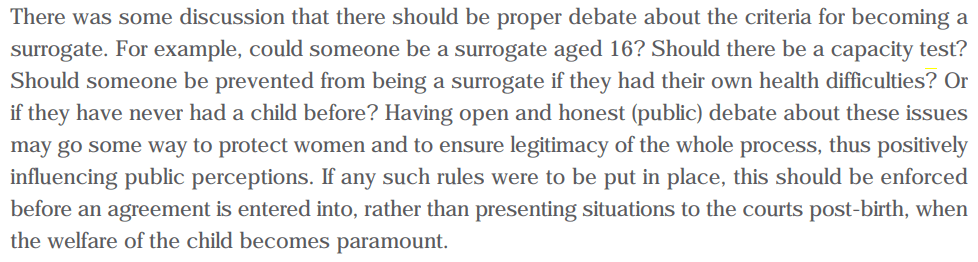
  4. Capacity assessment for 16 year mentioned in APPG sessions – the question of a capacity assessment for children to become surrogate mothers is sickening and it highlights the direction of travel for surrogacy in the UK. The UN Convention the Rights of the Child applies to children up to age 18. This move would exploit children. (See attached image below.)
  5. Light touch background checks – again, as a form of state sanctioned parenthood there should be a similar framework to adoption, to suggest otherwise ignores safeguarding of children.
  6. ‘Out of pocket’ expenses – the Law Commission gives an average of £15,000 which is unusually high given the actual cost of pregnancy and our free-at-source medical provision in the UK. This will effectively bring commercial surrogacy in through the back door by claiming for ‘lost earnings’ or other items which are not strictly ‘pregnancy expenses’. This is an area where surrogacy reform could target those in dire financial situations, a serious concern given the cost-of-living crisis. (Commissioning parents can also be exploited through this method of payment.)
  7. Advertising ban – poor women, single mothers etc could be targeted for the ‘womb rental’, again a serious concern given cost-of-living worries shared by millions.
  8. Integrity of implications counselling – this needs further exploration as to the integrity of the counselling surrogate mothers receive. It is also not compulsory and surrogacy arrangements can be made online with no framework of support for the woman for this significant and potentially life-changing decision.
  9. Influence of lobby groups on consultation and secretariat – Surrogacy UK lobbies hard for reform and have influenced the Law Commission, as have controversial lobby groups such as Stonewall. Surrogacy UK leads the Secretariat on the APPG for Surrogacy. This results in undue influence over the APPG.
  10. Double donation – as the HFEA announces a consultation with a view to lift anonymity on donated gametes from birth, surrogacy reforms suggest that double-donor conceived children could be also be surrogate-born, therefore removing the current requirement to have at least one genetic relationship between the child and their legal parent. This ignores and exacerbates genealogical bewilderment, a well-known suffering of children which extends into adulthood. What is the difference between surrogacy of donor conceived children and trafficking in human beings which is a violation of fundamental rights? The UN Convention on the Rights of the Child states: “contained in this treaty is a profound idea: that children are not just objects who belong to their parents and for whom decisions are made, or adults in training.” The proposed changes place the child last, not first.

Please also refer to the Convention on the Elimination of All Forms of Discrimination against Women, Human Rights (ENC 326/396 Official Journal of the European Union 26.10.2012) and the UN Convention on the Rights of the Child when considering surrogacy reform.


I have outlined several detailed problems with proposed changes which together show the fundamental problem with surrogacy. This practice has been banned in several countries including France, Germany, Spain, Portugal, Italy, Bulgaria and Poland. Indian banned commercial surrogacy on the basis that Indian women being exploited. The Ukrainian Children’s Ombudsman has called for a ban based on child safety.


The European Parliament – in its report on the impact of the war against Ukraine on women it officially condemns surrogacy. The report states that “sexual exploitation for surrogacy and reproduction is unacceptable and a violation of human dignity and human rights”.

Finally, I ask that you might consider becoming a member of the APPG on surrogacy or submitting a Parliamentary question on proposed reform.

Thank you for taking the time to read this email. I am very happy to talk to you about this in more detail and appreciate your support on this matter. I’d also be very happy to come and visit you at one of your surgeries to discuss this in more detail.

Kind regards

[insert your name]
[Insert your address – this is essential]
[Insert your contact details (phone and email) -optional]

Attachments: Screenshot from APPG Evidence session report