Tag Archives: exploitation

Ending Digital Violence in Surrogacy

In the digital age, social media platforms have become a sprawling landscape for connection and community but for every well-meaning and helpful group there is a flip-side. Online groups occupy the dark corners of the internet where bad actors take advantage of the vulnerable. As the annual 16 days for the Elimination of Violence Against Women and Girls (EVAG) draws to a close, we turn our attention to social media surrogacy groups as this year UN Women calls for an “End to digital violence against all women and girls”.

The alarming escalation of violence against women found online extends to surrogacy as this harmful practice is a form of violence against women, as clarified by the UN Special Rapporteur for VAWG in her report this year. Here, I examine the risk posed by online groups, primarily on Facebook. 

These groups are dangerous for several reasons. They perpetuate the illusion of empowerment through bodily autonomy with subtle language which encourages women to help others and create ‘positive change’ in the world. Women are told they can (and should) share their fertility, spread the joy of family and ‘give a gift’ of a baby to someone, somewhere who cannot, for whatever reason, have a baby themselves. 

For many women considering surrogacy, the prospect of helping others whilst providing a solution to financial difficulty is a no-brainer. The promise of financial ‘compensation’, coupled with the chance to help a family achieve their dream of parenthood, presents surrogacy as a noble act of altruism, the ultimate kindness. But these groups are predatory and deceptive as they hide the deeper exploitative practices. Clinics and agencies entice women in and then make direct approaches, often switching to Direct Messages to dictate the terms and conditions. One woman who got caught up in these groups told us that she wanted to offer herself to a couple abroad as she trusted legal systems in other countries, more than those in her own. 

This single mother was offered money for a positive pregnancy test, more than double that for the heartbeat, more money again for accommodation, transport, a ‘feeding allowance’ and lastly, vastly increased sums for a twin or triplet pregnancy. At no point were the known risks discussed. 

“I really wanted to do it all for my child to have a better life…after helping a family I’d come back to run my business” recognising her narrow escape in a country fraught with exploitation she told us, “I may have been used for a human trafficking scam”. 

Advertising for surrogacy in the UK is illegal but these online groups present a loophole. Where would this illegal action be prosecuted, the UK where the post was viewed or in the country where the platform is registered? How and where should these groups be reported? I have personally reported several predatory groups to Facebook and no action has been taken. A journalist in Nigeria has had better luck. Simbiat Bakare’s investigation resulted in closures of several surrogacy Facebook groups (and we encourage readers to report any concerning posts, particularly those that offer a payment plan, by reporting under the category of ‘sexual and human exploitation’ and then selecting ‘exploitation of people under 18’).

Both couples and single people can post about their desire to be parents and invite potential candidates to message them directly. Professional ‘matchmakers’ have private groups and we often see vulnerable women who are already navigating financial challenges, leap at the chance of being able to earn money this way. By making an arrangement with strangers online a woman can go through a pregnancy, birth and give up parental rights for her newborn in order to support the children she already has.

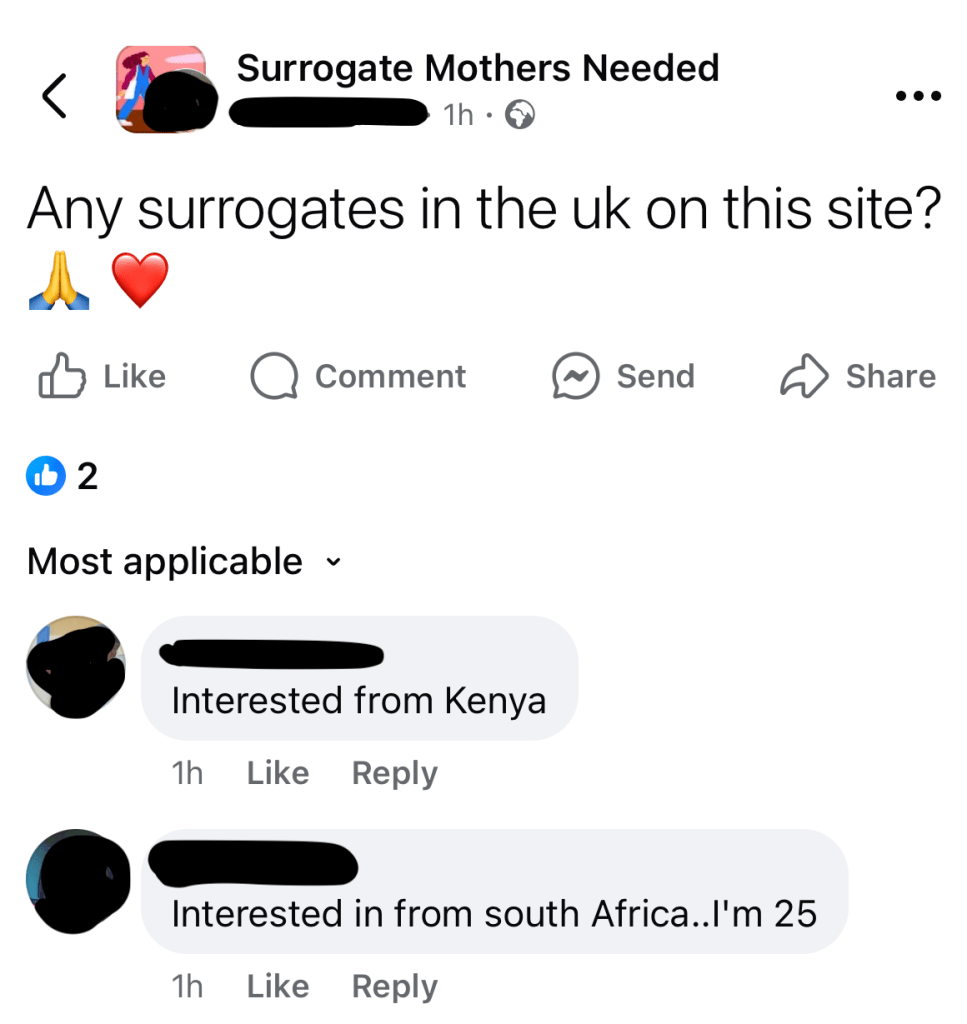
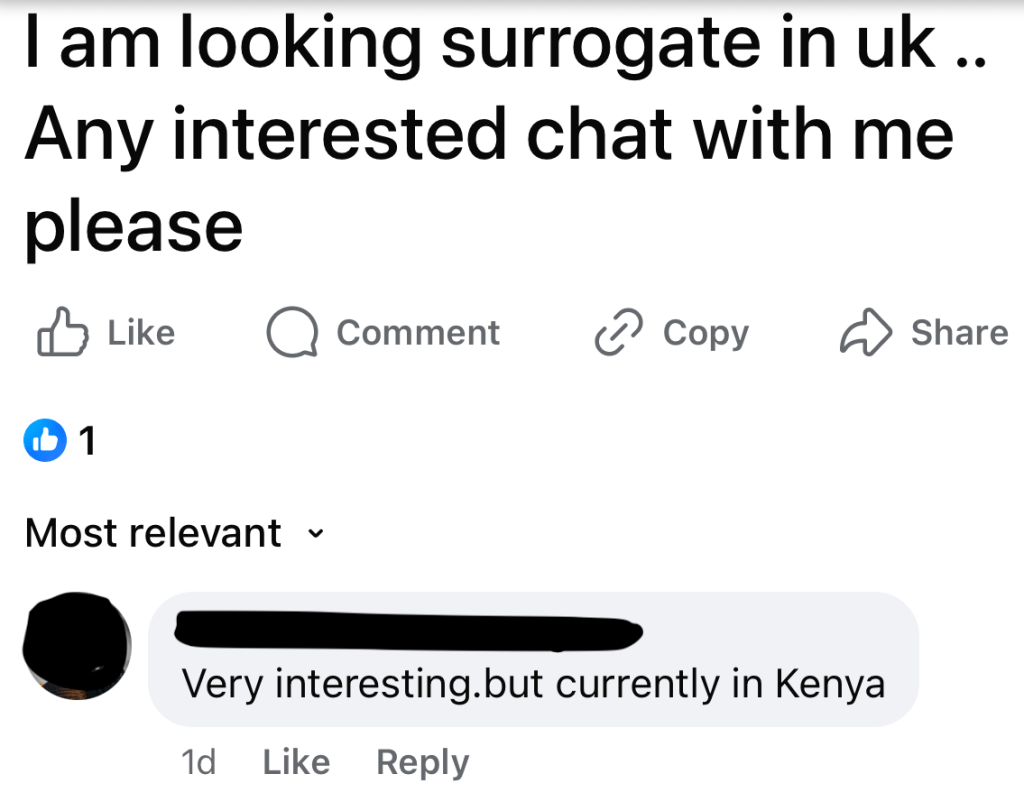
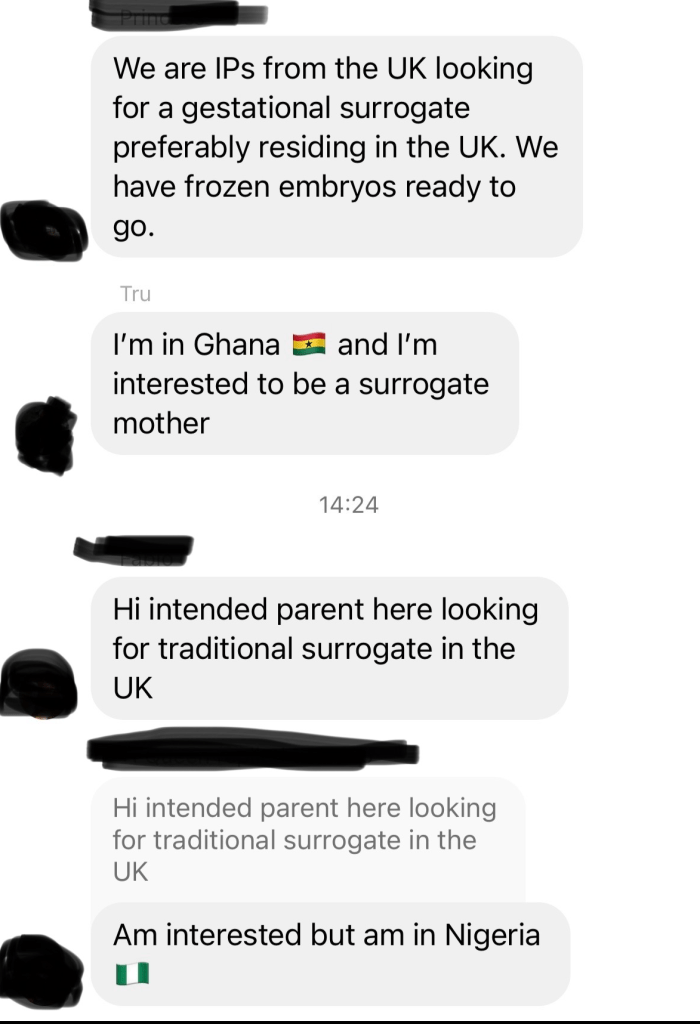
We understand why this is attractive and have seen countless replies to adverts, mostly from women in Ghana, Nigeria and South Africa, who intend to travel abroad to earn large sums that are simply not available to them at home. The possession of a passport and willingness to travel is mentioned in their replies. 

In surrogacy, women are reduced to mere vessels that meet the desires of wealthier individuals or couples, this power imbalance is plain to see from the thousands of screenshots I have seen personally and it exposes a troubling reality. Here are just a handful of examples. 

The allure of money overshadows the real emotional and physical risks involved in carrying a child for someone else. Playing on their vulnerabilities, agencies and brokers will dress this up as making someone’s dreams come true. How wonderful it must be, to be making wishes a reality for a hopeful couple who badly need your help. You have something they don’t and they are willing to pay for something that comes relatively easily to you. And by doing this lovely, selfless act, you can support your family and even work your way out of poverty.

It’s a harmless win-win for all! But the agencies brokering deals never mention the risks.

I was reminded recently of how it took decades for warnings to be attached to cigarette packets and tobacco companies were marking their own homework as they provided the ‘research‘. (The predictable outcome of these ‘studies’ resulted in more sales and profit for Big Tobacco as the risks were hidden so smokers thought they were safe to carry on.) 

Facebook groups also foster personal narratives that create a false sense of sisterhood (more on this soon) that also downplay the real dangers. The idealised version of surrogacy minimises the significant risks and the transactional nature of these arrangements reinforces this power dynamic and rather than challenging them, these online communities allow surrogacy to fester and grow, unchecked. 

We must remain vigilant against those that seek to commodify women’s bodies for profit and challenge the predatory nature of these exploitative groups. Instead of arguing for surrogacy as a reproductive right, that it is an act of generosity made possible with bodily autonomy, we should say no to it all, so vulnerable women do not take risks with her own lives, their own fertility and their own wellbeing for true empowerment without the biased influence.

Handmaid’s Tale, Chanel 4 – Season 6
(The irony of this image is not lost on me.)

Exploitation of Women through Surrogacy

Today, Wednesday 30th July, we observe World Day Against Trafficking in Persons to raise awareness about the increasing exploitation of women through surrogacy. The United Nations reports that the number of victims being trafficked globally continues to rise each year and the responses from criminal justice systems worldwide remain inadequate in addressing this rapidly evolving crime.

From 2020 to 2023, over 200,000 known victims were documented globally; however, the true numbers are believed to be significantly higher. This alarming statistic highlights the urgent need for comprehensive action against human trafficking and its often-overlooked connection to surrogacy.

When we began our campaign, it was soon clear that surrogacy was not the happy alternative to ‘family building’ seen in puff pieces from commissioning parents, soap operas and women’s magazines, and instead surrogacy and human trafficking are intrinsically linked. The scale of this exploitation can vary; it may occur in smaller, more individual cases or on a large scale.

In June 2020 a couple were discovered smuggling 13 people (adults and children) into the United States. Dubbed the ‘smugglers next door,’ the couple admitted to smuggling a girl into the country to make her their ‘surrogate’, claiming she had consented. In the same month, three individuals were arrested in Agrar, India for attempting to sell babies, further illustrating the grim realities of this global industry over a few short weeks.

Earlier this year, the Daily Mail exposed a surrogacy and egg harvesting farm in Georgia, where approximately 100 women were “treated like cattle”. The article confirms that the women  “were lured in by a job offer on Facebook, promising them a salary between 11,500 and 17,000 euros (£9,600 to £14,100) to work as surrogates for Georgian couples who could not have children.” 

A scandal of larger proportions hit the news in 2023. News reports said that 169 women from Romania, Ukraine, Moldova, Albania, Bulgaria and Georgia were trafficked to Crete for egg harvesting and surrogacy. Babies were sold for between 70,000 and 120,000 euros each.

Reports of human trafficking in surrogacy have surfaced with increasing frequency. Women are targeted by social media, moved across bordes, forced to become pregnant and made to surrender their babies to those who can well afford to pay for them. Just this month scandals broke in California, Indonesia and Vietnam and Greece, Argentina, Kenya, the Philippines, Cambodia and China have all featured in similar human trafficking news reports in recent years.

Over the last 12 months we have witnessed a significant rise in activity on social media platforms, particularly Facebook, where private surrogacy arrangements are being made ‘off the books’. While some may refer to these as ‘independent journeys’, the reality is that vulnerable women are being targeted by wealthier individuals seeking to exploit their desperation. When women respond to such posts, their consent is assumed, with little consideration given to the motivations behind their ‘choices’. Facebook has been mentioned in several surrogacy scandals but groups, private messages and online baby sales continue. 

In April, we highlighted three UK court cases that underscored the exploitation occurring within surrogacy arrangements and in April 2024, Unseen, the UK’s modern slavery line, reported on forced surrogacy in the UK for the first time. The following month, the EU issued a directive addressing the same issue, recognised surrogacy as a form for human trafficking and the report from the European Parliament which officially condemns surrogacy as sexual exploitation for surrogacy and  reproduction is unacceptable and a violation of human dignity and human rights”.  

Organisations such as the Hague Convention on Private Law formed to discuss global surrogacy regulations, their aim is to harmonise and normalise this contentious practice in legal frameworks across the world. With the focus on the child’s citizenship and parental rights for the child, little consideration is given to the women who are the mothers of these children.

Closer to home, UK agencies are working together to pressure this government to take law reform proposals forward with some interesting language surrounding this, for example, saying ‘travelling surrogates’ rather than trafficked women.

As exploitation and human trafficking in surrogacy is happening right now, somewhere in the world, stakeholders and benefactors seek to rationalise through regulation. We remind readers that there are no plans to change the current parental order system that allows British residents to go abroad and buy babies and reform proposals actively argue for this model to remain in place alongside the ‘new pathway’.

But there has been some progress recently. We welcome the extended ban on surrogacy in Italy and the new restrictions put in place in Spain, and we appreciate efforts made by the UN Special Rapporteur for Violence Against Women and Girls and eagerly anticipate her report on surrogacy due out this Autumn. 

As news reports of human trafficking continue to circulate more and more people are waking up to what surrogacy actually is.

Take action and write to your MP to reject international surrogacy. Use this template from our co-campaigners, Surrogacy Concern. It will take just a few minutes to register your concerns with law-makers.

Buying Babies from Abroad

Last month several cases in the high court came to light and we explore them here as each presents different areas of concern with international surrogacy – faceless mothers, simultaneous surrogacy and human trafficking.

Invisible Woman – a surrogate mother is faceless and nameless

A UK couple, with connections to Nigeria went there to obtain a baby. The baby was conceived with the egg of the surrogate mother and the sperm of the commissioning father but the couple never met the woman who they impregnated. Arrangements were made between their chosen clinic and agency and she remained anonymous throughout the process as this was their preference. Her face was covered during scans and appointments which were conducted remotely and only her initials were recorded in the paperwork.

When the baby was brought into the UK and a parental order was process though the court the commissioning couple’s intentions were laid bare. 

“At that point we are satisfied that opting for an anonymous surrogacy will be our best option since we will not meet the surrogate mother and she will not know us. We thought this will remove all the problems people face when they do surrogacy and the stigma that surrounds it. We want safety, protection, security, and peace of mind. We didn’t want unnecessary involvement and attachment; we just want to sign the contract without owing anybody obligation. We understand someone to do this is really giving us something special we don’t want to carry this for the rest of our lives identifying the person will make us think we owe them gratitude for the rest of our life.

This couple deliberately sought out a woman in Nigeria so they would not be required to build or maintain an ongoing relationship with the mother of their child. The burden of gratitude was too much for them and they do not know her name or what she looks like and neither will her child. The baby girl will also not know her maternal family or any other siblings she may have.

Every day we see, in private chats and on public groups, agents and brokers in Nigeria seeking women to donate their eggs and to rent their wombs. We consistently see posts from women who are clearly desperate for money and this makes them vulnerable to exploitation. Nigeria remains on the list of countries where you cannot adopt from if based in the UK, the basis for this is the risk and concerns over exploitation but this does not apply to surrogacy.

Consent was dispensed with. The full judgment is here.

Two for one – not the first case of simultaneous surrogacy for a UK couple

A UK same sex couple in their 60s and 70s paid £120,000 for two babies born to two different Ukrainian women in Northern Cyprus, though they believed the clinic to operate out of Southern Cyprus. The children were conceived from from the same woman’s eggs and the same man’s sperm so were related to each other but were not related to either of the two women, so the Parental Order was denied.  Consent from the Ukrainian mothers was dispensed with. The judge for this case, Sir Andrew McFarlane, president of the family division of the High Court said:

as nobody knew anything more than the first names of the two surrogate mothers. In addition, the clinic had been doggedly resistant to giving any information. The surrogates had been resident at the clinic four years earlier but had almost certainly returned to Ukraine after giving birth. I was fully satisfied that they could not be found and I, therefore, dispensed with consent on that ground.

The adoption of these children took 4 years and in the ruling the judge noted the women were “exploited for commercial gain’.

Consent was dispensed with. The full judgment is here.

Global baby – multiple international locations

This case involved a single man who paid a surrogacy agency in Israel and a fertility clinic in Northern Cyprus to implant an embryos into the womb of  a surrogate mother who came from Kyrgyzstan. The mother travelled to Northern Cyprus for an embryo transfer, before returning home and later gave birth in Moldova.

The full judgement is here.

The man paid Fullsuccess Medical Consulting almost £26,000 and he told the court that he believed the surrogate mother was paid £12,250. In the granting of the Parental Order, Mrs Justice Theis DBE said “what took place in this surrogacy arrangement, with the seemingly reckless disregard of the cross-jurisdiction implications of the arrangement,overseen by two essentially commercial organisations, causes the court enormous concern”.

The UK surrogacy model is meant to be altruistic and based on ‘friendship first’ but Parental Orders for international surrogacy arrangements continue to be granted by the UK courts and they appear to be on the rise. 

A 2022 study shows how UK residents prefer the commercial mode as it secures parental rights and control over the surrogate mother (see our analysis) . Women are being exploited for their reproductive capability and there are no friendships being formed prior to pregancy and no ongoing relationships once the child is born. There is no basis for the child to know where they come from, they may not even be told they are born from an arranged pregnancy. Courts can dispense with ‘free, fully informed and unconditional consent’ and the mother simply disappears, returning to her home country in a puff of smoke.

These are far from the only recent cases, this month two teachers from London obtained twins from a Kazakhstani woman who gave birth in Northern Cyprus, this has resulted (at the time of writing) in an ongoing police investigation.

The Law Commission of England and Wales and the Scottish Law Commission argue that the Parental Order system that transfers parental rights should continue and work alongside the ‘new pathway’, under their reform proposals. This would continue to allow arrangements like the ones we share here, to continue.

If you have concerns over the proposals, you can write to your MP using this template from Surrogacy Concern.