Author Archives: stopsurrogacynowuk

Words from a Surrogate Mother – Part 1: Marie Anne

My name is Marie-Anne Isabelle and the surrogacy experience that I endured here in this country nearly killed me. My mission now is to ensure that nobody goes through what I did. I have made it my cause to expose this barbaric practice for what it is and to enact change. I am not looking for glory or sympathy I just want change.  

People hear about how wonderful surrogacy is, how it’s a beautiful gift and a positive experience. Then, you hear about the “terrible” surrogate who dares to ask for her child back.  It’s an all-too-common depiction in our modern fairy tale world.

I believed that fairy tale when I agreed to help a family member by carrying her child.  At the time, I was happy to help because I loved her and did not want or need to be paid.  However, I made it clear that the child would be conceived using her egg and that I must be allowed to see and have contact with the child I would give birth to. That was the condition I would only do this under, if I could have regular contact with the child, as I could not live without seeing a child I would give birth to. 

I agreed to become a surrogate mother for my cousin. She was more like a sister to me.  She had been a significant presence in my life. We were a vital part of each other’s lives. I knew about her cancer. In 2009 she told me that she had created embryos and that she was researching surrogacy. 

One day, she came to my house with her sister, who is also my cousin and asked if I could help her. I told her that I would only help if she let me see the child. She looked me in the eye and said, “Absolutely. There’s trust.” We’re family, you know? Not for a minute did I think I’d actually need to get a lawyer and write a contract.

I think when she asked me, she knew I had no choice but to say yes. I think she exploited our relationship. As further information came out afterwards, it appeared that they couldn’t go ahead with a surrogacy abroad as it was deemed too expensive, so they were looking for a cheaper alternative. They kind of saw me as “Oh, she’ll do it for free.” A free and cheap option.

I was told there is trust. “You will be the child’s godmother.”  Those words would later come back to haunt me.  I don’t believe she knows what trust means. She made all sorts of promises to brainwash and coerce me into helping her.

It was a gestational surrogacy. They used IVF with their own biological material. I remember lots of injections and visits to the clinic for very obtrusive physical examinations. It was a very procedural process, and it was quite challenging, both emotionally and physically, to go through.  I’d had two normal, non-assisted pregnancies of my own and this pregnancy was nothing like those. This overmedication was purely to help these two people. 

The experience was bad enough. Having somebody else try to dictate what medical procedures you should endure, how you should give birth, and what you should eat was awful.  The list goes on. This affected me from the beginning of my pregnancy, yet there is still no specialized support for women going through surrogate pregnancies here in the UK.

In 2014, at the time of delivery, I made it clear that the commissioning father wouldn’t be present; it would just be her, me, and my partner. Everything went smoothly, and I felt in control. The hospital saw me as the mother. So, my wishes were taken into account; in how I wanted to do things. However, they wanted me to have an elective C-section. I refused, and my midwife backed me up by stating that C sections were not good practice. If someone doesn’t need one, they shouldn’t have one. They tried to force me and put pressure on me, saying, “Oh, it’d be better for you.”

I remember there being some confusion at the hospital. Even though the hospital had been told that it was a surrogacy, social services became involved. I thought, “This is awful. I’m trying to have a baby, and now I’ve got suspicious social services interviewing me.

The father came in after the birth because he wanted to have skin to skin contact. They had the baby. They were happy. They didn’t need me anymore so they told me to go home. However, the hospital staff did not agree. They wanted to see me walk out with the baby, carrying it according to their policy. I remember having to carry the car seat with the baby in it through the hospital in full view of the medical staff. Then, we had to do this strange exchange where I handed over the child in the hospital car park because, legally, the hospital was no longer responsible for the child once it was outside. 

After the birth, I was presented with all sorts of legal documents that I was forced to sign. The timing was awful, too, right when I was trying to recover from the birth. Imagine training your body and mind for nine months to believe that you are not the mother of the child you are giving birth to. Every surrogate woman has to do that. Then, after doing that, you are presented with a document stating that you are the mother, and you are forced to sign it. I was also threatened with financial and legal consequences if I didn’t sign it.  This is the dark side of surrogacy in the UK that nobody hears about because most women are given gag orders to prevent them from talking about it.

No payment was made.  I was only compensated for time off work. I remember them buying me maternity clothes and reimbursing me for transportation to the clinic. They wanted to pay for food, but I politely declined. I didn’t want to feel controlled by having someone tell me what to eat. I remember my dear cousin saying, “We’d like to pay for a kitchen for you,” and I said, “No, this is me helping you I am not doing this to get anything back in return.  For me to receive gifts would feel like I was being paid for a service.” I said no.

The court case started in 2014 and lasted two years. I didn’t start the court case. It was initiated by the commissioning parents because they wanted a parental order. A parental order legally transfers parental responsibility from the surrogate to the intended parents and ends the surrogate’s rights.

I had no idea about any of this. I didn’t even know there was going to be a court case. I just thought I would hand the child over and be done with it. None of this was made clear to me beforehand. Nobody told me. I gave birth, and suddenly, all of this legal process was forced upon me. I refused to sign because they reneged on their promise of allowing me contact and everything went downhill from there.

They attempted to obtain my consent against my will at the court, exploiting my mental health, which was irreparably damaged as a result of my experience. They tried to prove that I was incapable of giving consent.  However, through grit and determination—including psychiatric assessments proving I was capable of giving consent—I was permitted to remain involved in the court case and my consent was needed much to their dismay. Still, they continually tried to shut me out. Children’s Services even tried to use the case of a deceased surrogate mother. They said, “We can just use that case where someone died and pretend that’s happened here.” It was just appalling. It was made clear to me that the only way I had the best chance of having any contact was to agree to the parental order so in the end, I signed it to try and have contact with the child I gave birth to as I was promised. I have never seen the child to this day.

She was born in 2014. I haven’t seen her since I gave birth to her. 

I was promised on multiple occasions during the court case that I would see her, but each time, the appointment was cancelled the day before. They were playing games with me. I believe the promises were only for the benefit of the court.

They hinted that they used me as a cheap commercial surrogate and if it hadn’t been for their legal costs they would have been granted their wish. They constantly tried to remove any trace of me from their child’s life, which is another reason why they needed my silence. I believe their behaviour stems from their resentment of me as the child’s birth mother, and that is me being generous.

I have been diagnosed with complex PTSD and underwent EMDR to alleviate some of the trauma resulting from the surrogacy. I have a deep fear of hospitals, children, and babies, which does not work well with my career in education.  The damage done to me will never be repaired.  Constant panic attacks and a fear and distrust of people serve as constant reminders. There are many days that I still wish I wasn’t here just to be rid of this painful world that did this to me. 

The impact was not only on me, but also on my children. They took on the role of parents because I wasn’t able to take care of them. This happened ten years ago, and for the first five years, my children didn’t have a mother. They were taken away from me and sent to live with their father, which was traumatic for everyone. Then, the judge, when presented with evidence, came to the conclusion that this was not helpful to anyone and returned them to my care. Over the last five years, we have come together as a family and rebuilt our relationships, but for the first five years, we were a broken family. 

In trying to help another family, they broke mine.

When did a women’s right to have a child mean that it would take away another woman’s right to have contact with a child she gave birth to? We talk about women’s rights as if they are universal but surrogacy actually means you are choosing which woman deserves more rights. That is inequality. 

If leaders and law makers care so much about women’s rights why are they continuing to erode the rights of surrogate mothers?

Change needs to happen fast. Surrogacy in any form is wrong, not safe and harmful. It needs to be banned before any more women die as they already have. Listen to our voices and do not let us be silenced any more.

This speech was read by Marie Anne at FiLiA in Brighton on 11th October 2025.

Please share your thoughts with parliament – Deadline 5th October!

The Parliamentary Office of Science and Technology (POST) is an independent service that provides impartial research, analysis, and expertise on complex science and social science issues. They share their findings with Parliament to inform policy debates and decisions. Last month POST announced a new consultation on surrogacy law reform. This follows a public consultation in 2019 from the Law Commission of England and Wales and the Scottish Law Commission, which in total has already cost £945,000.

Any individual can contribute but POST encourages submissions from researchers and experts. Whether you are in a research position, have personal experience of surrogacy or have a view on surrogacy you’d like to share, we encourage you to submit using the form and our suggested guidance. The deadline is 23.55 on 5 October 2025.

Please use this form for your submission: 

After reading the Data Privacy Data Notice you will be asked for:

  1. Your name
  2. Your job title
  3. Your email address
  4. Your institution if relevant
  5. If you are submitting as an individual or as a group – please select individual
  6. If you are a researcher the form will ask for a link to your profile

Next, the form will show this text:

Approved work: Surrogacy: current practice and proposed reforms 

What reforms have been proposed to surrogacy law, and what are the ethical, social and medical considerations?

Many stakeholders consider UK surrogacy law (Surrogacy Arrangements Act 1985) to be outdated. In 2023, the Law Commission of England and Wales/ Scottish Law Commission published a report outlining proposed reforms to surrogacy law, including a new regulatory pathway for domestic surrogacy arrangements, and new rules on payments that intended parents may make to the surrogate.    

This POSTnote will describe current surrogacy practice in the UK, and suggestions for reform. It will consider research evidence and stakeholder views on surrogacy practice in the UK and internationally. It will discuss ethical, social and medical considerations, such as access to surrogacy, and the rights of surrogates, intended parents, and children.    

We welcome information on issues relevant to the project. To contribute to this research, please follow our guidance for contributors.     

Work will commence in September 2025, with publication expected in January 2026. The form for stakeholder contributions will close at 23.55 on 5 October 2025. We are trialing using an online form to make it easier for contributors to submit information to POST. If this form is not working, please send your submission to POST@parliament.uk   

For the guidance for contributors please click here:

https://post.parliament.uk/contributing-to-post-research-as-an-expert/#heading-2

You will then be asked a short series of further questions:

8. Please briefly explain how your research expertise is relevant to the POSTnote topic.

E.g. if you teach a course, or if you’ve published a paper linked to the topic.

Your answer for this cannot exceed 500 characters. (If you are not a researcher you may want to state your interest in this topic.)

9. What are the key issues relevant to the POSTnote that you would like to make us aware of?

Your answer for this cannot exceed 1,500 characters.

Here you can share your concerns about surrogacy. You may want to mention a few points from the following list but please keep the word count in mind:

  • The UN Report from the Special Rapporteur for Violence Against Women and Girls on surrogacy, published in August. You can read the report in English and refer to the 19 recommendations. You can get a breakdown of this here.
  • Human trafficking scandals – for more on this you can refer to this blog: https://stopsurrogacynowuk.org/2025/07/30/exploitation-of-women-through-surrogacy/
  • The number of Parental Orders for surrogate-born babies has more than quadrupled in the last 12 years and commissioning parent/s living in the UK are still allowed to undertake commercial surrogacy arrangements abroad, even though commercial surrogacy is banned domestically: risking financial exploitation of women in developing countries abroad and financial exploitation of working class and lower middle class women here in the UK too,
  • Surrogacy agencies in the UK must be ‘not for profit’, although several employ large numbers of staff; one is attached to a law firm, and another has opened a commercial branch in Mexico City, where surrogate mothers are paid under £12,000 per pregnancy. (Incentives used by one British agency to encourage women to become surrogate mothers include meal box vouchers, trips to theme parks for the surrogate mother’s existing children and Apple watches.) 
  • It is not a legal requirement that a woman has had her own child/ren before undertaking a surrogate pregnancy and surrogate mothers are permitted to use their own eggs in surrogacy,
  • There is no enforceable requirement that ensures a child has an ongoing relationship with their birth mother,
  • Surrogacy does not recognise the fact that babies bond in utero with their mothers, wanting her at birth, regardless of who’s egg used in the pregnancy. Surrogacy treats women as interchangeable incubators, exploiting their poverty and putting women at risk in higher-risk pregnancies. It is profoundly unethical as a way to treat a child, who recognises their mother and wants her at birth: nobody else, 
  • The UK is an outlier in allowing any form of surrogacy to take place at all: surrogacy is much more strictly limited or completely banned in countries such as France, Germany, China, Italy, Spain, Portugal, Austria, Poland, Finland and Switzerland. Commercial surrogacy is illegal across the EU where it is defined as child trafficking. President Macron of France condemned the practice of surrogacy in May 2024, and the UN Special Rapporteur on Violence Against Women and Girls has called for UN member states to move to ban the practice entirely.

You may share our concerns regarding law reform proposals already suggested by the Law Commission here. You may want to mention some of the following points:

  • The draft Bill published in March 2023 tips the balance of power away from the surrogate mother towards the commissioning parent/s: the “certainty” lawyers and commissioning parents say they want/need only benefits them at a huge cost to working and lower middle class surrogate mothers,
  • The current Government have said they do not intend to make time to take forward changes to British surrogacy law in this parliament: why are POST spending public money on exploring this topic when that statement was made relatively recently? 
  • The draft Bill reduces the time limit the surrogate mother has to change her mind to just six weeks after birth: even if she does change her mind, she is not guaranteed custody of her child but would need to apply for a parental order for her own baby, even if she has used her own egg, 
  • The draft Bill proposes to make the commissioning couple legal parents of the child at birth, meaning the birth mother would never be recognised in law or listed on the birth certificate. This is according to the Law Commission’s preferred model,
  • The draft Bill proposes a minimum age of 21 for surrogate mothers, and just 18 for commissioning parents. There are no upper limits suggested for commissioning parents or surrogate mothers, 
  • The draft Bill does not require a surrogate mother to have previously been pregnant, given birth or completed her own family. If she has not previously been pregnant or given birth, she cannot give informed consent,
  • ‘Expenses’ would continue to be uncapped for British surrogate mothers. These potentially total thousands and this provides a real financial incentive to many women from lower socio-economic backgrounds, and disproves the myth that the UK surrogacy is genuinely ‘altruistic’. There is a categorisation proposed under reform but no upper limits. We believe the average ‘expenses’ in a British surrogacy arrangement may now significantly exceed £20,000 per pregnancy: exploiting women’s poverty in a cost of living crisis,
  • The draft Bill continues to allow people to bring babies to the UK who have been conceived and carried through commercial surrogacy abroad, despite significant, well-known problems of exploitation and coercion in the global commercial surrogacy market (see link below for the market value),
  • The draft Bill allows for open advertising to attract and recruit surrogate mothers in the UK, likely leading to an explosion in the numbers of women from lower socio-economic backgrounds agreeing to undertake the practice out of financial necessity, rather than genuine desire,
  • The draft Bill enables surrogacy agencies to become Regulated Surrogacy Organisations (RSOs) with power to determine which commissioning couple or individual can enter a so-called Surrogacy Pathway (with power to grant legal parentage without oversight of the Family Court or CAFCASS, as is the case now): this is a conflict of interest and gives power to organisations who have financial incentives and an ideological commitment to surrogacy and who are not experienced in meeting the ongoing burden of regulatory obligations. RSOs would be overseen by the HFEA, a role the HFEA have made clear they do not welcome and do not have necessary skills or expertise in to adequately supervise,
  • The Law Commission’s plans take social workers and CAFCASS out of arrangements on the new Surrogacy Pathway. The proposals remove the current practice of CAFCASS assessment for arrangements on the new Pathway, putting surrogacy on the Pathway completely at odds with UK adoption legislation and practice. 

This question also asks for relevant policy documents, or statistics that relate to the topic.

These are the links to the studies you may want to share:

  1. A 2024 study that confirms that surrogacy 3x increased risk for severe pregnancy complications – Severe Maternal and Neonatal Morbidity Among Gestational Carriers: A Cohort Study https://www.acpjournals.org/doi/10.7326/M24-0417
  2. A study published in July revealed an increased risk in new onset mental illness in surrogate mothers – New-Onset Mental Illness Among Gestational Carriers https://jamanetwork.com/journals/jamanetworkopen/fullarticle/2836835
  3. Mater Semper Certa Est? Human Rights Violations in Surrogacy Arrangements https://ojs.academicon.pl/tkppan/article/view/9178

10. Where possible, please provide links to sources for any statements you make.

You can link to:

The 2024 European Parliament’s directive on preventing and combating trafficking in human beings, including surrogacy: https://www.consilium.europa.eu/en/press/press-releases/2024/05/27/fight-against-human-trafficking-council-strengthens-rules/#:~:text=Resources-,Council%20of%20the%20EU,in%20case%20of%20aggravated%20offences. 

Surrogacy breaches the UN Convention on the Rights of the Child and many of the issues within surrogacy can be addressed by centring children and their human rights. https://www.unicef.org.uk/wp-content/uploads/2016/08/unicef-convention-rights-child-uncrc.pdf

Surrogacy is a global trade estimated to be worth approx. $201bn by 2034 https://www.gminsights.com/industry-analysis/surrogacy-market?gad_source=1&gad_campaignid=20434039883&gbraid=0AAAAACuPGhVpE62Z3S7ihCgE5Cmo9mnXe&gclid=Cj0KCQjwh5vFBhCyARIsAHBx2wxibmyT1w8HO8bFvSgXZ8Im6jRhtQGVR5dWjcjERbh97u9FoL5IFqQaAt1MEALw_wcB

11. Are there other individuals or organisations you think would be interested in contributing to this POSTnote? Please only share publicly available information.

Your answer for this cannot exceed 300 characters

If you wish, you can name:

Stop Surrogacy Now UK, Surrogacy Concern, Nordic Model Now and Object Now. International organisations include the International Coalition Against Surrogate Motherhood and Casablanca Declaration.

12. Please select which stakeholder group best represents you (or the organisation you are representing).

Please select No affiliation if submitting as an individual.

Finally:

13. Where did you find out about this opportunity to contribute to POST’s research?

Please answer how you found out about this consultation, we expect this to be via the X/Twitter accounts of Stop Surrogacy Now UK and Surrogacy Concern.

When all fields are completed within the character limit you can submit. Once submitted you can print your answers. Please let us know when you have submitted your response by emailing stopsurrogacynowuk@gmail.com.

If you would like to contact the POST team directly, their general enquiries email is: post@parliament.uk

Thank you!

Exploitation of Women through Surrogacy

Today, Wednesday 30th July, we observe World Day Against Trafficking in Persons to raise awareness about the increasing exploitation of women through surrogacy. The United Nations reports that the number of victims being trafficked globally continues to rise each year and the responses from criminal justice systems worldwide remain inadequate in addressing this rapidly evolving crime.

From 2020 to 2023, over 200,000 known victims were documented globally; however, the true numbers are believed to be significantly higher. This alarming statistic highlights the urgent need for comprehensive action against human trafficking and its often-overlooked connection to surrogacy.

When we began our campaign, it was soon clear that surrogacy was not the happy alternative to ‘family building’ seen in puff pieces from commissioning parents, soap operas and women’s magazines, and instead surrogacy and human trafficking are intrinsically linked. The scale of this exploitation can vary; it may occur in smaller, more individual cases or on a large scale.

In June 2020 a couple were discovered smuggling 13 people (adults and children) into the United States. Dubbed the ‘smugglers next door,’ the couple admitted to smuggling a girl into the country to make her their ‘surrogate’, claiming she had consented. In the same month, three individuals were arrested in Agrar, India for attempting to sell babies, further illustrating the grim realities of this global industry over a few short weeks.

Earlier this year, the Daily Mail exposed a surrogacy and egg harvesting farm in Georgia, where approximately 100 women were “treated like cattle”. The article confirms that the women  “were lured in by a job offer on Facebook, promising them a salary between 11,500 and 17,000 euros (£9,600 to £14,100) to work as surrogates for Georgian couples who could not have children.” 

A scandal of larger proportions hit the news in 2023. News reports said that 169 women from Romania, Ukraine, Moldova, Albania, Bulgaria and Georgia were trafficked to Crete for egg harvesting and surrogacy. Babies were sold for between 70,000 and 120,000 euros each.

Reports of human trafficking in surrogacy have surfaced with increasing frequency. Women are targeted by social media, moved across bordes, forced to become pregnant and made to surrender their babies to those who can well afford to pay for them. Just this month scandals broke in California, Indonesia and Vietnam and Greece, Argentina, Kenya, the Philippines, Cambodia and China have all featured in similar human trafficking news reports in recent years.

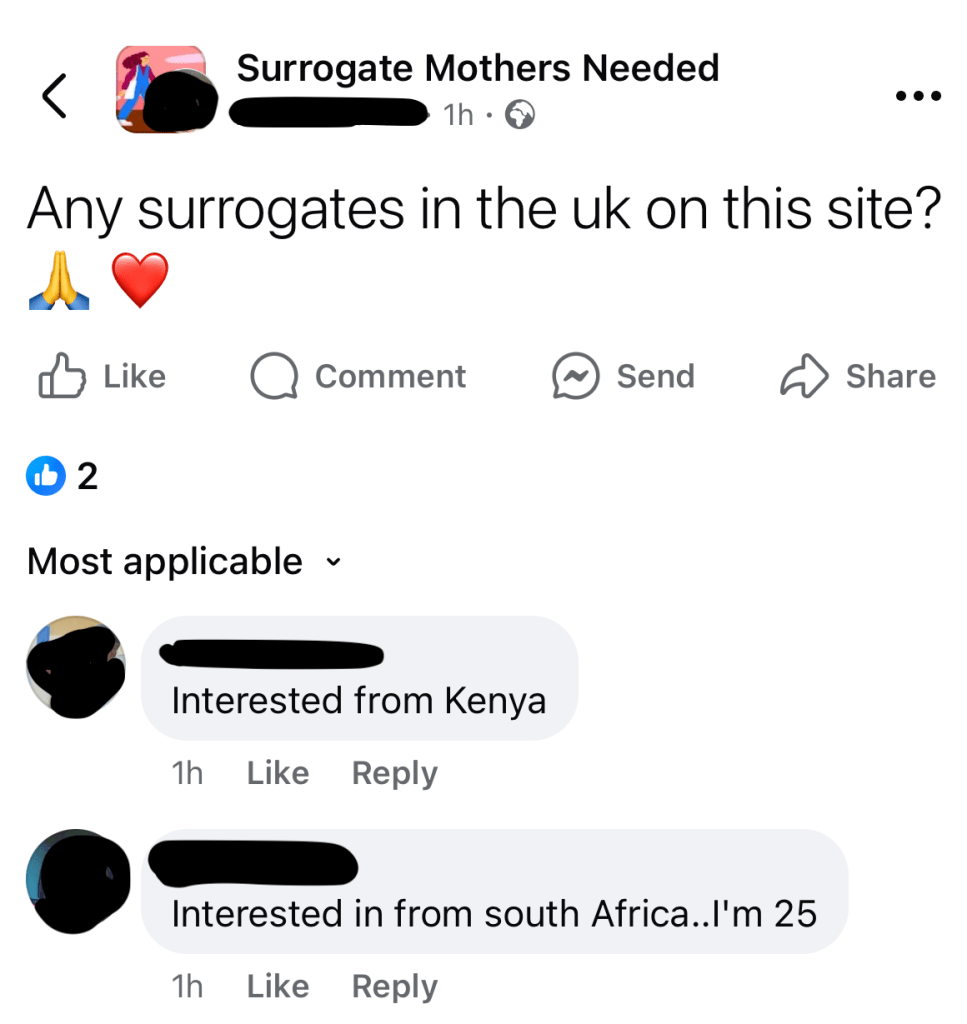
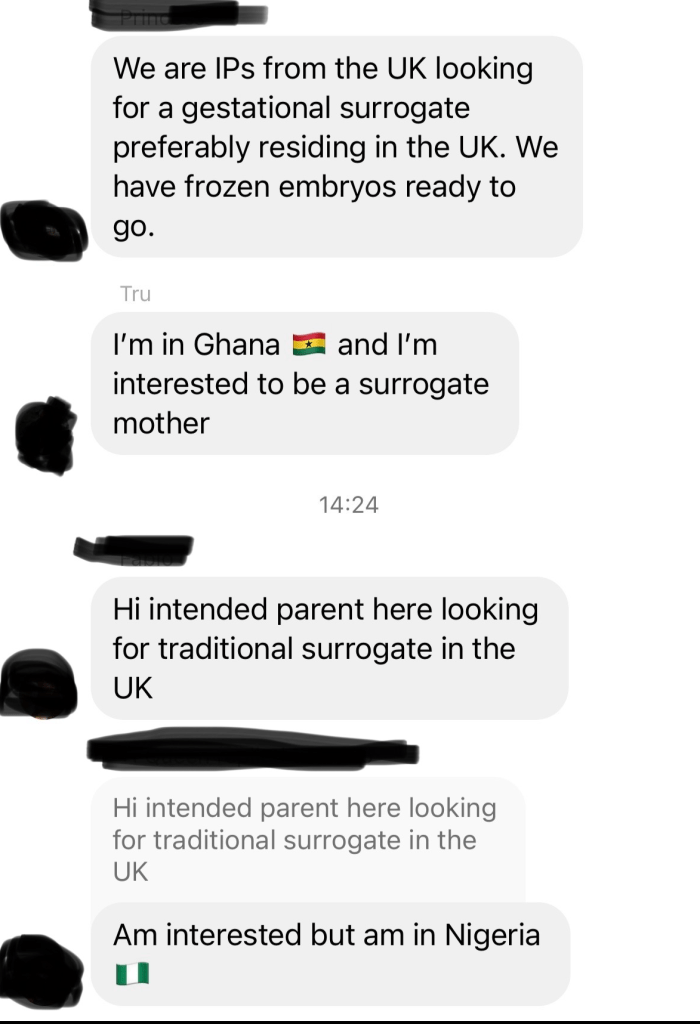
Over the last 12 months we have witnessed a significant rise in activity on social media platforms, particularly Facebook, where private surrogacy arrangements are being made ‘off the books’. While some may refer to these as ‘independent journeys’, the reality is that vulnerable women are being targeted by wealthier individuals seeking to exploit their desperation. When women respond to such posts, their consent is assumed, with little consideration given to the motivations behind their ‘choices’. Facebook has been mentioned in several surrogacy scandals but groups, private messages and online baby sales continue. 

In April, we highlighted three UK court cases that underscored the exploitation occurring within surrogacy arrangements and in April 2024, Unseen, the UK’s modern slavery line, reported on forced surrogacy in the UK for the first time. The following month, the EU issued a directive addressing the same issue, recognised surrogacy as a form for human trafficking and the report from the European Parliament which officially condemns surrogacy as sexual exploitation for surrogacy and  reproduction is unacceptable and a violation of human dignity and human rights”.  

Organisations such as the Hague Convention on Private Law formed to discuss global surrogacy regulations, their aim is to harmonise and normalise this contentious practice in legal frameworks across the world. With the focus on the child’s citizenship and parental rights for the child, little consideration is given to the women who are the mothers of these children.

Closer to home, UK agencies are working together to pressure this government to take law reform proposals forward with some interesting language surrounding this, for example, saying ‘travelling surrogates’ rather than trafficked women.

As exploitation and human trafficking in surrogacy is happening right now, somewhere in the world, stakeholders and benefactors seek to rationalise through regulation. We remind readers that there are no plans to change the current parental order system that allows British residents to go abroad and buy babies and reform proposals actively argue for this model to remain in place alongside the ‘new pathway’.

But there has been some progress recently. We welcome the extended ban on surrogacy in Italy and the new restrictions put in place in Spain, and we appreciate efforts made by the UN Special Rapporteur for Violence Against Women and Girls and eagerly anticipate her report on surrogacy due out this Autumn. 

As news reports of human trafficking continue to circulate more and more people are waking up to what surrogacy actually is.

Take action and write to your MP to reject international surrogacy. Use this template from our co-campaigners, Surrogacy Concern. It will take just a few minutes to register your concerns with law-makers.

Surrogacy: A risky Business

As a new study from Dr Velez was just published, I review this and revisit the study from 2024. In doing so I quote both studies verbatim, despite the dehumanising language.

2024 Study

Published in September 2024, Severe Maternal and Neonatal Morbidity Among Gestational Carriers: A Cohort Study looked at over 863,000 births in Ontario, Canada over a nine year period (1st April 2012 to 31st March 2021).

The study concluded that surrogacy pregnancies are 3 times the increased risk, with severe postpartum hemorrhage, severe pre-eclampsia, and postpartum sepsis given as the medical risks. This is an alarming statistic but one we have seen from previous studies and it is important to understand the approach.

Firstly, Dr Velez (et al) created a baseline by making certain deliberate omissions.

  • 405,876 pregnancies were excluded because of history of cancer, miscarriage or abortion as well as invalid insurance, high risk diagnosis and the application of Intrauterine insemination (IUI) for conception.
  • 130 twin pregnancies for surrogate mothers were excluded. This amounts to 16% of the total sample of surrogacy pregnancies (806) but only 2.3% in the unassisted conceived pregnancies. It is worth noting that had multifetal (twins or triplets, etc) pregnancies been taken into account, the risk would have been even higher. Twins are common in surrogacy as multiple embryos are implanted, “surrogate pregnancies more likely to result in twin pregnancies: 33% vs. 1%.” ( Woo et al, 2017)
  • Home births were excluded and these make up around 1% of pregnancies in Ontario – Data was gathered Better Outcomes Registry & Network (BORN) Ontario database which holds 99% of all birth records. 

Secondly, following the omissions, 3 comparison groups were created. A group with Unassisted (natural) Conception, IVF conception and ‘Gestational Carriage’ or surrogacy.

The group of surrogate mothers were not categorised further into ‘gestational’ (IVF) and ‘traditional’ (conceiving with the surrogate mother’s own eggs) and was small within this study – at only 806 of the overall group (0.09%) – but it remains the largest study of surrogate mothers in the last decade and it draws out several interesting observations.

  1. A significant number of women (290) who undertook surrogacy pregnancies had a high BMI as the study measured that 36% of surrogate mothers were obese.

“Before weighting, gestational carriers were more likely to be parous, reside in a lower-income area, and have higher rates of obesity and chronic hypertension.”

Dr Velez weighted the obesity in surrogate mothers against obesity in women who were became pregnant naturally, but did not explore why surrogate mothers are almost twice as likely to be obese, though she notes that surrogate mothers are more likely to have already given birth and live in poorer areas. The surrogate mother group also had high blood pressure which can be linked to several underlying health conditions and can be a sign of stress.

  1. Nearly 10% (8.9%) of “gestational carriers” were first time surrogate mothers. This is disturbing for two reasons. Firstly it means that of the 806 births for surrogacy, nearly 90% of women had done this before. This could be for a ‘sibling journey’ or for multiple different commissioning parents. These women were likely to be undertaking the increased risk of a surrogacy pregnancy when they have children at home to care for. Secondly, we do not know if the women who became surrogate mothers for the first time already had the experience of labour and childbirth so we cannot know if they gave informed consent. 
  1. In maternal morbidity, across the 3 groups, the study assessed the risks to be 2.3% for unassisted pregnancy, 4.3% for IVF pregnancy, and 7.8% for surrogacy. This means that surrogacy is nearly double the risk of Severe Maternal Morbidity (SMM) than that of IVF. 

A different study involving in-depth interviews of 96 surrogate mothers in the USA published in 2022 found complications or adverse effects including:

“high blood pressure during pregnancy, preeclampsia or eclampsia, gestational diabetes, hemorrhage, infection related to pregnancy, pre-term labor, hyperemesis gravidarum, anemia, ectopic pregnancy, placenta previa, placental abruption, ovarian cysts, miscarriage, postpartum depression, and high blood pressure in the postpartum period. Not all surrogate pregnancies resulted in complications or adverse effects. The most complications that one woman faced during her surrogate pregnancy, that she did not experience during her non-surrogate pregnancy or pregnancies, was seven.”

A meta analysis of similar studies over the last decade  (with smaller cohorts and different methodologies) shows that the medical risks in surrogacy pregnancies are 3 times the risk, so this supports the findings of the 2024 study.

2025 Study 

The latest study coming out of Canada looked specifically at maternal mental health. “New-Onset Mental Illness Among Gestational Carriers” published in the Journal of the American Medical Associated, an established and well regarded peer review journal, uses the same data from the 2024 cohort and Dr Velez concludes that “gestational carriers were more likely to be diagnosed with mental illness during and after pregnancy.” 

The number of pregnancies assessed initially drops from 863,017 in the 2024 study to 767,406 in the 2025 study. The additional omission is key. Women with a history of mental illness were omitted. Within these numbers, 758 eligible pregnancies were for surrogacy purposes. 178 women were surrogate mothers with a previous mental health condition and these women were initially excluded from the study but not from surrogacy. It’s important to understand that across Canada, a psychological screening of both the surrogate mother and the commissioning parents is required prior to conception. This is not a legal requirement but is considered mandatory according to the study.

(The UK model for so-called ‘altruistic’ surrogacy is broadly followed in Canada. Agencies here require a psychological assessment but suicidal thoughts or depression will not exclude women from undergoing a surrogacy pregnancy, or even several surrogacy pregnancies arranged through an established agency. ‘Independant Journeys’ – agreements made outside of the agency framework – are permitted.) 

The study suggests “that gestational carriers were more likely to be diagnosed with mental illness during and after pregnancy” as it measured that a “new-onset mental illness occurred in 236 ‘gestational carriers’.”

Remember the 2022 study of 96 surrogate mothers? This found that surrogate mothers were “significantly more likely to experience postpartum depression following the delivery of surrogate born children than their non-surrogate born children.” Given the omissions and that if you experience post natal depression you are likely to experience it again in any future pregnancies, we are glad that some further analysis was done. 

Dr Velez reintroduced the group of 178 surrogate mothers (19%) with a prior mental health condition..

“In the current study, 19.0% of gestational carriers had a documented diagnosis of mental illness before pregnancy. Among these, 10.7% had a prior history of mental illness diagnosed through an emergency department encounter or a hospitalization, which might have precluded them from being an eligible gestational carrier.”

But it didn’t preclude them. Importantly, a prior known mental health condition involving either an emergency assessment or a stay in hospital did not prevent 19 women proceeding under the psychological assessment and becoming pregnant for others. 

So if you didn’t have a mental health condition, a surrogacy pregnancy could mean you go on to develop one and if you did have a mental health issue before, you could still be cleared for surrogacy, despite the regulation in place which applies the ‘altruistic’ only model.  

The 2025 study appeared in The Guardian newspaper two days ago, quoting Dr Velez who said:

“Our findings underscore the importance of adequate screening and counselling of potential gestational carriers before pregnancy about the possibility of a new-onset mental illness, or exacerbation of a prior mental illness during or after pregnancy.”

But with medical risks measured at 3 times the risk and the increased likelihood of a new mental health issue occurring during or after a surrogacy pregnancy (43% compared to 29% in pregnancy not for surrogacy), is this not the time to consider the dangers for women and ban surrogacy, instead of calling for ‘adequate screening’? 

Surrogacy can never be ‘safe’ nor can it ever be ethical. It involves taking a newborn from their mother at birth. The study also found that:

“The findings of additional analysis suggest that some gestational carriers may experience grief from relinquishing the newborn, such as that described after adoption or removal of the child into foster care—something that needs detailed study.”

I welcome further research in surrogacy but don’t we already know enough to say, let’s just not do this anymore? We could just not put women through the physical and mental health risks to make other adults happy.

Do be quiet!

Last month we received a ‘cease and desist’ letter from a law firm on behalf of their clients, My Surrogacy Journey.

This UK agency wanted us to stop talking about them and the law firm representing them issued a SLAPP – a Strategic Legislation Public Participation. Frowned on by the Solicitors Regulatory Authority, a SLAPP aims to intimidate and silence opponents. It sends a message to recipients that speaking further may land them in legal trouble. 

Since I have not done anything illegal I will continue to write about this agency and their connected businesses such as their new clinic, their foundation, their agency in Mexico and the Modern Family Show which is paused as they await the birth of their third child, born to a woman in Mexico this time. 

But I am not at all surprised that an agency operating under the UK model of so-called ‘altruistic’ surrogacy whilst running a commercial operation in Mexico, might not appreciate my words in this article, which inspired the letter. No, I am not surprised at all as we have seen the active silencing of women who speak up about surrogacy before. 

Several surrogate mothers who were signed up with Surrogacy UK have told me they were removed from groups after raising doubts, concerns or for expressing feelings doutb, reluctance or regret. As this doesn’t align with their narrative they were ejected and blocked. These women can no longer access the social networks designed to support them, they have no one to talk to outside of their own friendships and family, and as surrogacy is presented as a unique and alternative way to have a family, many do not understand the intricate and complex emotions that come to a head in a surrogacy pregnancy and postpartum.

We supported a surrogate mother through part of her legal ordeal which was thankfully successful in ‘setting aside’ the parental order she signed under judicial encouragement. The judgment handed down prevents her from speaking publicly and she is not the first, nor will she be the last. 

Another surrogate mother has been threatened more subtly, by calling her character and reputation into question and should she continue to speak out her credibility will be undermined. Others may want to speak but they don’t have the freedom to discuss their experiences and this is not a new experience. Surrogate mother’s in the USA fear being sued if they speak out. A 2015 UK court case saw a surrogate mother banned from speaking to the press after a judge’s decision saw her baby  placed into the care of the genetic father, and his partner, against her wishes:

“The court order preventing the mother from speaking out about the decision, which has been reported on the front page of today’s Daily Mail, has been described as “totally disproportionate”.

Similar gagging orders are issued in other countries that apply the so-called ‘altruistic’ surrogacy model. A 2017 case in Canada saw a rapid agreement following an online meeting and a contract that prevented her from speaking out:

“the couple offered her $500 to forego legal advice in order to speed things up….The document was also written to make the arrangement appear completely altruistic on the part of the surrogate, even though she would be paid a set amount of money whether or not she actually incurred expenses.”

Alison Motluk writes “But what bothered me most was that she was strictly forbidden from revealing any of it. The contract contained a gag order.”

Alison Motluk has written on the regularity of surrogate mothers being ‘gagged’ and shares lines from contracts detailing where surrogate mothers cannot share anything about their ‘journey’.

In some countries the threats go beyond a legal letter or a court ruling. Some surrogate mothers are threatened with the loss of their lives. An international contact of ours who wishes to remain anonymous told us:

“Mothers are afraid to speak because agencies are very powerful and there are countries where it is very easy to make a woman disappear, because their lives are worth nothing. Earlier this year a 25 year old woman acting as a surrogate mother bled to death in an illegal clinic. This happened in a country where surrogacy is legal. The mafia are threatening the family to keep silent, forcing them to delete social media posts and stay silent after the death of their loved one.” 

We are often asked, why don’t these women say something, but is it any wonder as to why you don’t hear their stories when legal rulings, contracts, agencies and legal threats prevent them from sharing what happened to them?

We are one of only a handful of organisations in the UK representing the other side of surrogacy. We are not funded, we do not charge for membership and we do not receive donations. We do not have money to pay lawyers but we do have is an abundance of time to listen to surrogate mothers. 

I invite all surrogate mothers with regret, doubts or concerns, to reach out to us by email (or DM us on Twitter/X) to share your stories with us in confidence. We understand why you have not been unable to speak and we are here to listen to you and what your experience of surrogacy has been.

And the cease and desist letter? Well, when someone wants you to stop talking about them as you’re making them look bad, that’s reason enough to carry on and perhaps shout even louder.

Law reform will not proceed!

The Times confirmed today that this government will not proceed with law reform of the 1985 Surrogacy Act, as is proposed. We are thrilled to hear this news!

Reform proposals were first jointly shared in the 2019 public consultation from the Law Commission of England and Wales, and the Scottish Law Commission. It is why this campaign formed as we stand against surrogacy because of the harm it brings to women and children.

The legal model for surrogacy in the UK is meant to be based on ‘altruistic’ surrogacy only, but ‘reasonable expenses’ are paid like a monthly salary and the total fee averages between £16,000-20,000. These are numbers from the surrogacy agencies themselves. UK agency, Brilliant Beginnings states “In the UK, which is often described as having an ‘altruistic’ surrogacy framework, surrogates typically receive £12,000 to £35,000 as expenses (which is less than in the USA, where surrogacy is commercialised and surrogates typically receive compensation of $40,000 to $90,000).”

The number of people commissioning a child in England and Wales has quadrupled. A study from Dr Kirsty Horsey, Law Professor at Loughborough University (previously a Senior research Associate at London Women’s Clinic) and My Surrogacy Journey shows that Parental Orders – where a mother transfers her parental rights to the commissioning parents or parent – rose from 117 in 2011 to 413 in 2020.

Now, approximately 500 applications for parental order go through the courts each year, and roughly half of these PO applications are for babies born abroad.

Commissioning couples or individuals living in the UK are allowed to undertake commercial surrogacy arrangements abroad and bring a child back to this country, despite commercial surrogacy being illegal here. UK Adoption laws prevent international adoption from countries due to safeguarding and exploitation risks, such as Nigeria, Cambodia, Guatemala, Nepal, Haiti, and Ethiopia – but there is no such list for surrogacy. Minimal safeguards are applied and we are aware of several examples where a convicted child sex offender obtains a child through a commercial surrogacy arrangement abroad and others who planned to obtain a child through surrogacy for the purposes of abuse.

Whilst the Law Commissions jointly acknowledge that international surrogacy “can bring a greater risk of exploitation of women and children” there were no proposed changes to the ‘old pathway’ which would continue to allow babies to be removed from their mothers abroad and brought into this country. It is worth remembering that children who are conceived and carried this way will likely never see their mothers again.

In fact, there is a section in reform that argues or Parental Orders to remain and operate alongside the ‘new pathway’ as “some surrogacy teams may still choose to make agreements outside of the new pathway. Closing off the parental order process to them would mean that a decision by the court about the legal parental status …would be unavailable.”

As a reminder, the ‘new pathway’ under reform would see:

  • The introduction of pre birth orders – so commissioning parents would secure parental rights a birth, as practiced in countries that apply the commercial model.
  • Lower age limits of 18 years for commissioning parents and just 21 years old for surrogate mothers – there were no proposed limits for the upper age for either of the adult parties and there were no limits for the number of pregnancies a woman could have for others.
  •  There is no requirement for a woman to have previously given birth or completed her own family before embarking on a pregnancy for others and proposals would to continue to use surrogate mothers to have a baby for others, conceiving with her own egg – meaning at the point of handover the child is removed from their genetic mother who is also their birth mother.

(For more on what the proposals mean, read this blog or watch the video.)

So what next for us, with this news today? We are hugely grateful to the Government for this step and, with Surrogacy Concern Nordic Model Now, Object Now and our co-campaigners in Scotland, Ireland, America and internationally (Casablanca Declaration and the International Coalition Against Surrogate Motherhood), will continue to fight for a ban on this controversial, harmful practice here and around the world.

Finally, we would like to thank everyone who sent a letter to their MP using the template from Surrogacy Concern, we truly appreciate your support. Every single email sent, every conversation, every tweet or post counts. We could not do this without your support.

Surrogacy is an inherently risky and exploitative practice which needs to end.

So let’s begin.

Buying Babies from Abroad

Last month several cases in the high court came to light and we explore them here as each presents different areas of concern with international surrogacy – faceless mothers, simultaneous surrogacy and human trafficking.

Invisible Woman – a surrogate mother is faceless and nameless

A UK couple, with connections to Nigeria went there to obtain a baby. The baby was conceived with the egg of the surrogate mother and the sperm of the commissioning father but the couple never met the woman who they impregnated. Arrangements were made between their chosen clinic and agency and she remained anonymous throughout the process as this was their preference. Her face was covered during scans and appointments which were conducted remotely and only her initials were recorded in the paperwork.

When the baby was brought into the UK and a parental order was process though the court the commissioning couple’s intentions were laid bare. 

“At that point we are satisfied that opting for an anonymous surrogacy will be our best option since we will not meet the surrogate mother and she will not know us. We thought this will remove all the problems people face when they do surrogacy and the stigma that surrounds it. We want safety, protection, security, and peace of mind. We didn’t want unnecessary involvement and attachment; we just want to sign the contract without owing anybody obligation. We understand someone to do this is really giving us something special we don’t want to carry this for the rest of our lives identifying the person will make us think we owe them gratitude for the rest of our life.

This couple deliberately sought out a woman in Nigeria so they would not be required to build or maintain an ongoing relationship with the mother of their child. The burden of gratitude was too much for them and they do not know her name or what she looks like and neither will her child. The baby girl will also not know her maternal family or any other siblings she may have.

Every day we see, in private chats and on public groups, agents and brokers in Nigeria seeking women to donate their eggs and to rent their wombs. We consistently see posts from women who are clearly desperate for money and this makes them vulnerable to exploitation. Nigeria remains on the list of countries where you cannot adopt from if based in the UK, the basis for this is the risk and concerns over exploitation but this does not apply to surrogacy.

Consent was dispensed with. The full judgment is here.

Two for one – not the first case of simultaneous surrogacy for a UK couple

A UK same sex couple in their 60s and 70s paid £120,000 for two babies born to two different Ukrainian women in Northern Cyprus, though they believed the clinic to operate out of Southern Cyprus. The children were conceived from from the same woman’s eggs and the same man’s sperm so were related to each other but were not related to either of the two women, so the Parental Order was denied.  Consent from the Ukrainian mothers was dispensed with. The judge for this case, Sir Andrew McFarlane, president of the family division of the High Court said:

as nobody knew anything more than the first names of the two surrogate mothers. In addition, the clinic had been doggedly resistant to giving any information. The surrogates had been resident at the clinic four years earlier but had almost certainly returned to Ukraine after giving birth. I was fully satisfied that they could not be found and I, therefore, dispensed with consent on that ground.

The adoption of these children took 4 years and in the ruling the judge noted the women were “exploited for commercial gain’.

Consent was dispensed with. The full judgment is here.

Global baby – multiple international locations

This case involved a single man who paid a surrogacy agency in Israel and a fertility clinic in Northern Cyprus to implant an embryos into the womb of  a surrogate mother who came from Kyrgyzstan. The mother travelled to Northern Cyprus for an embryo transfer, before returning home and later gave birth in Moldova.

The full judgement is here.

The man paid Fullsuccess Medical Consulting almost £26,000 and he told the court that he believed the surrogate mother was paid £12,250. In the granting of the Parental Order, Mrs Justice Theis DBE said “what took place in this surrogacy arrangement, with the seemingly reckless disregard of the cross-jurisdiction implications of the arrangement,overseen by two essentially commercial organisations, causes the court enormous concern”.

The UK surrogacy model is meant to be altruistic and based on ‘friendship first’ but Parental Orders for international surrogacy arrangements continue to be granted by the UK courts and they appear to be on the rise. 

A 2022 study shows how UK residents prefer the commercial mode as it secures parental rights and control over the surrogate mother (see our analysis) . Women are being exploited for their reproductive capability and there are no friendships being formed prior to pregancy and no ongoing relationships once the child is born. There is no basis for the child to know where they come from, they may not even be told they are born from an arranged pregnancy. Courts can dispense with ‘free, fully informed and unconditional consent’ and the mother simply disappears, returning to her home country in a puff of smoke.

These are far from the only recent cases, this month two teachers from London obtained twins from a Kazakhstani woman who gave birth in Northern Cyprus, this has resulted (at the time of writing) in an ongoing police investigation.

The Law Commission of England and Wales and the Scottish Law Commission argue that the Parental Order system that transfers parental rights should continue and work alongside the ‘new pathway’, under their reform proposals. This would continue to allow arrangements like the ones we share here, to continue.

If you have concerns over the proposals, you can write to your MP using the government website. If you need any support with this, please email us on stopsurrogacynowuk@gmail.com.

Celebrity Surrogacy: Buying babies is in fashion – Guest Post from Susan Calvin

In recent years the trend of celebrities buying babies has grown exponentially. We now regularly hear stories of well-known figures becoming parents ‘through surrogacy’ and see announcements on social media of their newborn’s arrival, usually accompanied with a stylized photo of the babies’ feet. Headlines like “Celebrity becomes parent” is commonplace with Paris Hilton, Amber Heard, Cameron Diaz, Rebel Wilson, adding to the trending list on Twitter. The birth mother rarely gets a mention and perhaps this is to protect her identity, but we are told by these same news stories what a wonderful thing it is to be a ‘surrogate’ so why not fully celebrate the wonderful, altruistic act a surrogate mother has done for someone less fortunate?

Most of these articles normalise surrogacy, presenting as it no different from buying a mansion or signing a business contract. We may see claims of ‘fertility issues’ as a reason to justify the practice of commercial surrogacy or – as with Priyanka Chopra and Nick Jonas – a ‘busy schedule’ is to blame for the lack of natural conception. How that same busy schedule allows time for raising a child is best left to our imaginations.

There is no room to bring ethical issues to the forefront, the glossy magazines will tell us it was the surrogate mother’s choice, so it is justified. Under the auspices of body autonomy and ‘choice feminism’ we must respect that a woman selling her child for money is to be respected and never questioned. ‘Her Body Her Choice’, a slogan once used to fight for legal abortion and further access to safe terminations has been rebranded, but this time disingenuously. If we were more honest it would be Her Body My Choice.

Choice Feminism

When a woman engages in surrogacy, we may hear talk about “free choice”, it is something a woman chooses to do. Ok, but when most surrogate mothers engage with surrogacy due to financial need, must we accept this without question? Did we ever see a celebrity renting her womb to “help” other women fulfil their desire to become mothers?

No financial need is a free choice; it is a necessity, survival. When there is a need, there is no room for free choice. There may be 100 different types of cereal on the shelves, but you can only afford the cheapest one for your children. Is that choice? If you rely upon benefits or welfare, can you use that money to buy a designer handbag if that is what you choose? We can only make free choices after our basic needs are covered. Most women engaging as surrogate mothers do not have their basic needs covered; they usually have children, a family to support – can any of these news articles tell us how a wealthy, famous woman has rented their womb out to “help” another women less fertile than herself become mother?

Celebrity Culture

This has long been held up as aspirational, for their wealth, popularity, appearance and glamourous lifestyles. Teenagers may become infatuated with a particular singer, looking to emulate them or heartbroken when their favourite band splits up. Those who once influenced fashion trends now flood the market with their own brands, from clothing and make-up brands to a shape underwear, all with a ‘name’ on them. When a Birkin bag is seen on the arm of a Oscar Winning actress, coffee cup in her other hand, the item will not only fly off the shelves but there will be a long waiting list for the next batch of bags to be delivered. The counterfeit markets are booming from cheap fakes just so those on a medium income can mimic a celebrity and, as it is with surrogacy, is not the factory workers making the big bucks.

When the of surrogacy cost is reduced and access made possible we can all have what a wealthy celebrity has, a fake designer bag can be very convincing. Kim Kardashian once paid more for a handbag than she did for a surrogate-born child. (The average cost of a surrogacy pregnancy is $90,000, depending on the US State, it is far cheaper in Ukraine, Mexico, Columbia, etc where poor women can be exploited for their eggs and womb rental.) But contrary to jokes from an Oscar Wilde play or BBC Correspondent’s tweet, babies are not handbags and not should they be carried around in one.

The comments sections of news article on this topic may see people promoting the idea that everyone as a “right to be parents”, though no human rights law even mildly suggest this. Others argue that “adoption” is not easy for gay couples in some countries, so surrogate mothers should be provided for them to realise their dreams of a biological family. This is done in place of fighting for better adoption conditions.

Infertility and Social or Situational ‘Infertility’

Fertility issues and advancing years mean it is difficult for many women to conceive and deliver a healthy baby, but neither are a reason to use women as a ‘proxy’ to deputise and carry the risks of pregnancy and labour to produce a child. Human beings have health problems, something inherent to the human condition. Some maybe lose their vision, a leg, an arm, teeth, or feet. Are these people entitled to a new human part to supplant their health problems? Many will agree that it is not reasonable and that organ trafficking is horrific. Nevertheless, when it comes to renting a womb it is a solution to ‘infertility’. Why did that speech change? Why is buying a healthy liver from a poor, vulnerable person abhorrent, but renting a woman’s womb and paying for a newborn is acceptable? Could it be that society normalized using women as commodities and that renting one is just not that bad?

Homosexual celebs couples with ‘situational infertility’ are well-known for renting wombs to fulfil their desire to make a family, and in cases like Nacho Palau and Miguel Bosse, who, after breaking up, separated their children, taking each one their biological boys according to the paternity. This decision left no room for sibling bonding between the four boys. In other cases, like Jeff Lewis and Gage Edwards, who’s acrimonious split after the birth of their surrogate-born daughter, now co-parent and arguments over remaining frozen embryos were tame in comparison to the law-suit from the birth mother of Monroe. Ricky Martin and his partner, Jwan Yosef, received backlash when these two men said they were “pregnant”…how many women were involved to produce their family of four? Though surrogacy scandals are not limited to homosexual couples. Actress Jamie Chung has the ‘social’ type of ‘infertility’ and claimed pregnancy would hurt her career so she outsourced it. Zheung Shaung hoped to cancel the baby order she placed with two women when she split from her boyfriend. The babies she had commissioned became inconvenient and she wanted these women, each seven months pregnant at the time, to get abortions.

Parenthood as a Human Right

From ‘fertility privilege’ of heterosexual couples and women without fertility struggles, to the claims of gay equality rights to IVF, there is a move towards a ‘right to parenthood‘. In country law and human rights in general, there is no right to become a father or a mother, it falls in the wish or dream category. To be a mother or father is a hope, a desire, not a human right.

Commodities, not humans

The discussion about surrogacy ignores a vital element—the children. Nobody addresses what biological, psychological, or developmental consequences impact these luxury babies. There is not enough research and no interest in figuring it out. However, specific facts prove that children are not the priority since, in many cases,” like in many cases in Ukraine and Thailand. In these cases, the law and contract policies with the agencies did not consider the fundamental right of the children to be protected as human beings but instead treated them as mere ‘things’. No parent in any country is entitled or has the right to abandon their children if they are born with a disability since this is a crime but babies bought as a ‘faulty product’ are rejected and abandoned for not being perfect.

As adults, knowing they were the product of surrogacy may be a traumatic discovery. Jessica Kern, a ‘product’ of commercial surrogacy asks why her mother gave her away but kept other children, she too asks why her commissioning and legal parents bought her and of decision makers, why this is permitted. Is Jessica the only surrogate-born child, who in her adulthood is asking this question? No.

Children in the surrogacy trade are not considered human beings but commodities, a social media tool, and now this celebrity ‘luxury item’ is available to the general public via the law-makers affording access and with the media usefully promoting it. There are more and more justifications for surrogacy in the media, but only a few truly explore even the most basic questions. The fact that it is already allowed demonstrates the direction we are going in. A society where money and power can buy anything, where a adult wish, realised through cold hard cash, has more weight than the rights of babies. Children are now the new Birkin. Through the popularisation of this questionable practice facilitates the increase the trade of children and the exploitation of women.

Normalising the buying and selling of babies and women as a tool to solve ‘infertility’ is not acceptable.

Commercial vs Altruistic, Old vs New, UK vs America – A comparison in research

“The outcome of any serious research can only be to make two questions grow where only one grew before ” ~ Thorstein Veblen

As a new study on surrogate mothers was published last month we were inspired to look at various research that has been done over the years and was struck by one from 1994 that I read some time ago when I came to this topic. The 2022 study – with surrogate mothers in America, engaging with surrogacy under a commercial model – appeared to be both similar and different, to the women from a study nearly 30 years ago in the UK who were having a baby for someone else, for ‘altruistic reasons’.

Here we compare and contrast both studies and as these are just our observations we encourage readers to read the original studies and the other studies listed. 

Published in Dignity last month, findings from a survey and in-depth interviews of 96 surrogate mothers between 24-50yrs were analysed.

These are my top 3 key findings in this study:

  • The women were 3 times more likely to have a caesarean section
  • They were 5 times more likely to go into early labour
  • Surrogate mothers are “more likely to experience postpartum depression following the delivery of surrogate children than after delivering their non-surrogate children.”

With maternal mortality in the US remaining an issue for women, particularly for women of colour, it’s clear that surrogacy pregnancies are more likely to have both physical and mental health challenges, compared to pregnancies that are not for others.

“We found that surrogate pregnancies are more often labelled as high-risk pregnancies independent of maternal age or gravidity. This research supports the findings of Woo et al. (2017) in that surrogate pregnancies had a higher rate of delivery via Csection. Women were more likely to deliver at an earlier gestational age compared to their genetically related or spontaneous pregnancies.”

Of 141 pregnancies recorded in this survey, 157 babies were born, so ‘multiples’ of twins (or more) were present in this cohort and the highest number of complications, (such as pre-eclampsia, gestational diabetes, haemorrhage, infection related to pregnancy, pre-term labour, hyperemesis gravidarum, anaemia, placenta previa, placental abruption etc) in one pregnancy was 7.

To support their findings researchers reference existing studies:

“In their study, Duffy et al. (2005) documented significant obstetrical complications of ten gestational surrogate mothers. Almost a decade later, Merritt et al. (2014) sought to determine the impact of assisted reproductive technologies (ART) on pregnancy-related outcomes, including surrogate pregnancies. Their research found a fourfold increase in stillbirths, a fourfold increase in cesarean sections for mothers who used ART and a nearly fourfold increase in preterm birth (Merritt et al., 2014). Another study by Woo et al. (2017) looked at pregnancy outcomes of gestational surrogate pregnancies alone. It examined the records of 124 surrogates and found a significant difference in physical outcomes between their own spontaneous pregnancies and their gestational surrogate pregnancies.”

As well as pregnancy, birth and post-birth issues, such as post natal depression (which is 37.5% more likely in surrogacy pregnancies vs 4% in non-surrogacy pregnancies), I was interested in the educational background and financial circumstances of the surrogate mothers in the study. 

It showed that Surrogate Mothers by and large, educated but economically disadvantaged and therefore likely motivated by the payments they will receive for the baby they grow and give birth to. 

“Of the 96 women, 69 were employed at the time of the interview and the median annual family income reported was $85,000 (minimum income of $13,000 and maximum income $225,000—quite a large range). In addition, 74 of the 97 women had some post-secondary school education: 17 had an associate degree, 42 had a bachelor’s degree, 14 had a master’s degree, and 22 were high school graduates. Only one woman did not complete high school. No women had completed doctoral degrees. Of the 87 women who had a husband or a partner, 50% of the partners had a high school education or associate degree.”

The commercial aspect of surrogacy in the US results in obvious ethical concerns , but this otherwise apparent problem is often rejected as an issue for UK surrogacy due to the so-called ‘altruistic’ model we have in law. However, education, employment  and level of income are intrinsically linked. Additionally, as noted in our Egg Donor Blog, the payment for ‘expenses’ can be central to the decision making. This is the same with surrogacy ‘expenses’. Women who have contacted us tell us that the regular monthly payments for ‘expenses’ are key factor in their decision to have a surrogacy pregnancy. The US study remarks:

“Interestingly, women were less likely to admit that money was the motivating factor for entering into a surrogate arrangement, but held the belief that other women who enter into these arrangements are motivated by the money it offered. Regardless of perceived motivation, women in this study were more likely to use the payment they received to get out of debt or pay bills and none of the participants were in the upper tiers of taxable income.”

In the UK study from 1994, only 19 surrogate mothers were interview. Aged between 20-30 yrs the surrogate-born children they gave birth to made up roughly half the population of this cohort of babies at the time (all singleton births but for one set of twins and ongoing pregnancies). As the UK law had only been introduced less than a decade prior, and with the popularity of surrogacy at the time in no way reflecting the levels of surrogacy we have today in the UK, this can only serve as a snapshot in time. 

Titled I wanted to be interesting. I wanted to be able to say I’ve done something interesting with my life the study aims to look at awareness of surrogacy as well as the reasons for engaging in surrogacy and the relationships that resulted for these women. There was some scepticism of IVF as  at the time wasn’t as widely used as it is today. Artificial Reproductive Therapy (or ART) was considered a new technology. Interestingly, one surrogate mother refused to transfer parental rights as she didn’t perceive the parents as suitable by the end of the pregnancy, another conceived through sexual intercourse (or what is now known in some donor conception circles as ‘natural insemination’, or unprotected full sex).

Whilst the majority of the women in the American study were educated and employed, in the UK study the vast majority of women had no higher education and in fact may have not completed school.

 “Fourteen of the women had left school at age 16 or earlier and only one had remained in full- time education to age 18, although nine had undertaken further vocational and educational studies, often on a part-time basis-combining study with employment and/or motherhood. Five women had left school with no format educational qualifications, the remainder gaining qualifications to GCE; and CSE level at least. For two women advancement through educational qualifications was an expressed priority and for whom the need to finance further education was a major motivating factor in becoming a surrogate mother.”

Despite the status of surrogacy allegedly being for ‘altruistic reasons’ two women sought it out for the purpose of investing in their education as to advance, or ‘escape,’ their current circumstances. 

“I needed some money and it seemed an easy way to gain a large sum. Secondly, I loved being pregnant but didn’t want to look after any more children … Once I am qualified and able to make money in a more acceptable way there is no possibility of me considering surrogacy again even though [it has] been most exciting and rewarding. I looked at it as a way of getting out of the poverty trap.”

Understandably, money, regardless of location, education or business model, remains a primary factor drawing women to surrogacy. This study noted that two women saw surrogacy as a “reasonably convenient” way of ‘earning’ money whilst being a stay-at-home mother and as recently as 2015, Kim Cotton from COTS was ‘recruiting’ women for surrogacy as a practical method to earn money as a stay at home mother. (For background, Kim Cotton is a UK resident who agreed to have a baby for an unknown couple from America before there was Uk law on surrogacy. She was paid £6,500 at the time.)

However over half of the UK women thought that money was not (and should not be) – the prime motivating factor. One commented that there were easier ways of making money, such as refusing to relinquish the child and selling their story! Laws regulating surrogacy were not a decade old when these women were interviewed but it mentions “ evidence of both sensitivity and ambiguity concerning payment.” This has been clarified by the 1998 Brazier report as “reasonable expenses”.

The study says:

“It is unrealistic to expect surrogate mothers to carry a pregnancy and hand over a baby (or babies) to the commissioning parents without reimbursement of expenses at least, in recognition of their time (e.g. loss of earnings), the inconvenience, discomfort and risks to which they were exposed, and additional costs incurred.”

So even under a ‘altruistic’ model, a ‘service’ payment was incorporated into the considerations of the sum. Expenses should ‘at least’ be paid, alongside a loss of earnings and exposure to risk. Now we see payments being referred to as ‘expenses’ but it’s unclear how an ‘expense of pregnancy’ is defined. From the Law Commission consultation it was noted that in 2015 only 4.4% of surrogate mothers were claiming in the £15,000 – £20,000 bracket, but by 2018 this increased nearly 10% to 14.6%. 

Have the lines become blurred to disguise a payment as an ‘expenses’ to to make surrogacy more socially acceptable under an altruistic model? 

(Regarding loss of earnings, it’s important to note that Maternity and Parental Leave didn’t come into effect until 1999 in the Employment Act so this study pre-dates this and in 2022, America’s maternity provision falls far short of the UK’s.)

The difference in the US study was that over half of the women had degrees but were stay at home mothers and it is unsurprising that military wives are a cohort of surrogacy candidates. A perfect example is La’Reina Hyanes, the surrogate mother for one of the Kardashian/West children. According to Heavy.com La’Reina has a degree in criminal justice but was a stay at home mother of two young sons at the time, her husband worked in the military and one of her sons has a medical condition. The US health system  would require money for her son’s treatment and would be a strong motivating factor for a surrogacy pregnancy. Her second surrogacy pregnancy was for the Kardashian/West couple who paid her $45,000 over 10 months. 

As was explored with our blog on BBC 3’s The Surrogates, we agree with the US study as…

“A great deal more could be done to study the financial incentive on the decision to become a surrogate mother”. The UK study highlights altruism as 11 women specifically identified the “pleasure and joy” given to the commissioning parents as the “best part” but there was an underlying sense of being kind or worth present.

“I wanted to do something that was out of the ordinary and that made me a little bit special. And I think, because I haven’t got a lot of confidence, I’m not a mathematician or anything like that, I’m not a world-class model, and just normal. And I didn’t want to be normal, I wanted to be interesting. I wanted to be able to say “I’ve done something interesting with my life.”

This sentiment is mirrored in some of the stories we hear from the women who have contacted us and for me it is worthy of exploring as in a wider context, I have a sense that there is possibly some form of ‘toxic femininity’ contributing to a women who see their value in their fertility and their ability to produce children.

Reproductive Gifts and Gift Giving: The Altruistic Woman – Raymond – 1990 – Hastings Center Report – Wiley Online Library

There appear to be some trends in both the situations and circumstance of the women who engage in surrogacy as well as the motivating factors involved in their choices. We aim to return to explore this further but no-one says it better than Janice Raymond. She argues that altruism, though mistaken for agency, “has been one of the most effective blocks to women’s self-awareness and demand for self-determination”. Altruism for women must be put into context to be fully understood. 

Another reason given was what we might recognise today as obstetric violence and a need to  rectify mistreatment from a previous pregnancy.

“It’s given me the chance to experience a pregnancy and a birth where I’m in control, not the doctors…. I know what I’m doing this time and I’m not going to allow things to be done to me that were done to me in my previous pregnancy.”

Both studies make reference to respect and relationships and the US study highlights some interesting statistics on respect in maternity care and extended family:

“Participants, on average, reported feeling respected 88.1% by intended parent(s), 85.5% by the agency, and 90.3% by healthcare staff.”

“My first two surrogacies, I felt very respected (100%) by the intended parents and the agency, but my last surrogacy I [felt] very disrespected (0%).”

“When you are pregnant with your own, everyone wants to help you, but, with my surrogacies, my in- laws didn’t want to help me at all—and my co-workers were annoyed because I got time off after my surrogate delivery because ‘It’s not your baby.’”

“My care team giving birth was amazing, but I was discharged less than 24 hours after birth. Nobody asked me if I was okay or how I was feeling.”

The UK study looked in detail at the relationship between parties and future contact.

“Whatever had been decided jointly at the outset with commissioning parents agreements concerning future contact, telling the child the truth about her or his conception and birth, and the payment of expenses, may not be kept. However, they recognized that they could do little about this other than trust the commissioning parents to keep their word.”

Referring to the children born of surrogacy and genealogical bewilderment, some of the women wanted to stay in the life of the child they gave birth to.

“I was adamant that I would never bring a child into the world and it was going to be lied to. I’ve had friends who were adopted and told at 16 and I’ve seen them crushed. It must be awful. And I said “I’m not prepared to be party to any of this. It’s to be told as soon as it starts asking questions at 2 and 3. It’s to be made as normal as possible, no big deal”. And we all agreed on that. And that was probably the first thing which caused the underlying problems … I discovered when I was pregnant that [the commissioning mother] was pretending to be pregnant to her family.”

In the conclusion it is stated that all the surrogate mothers felt some continuing responsibility for the future well-being of the children they had helped to bring into the world. Five surrogate mothers feared their involvement in the child’s life would only serve as a “constant reminder” and cause confusion or distress. There were two cases at the time of the interviews where contact was about to cease due to strain and the stress of the relationship. 

“It should not be assumed that parting with the child was unproblematic. Five mothers spoke about their sorrow and distress about parting with the child, and for two this was described as the worst part whilst one husband described his worst part as recurrent fears that his wife – having conceived – would change her mind about relinquishing the child.”

So where one woman may be occupied with thoughts of how to give the baby to the commissioning parents, her partner or husband is concerned that she may be unable to do so. Personally, I recognise the impact on other members of the family, including the surrogate mother’s other children. 

Two surrogate mothers experienced surrogacy regret.

“If somebody came up to me and said that they wanted to be a surrogate mother I would do my damnedest to talk them out of it. I don’t think I’d ever recommend it to anyone again.”

Similar sentiment was expressed in the US study.

“I suggest to every woman who thinks about becoming a surrogate: please consider another way, whether it’s for the money, or the delusional idea of self-fulfilment, or whatever. You’re not just hurting yourself, you’re hurting the baby you carry inside you as well.” 

To conclude (thank you for reading this far!), research is important. It informs policies and laws. 28 years apart, both studies explain their limitations and call for further research. We can obtain, statistics and facts, work out percentages and averages and at the same time recognise that each person has their own experience and this cannot be summed up as a number. But we also can recognise that each woman has their own individual experience  that cannot be summed up as a number or a percentage. Nor does quantitative data always give us the fullest picture in light of more women’s narratives. 

The women we hear from make up a miniscule percentage of the UK population but their experiences of surrogacy regret is of no lesser value than those who it works out for. For every happy ending there could be an equal number of stories of loss and regret, we simply don’t know. How do these numbers stack up, how many would you comfortable with, if laws are further relaxed…maybe 10 women with regret, maybe 100?

As the UK Law Commission prepares to deliver it’s report this Autumn we look forward to reading their recommendations that will draw from the public consultations and other research, as this will inform the reform of UK law that is likely to follow. We also eagerly await the outcomes of a study currently underway into the voices of the children born from surrogacy.

In both studies I reviewed there were women who did it for money, but not necessarily only for the money. A desire to help, to be useful, to give something to someone to realise their dreams  of parenthood – all can be true whilst also being paid for your ‘service’. The line of where that payment is for expenses compared to what earns you a different future can be thin. This must also be weighed against how much is too much for ‘reproductive service’ and does this mean that the final product, a newborn baby, equate to a trade in children and yet another method of exploitation in women?

Is surrogacy baby buying or a kindness only women can offer? What happens when the arrangements made isn’t what you thought it would be and you want to change your mind? What happens when the child isn’t ‘perfect’ and the commissioning parents change their minds? Is it reasonable for surrogacy to be funded on the NHS, similar to IVF treatment? Should parental rights be transferred at birth and how much control could then be exerted over the pregnant woman?

It is lawmakers who get to decide on the policymaking around surrogacy. These are men and women who have been elected and constituents are invited to write to their MPs to express their concerns around these practices. 

For more on these issues, please subscribe and follow us on Twitter.  @WombsNotForRent.

Surrogacy – In the Extreme

UPDATE: This shocking story of child trafficking between the USA and UK has been shared by Centre of Bioethics. This complex case involved deception of the surrogate mother, employees of the genetic father and a nanny who brought the child to England.

The adoption was eventually agreed so we believe the child is with the genetic father, despite his reference to the child as the “project”.

Another shocking case in the USA involves siblings lying to fertility doctors about their relationship.

The UK’s First Surrogate Mother

In 1984, a woman called Kim Cotton sold a baby to a couple she had never met.  Often referred to in the national press at the time as exchanging a baby for ‘carpets and curtains’, Cotton was paid approx. £20,000 in today’s money. The following year a new law was put in place to prevent a baby from being sold again.

Kim Cotton went on to found COTS and has since spoken on many a TV and radio interview that surrogacy is based on friendship and trust, but she remains unaware of what happened to the little girl she gave away, she doesn’t even know her name.

The First Single Commissioning Father

The UK’s first single father might be considered to be David Watkins, but actually the first single father to obtain children through surrogacy was actually Ian Mucklejohn.

Mucklejohn was 54 when he had an agency in California arranged the surrogacy pregnancy with an egg donor (a 27 yr old civil engineering student) and surrogate mother (aged 30). Nannies were employed to care for the boys when they were young, they are now adults. Their mother suddenly died from a stroke aged 45. Her name was Tina Price.

The Youngest Surrogate Mother

The youngest surrogate mother was 17 at the time of giving birth. Abused and coerced into having a baby for her mother, who adopted her, her case was reported on back in 2013.

Another young surrogate mother is Shaniece Sturdy. As a single mother of one, she was 19 when she decided to participate in surrogacy. Aged 21 she gave birth to triplets (from one embryo) for a couple she met through an agency, via C section as the triplets were born prematurely. According to a recent TV appearance, Shaniece said she never held them and is no longer in touch with the family, she also spoke about post natal depression and how she should have not been on a post-natal ward after giving birth. 

The Oldest Surrogate Mother

Harriet Stole was 66 years old when she gave birth to her own grandson in April 1999.  Harriet was post menopause when had an embryo made from her daughter in law’s egg ad son’s sperm, implanted in her uterus.

And mothers having children for their children has become more common. A landmark case in the UK in 2015 led to the removal of the requirement for two people to apply for a parental order, as a mother had a baby for her son, a single applicant, making her the mother and grandmother and her son both the genetic father and brother of the baby boy.

The oldest surrogate mother in the world is believed to be a grandmother from Greece who gave birth to her grandaughter via C section, weighing 2.6lbs.

The First Same Sex Male Couple

Tony and Barrie Drewitt-Barlow were UK based when an American woman, Rosalind Bellamy gave birth to twins for them. They are now separated, having had more children born via a different surrogate mothers, but they live together with Barrie’s fiancé (his eldest daughter’s ex-boyfriend) with whom he has a second daughter and plans for more children via surrogacy.

Mother of the most Surrogate Babies

Carole Horlock is the most ‘prolific’ surrogate mother in the UK and has had to date, it is claimed, 13 children for others. It was reported in 2025 that she still hopes to have her more and before she turned 58 and despite the risks and her Doctors advice, she sought embryos implantation in Greece. With two daughters and a son (from a surrogate pregnancy, Carole and her partner decided to give him to the people she had the pregnancy for) Carole has had miscarriages at different stages of pregnancy, as well as multiple pregnancies (twins and triplets). Her youngest daughter has spoken about following in her footsteps and also being a surrogate mother but also calls her mother’s surrogate pregnancies as a “borderline addiction”.

Jill Hawkins is another example of ‘serial surrogacy’ having ten children for others, but no ‘keepers’ (not our term).

“And even though the legal secretary from Brighton, England, had complications with her last pregnancy and has been treated for depression and once threatened suicide, she wants to give birth twice more before she turns 50.”

There are not multiple examples of serial surrogacy in the UK, such as Ria Pawlow, Laura McCarthy and Tara Sawyer to name three. Some surrogate mothers speak on the addictive nature of surrogacy.

Surrogacy for a Gap Year

A young British surrogate mother called Kim had a son for a couple so to receive paid maternity leave and be able to take a year off to travel. She follows in the footsteps of her mother who had six surrogacy pregnancies when Kim was aged 5-11. Both women used their own eggs for their pregnancies. In 2024 Kim had a second child for others and in the announcement explained how she had lost touch with the first couple over difference of opinion on how public Kim is. (Kim also spoke about how the Getting To Know period wasn’t required for the second pregnancy as agency COTS failed to implement their own policy to meet Kim’s preferences).

Kim vlogs about her experiences here and has since lost touch with her first born son and last year had another child for a different couple.

Surrogacy and ‘expenses’

A 2019 study from the University of Kent revealed that of 177 sets of parents who took part in the survey, 30 % paid between £20,000 to £30,000 whilst 25 % paid between £10,000 and £15,000, and 21% paid £15,000 to £20,000.

Meanwhile 7% paid up to £40,000, and in five cases couples paid up to £60,000.

Oldest Commissioning Parents

A couple in their 60s had a one year old child removed from their care by social services. The couple used the services of an overseas fertility clinic, bypassing UK restrictions, to conceive the child. The Surrogate Mother and her husband signed a parental order and legal rights were granted to the couple.

In 2023 a 72 year old man in Edinburgh was granted a parental order for a 3 year old who was born to a surrogate mother in Oklahoma. By the time the application was made the man’s wife had already passed away in a nursing home. The boy appears to have been cared by nannies since birth and plans were being made for boarding school and for a legal guardianship.

_____

Aside from mainstream news, another example of extreme circumstances in surrogacy is shown here. The Commissioning father dies suddenly, prior to the birth of the surrogate-born child. As the father was the only genetic parent applying for legal parental rights the Commissioning Mother had to apply to the courts for a parental order to be granted, outside of the current laws.

Outside of the UK, there have been some recent extreme surrogacy stories in other parts of the world, such as this couple in Georgia who have 21 children born through surrogacy, and the Japanese Businessman who had 16 children via surrogate mothers, however we would like to end this by remembering the lives of the women who have died. I dedicate this blog to them, including the women we don’t hear about.

Jenny Craft – October 2021

Lydia Cox – July 2021

Surrogate mother – name unknown – died May 2021

Michelle Reeves – died January 2020

Crystal Wihite – died Feb 2017

Brooke Brown – died October 2015

and from the UK, Natasha Caltabiano who died on New Years Eve 2005.

2025 Update: In addition to a 22 year old surrogate mother who died in Ukraine we are also aware of another young surrogate mother who died after giving birth and that attempts have been made to cover up the circumstances of her death.

Perhaps, in time, the reporting of Maternal Death in the UK will record data on surrogacy so we can understand what links IVF drugs and surrogacy pregnancies have to the deaths of these women.